All species › Passerines › Tanagers and allies › Green-capped Tanager
Green-capped Tanager | Stilpnia meyerdeschauenseei
Sandiatangare | Tangara coroniverde | Saíra-de-coroa-verde
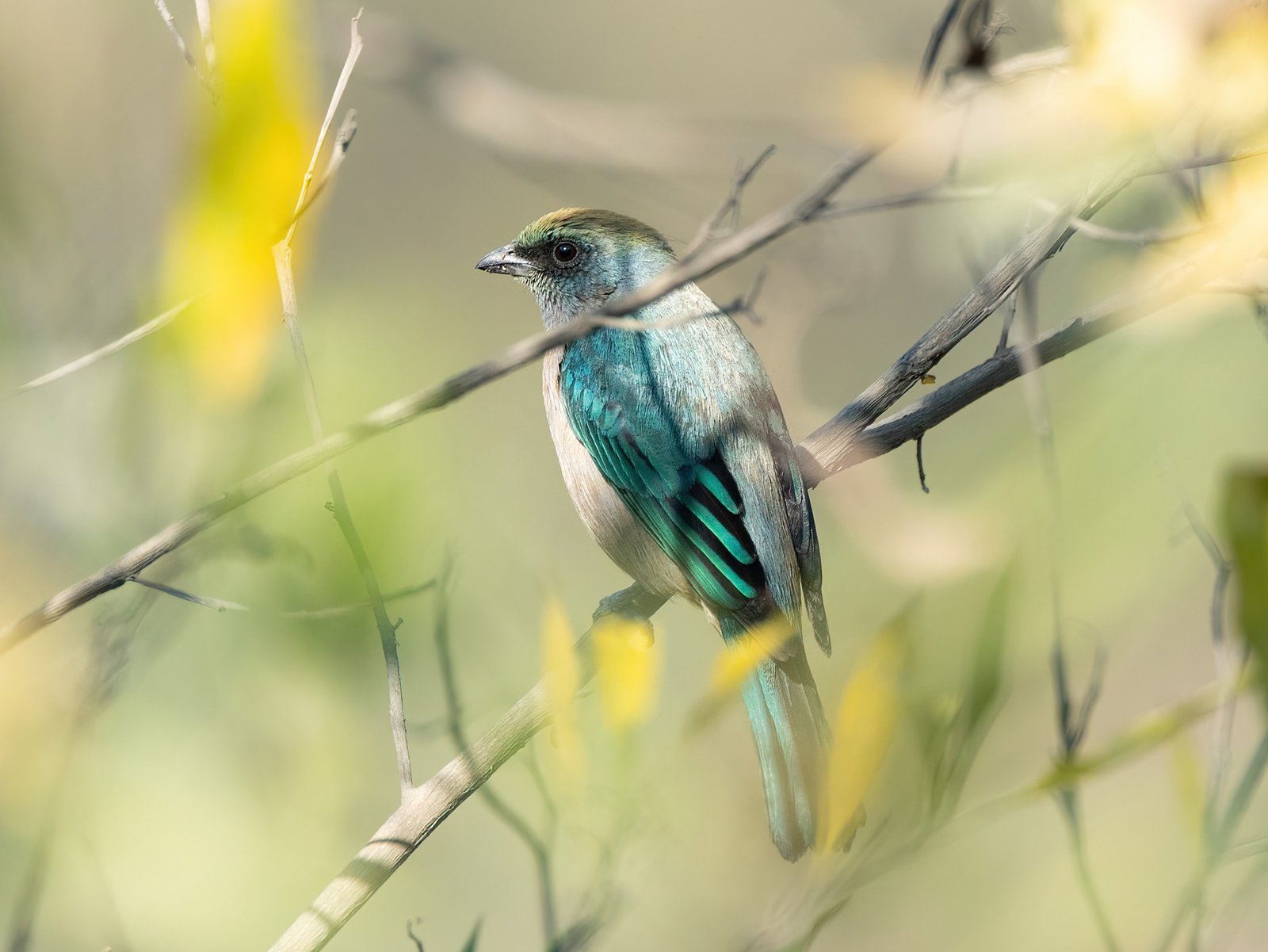
The Green-capped Tanager is the tanager of the town of Sandia in Puno, south-eastern Peru, where it was discovered. It is a pale, straw-coloured tanager with a greenish crown that lives in the semi-arid valleys on the eastern slope of the Andes, often near villages, in gardens and in coffee plantations.
Voice
High, thin tseet calls and a dry chipping; the song is a short series of high, thin notes.
No recording with a suitable Creative Commons licence is available for this species yet.
Identification
14 cm. Crown and hindneck are pale green to golden green. The face is grey-green with dark lores. Back and underparts are pale straw to buffy, with a greenish tinge on the breast. Wings and tail are dark with green-blue edges. The female is slightly duller. Juveniles are greyer.
Confusion species
Burnished-buff Tanager Stilpnia cayana is similar in shape and colour, but has a rufous crown and a black mask, and lives lower, in savanna and open lowlands. Blue-necked Tanager Stilpnia cyanicollis has a turquoise-blue head and a black body. Straw-backed Tanager Stilpnia argyrofenges has a black head in the male and lives in more humid forest.
Habitat
Semi-arid montane scrub, forest edges, scattered trees, gardens, orchards and coffee plantations in the valleys on the eastern slope of the Andes, roughly between 1600 and 2300 m. It eats fruit and searches for insects, in pairs or small groups. Nests have been found in trees in gardens.
Where the bird is most at home, classified by the vegetation units of the Andes and the west coast.


Range and movements
In Peru only in the south-east, in the valleys around Sandia in Puno. In Bolivia in the adjacent north-west, in La Paz. Does not occur in Colombia, Ecuador or on the Galápagos. Not known outside the guide area.
- Resident
- dark = core range, pale = thinly spread
How and when to look
Search gardens, orchards and scrub around Sandia and in the surrounding valleys; the birds often perch in scattered trees near houses and fields.
Conservation status
Near Threatened. The range is small; the species tolerates small-scale farmland, but the original vegetation in the valleys is being converted to agriculture.
Scientific name
Stilpnia meyerdeschauenseei | (Schulenberg & Binford, 1985)
Schulenberg & Binford described the species in 1985 as Tangara meyerdeschauenseei; because it was later moved to another genus, the author and year stand in brackets. The genus Stilpnia was introduced in 2016 by Burns, Unitt & Mason. The genus name comes from Greek stilpnos, 'glittering' or 'glistening'. The specific name honours Rodolphe Meyer de Schauensee (1901–1984), a Swiss-born American ornithologist at the Academy of Natural Sciences of Philadelphia. The specimen the first description was based on came from Sandia, Puno, Peru.