All species › Passerines › Ovenbirds and woodcreepers › Cabanis's Spinetail
Cabanis's Spinetail | Synallaxis cabanisi
Cabanis' stekelstaart | Pijuí de Cabanis | João-de-cabanis
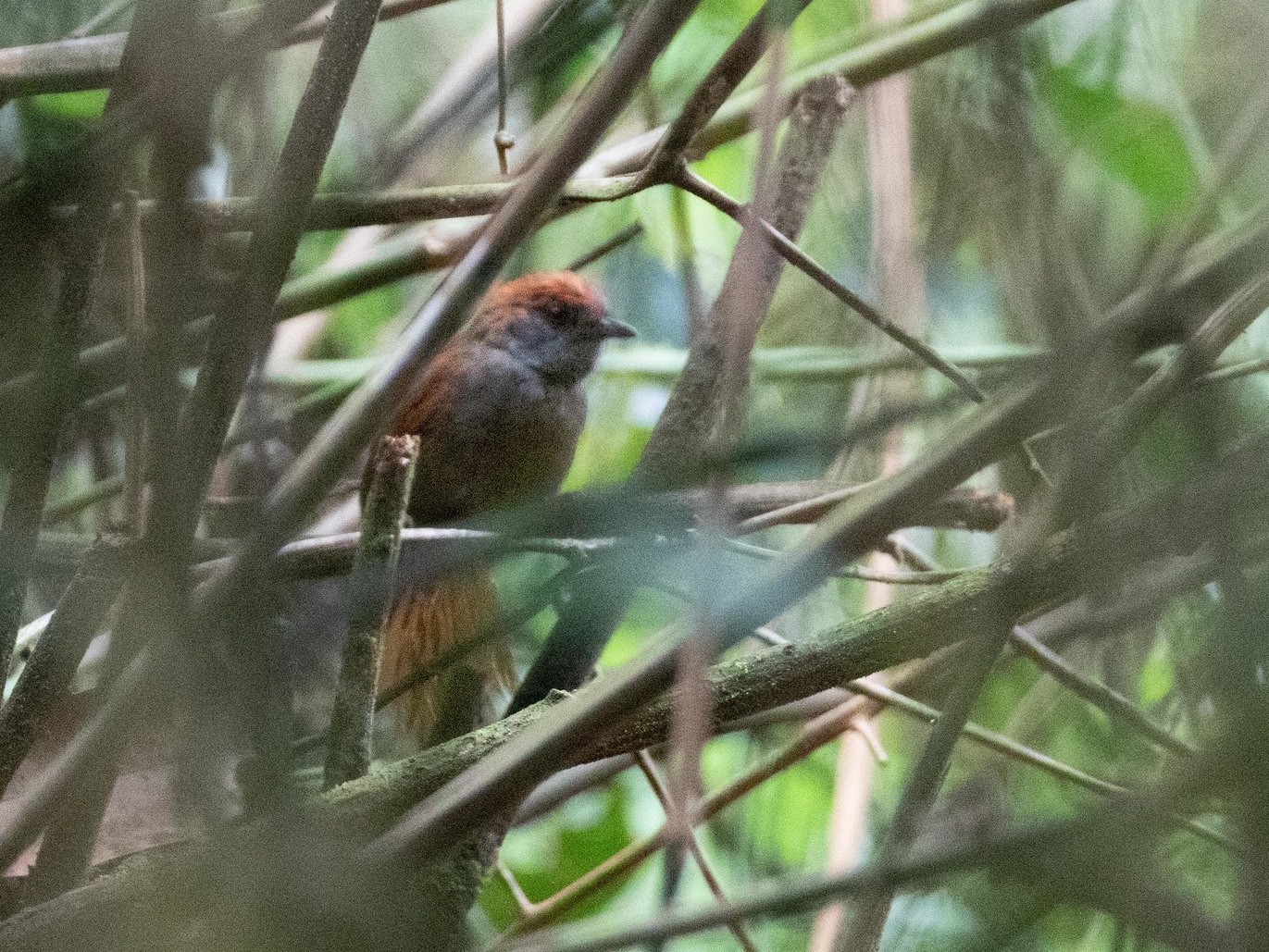
Cabanis's Spinetail is a dark spinetail of dense thickets along forest edges at the foot of the Andes in Peru and Bolivia. It keeps to bamboo and stands of cane and is heard more often than seen. It was formerly treated as a subspecies of Dusky Spinetail.
Voice
The call is a low, nasal nyap, often repeated. The song of birds in Peru and Bolivia is barely described; birds in Brazil give a hurried, chattering tjetjetjetjet.
Recording: Jacob Wijpkema — CC BY-NC-SA 4.0 · xeno-canto
Identification
16–18 cm, with a long, graduated tail of pointed feathers. The crown and nape are dark rufous, the face is sooty greyish brown with a paler grey cheek patch. The back and rump are dark brown, the wings mostly rufous and the tail dull chestnut. The underparts are brownish grey, the belly paler. Birds in Bolivia are smaller, with a whiter throat and much paler underparts. The sexes are alike.
Confusion species
Dusky Spinetail Synallaxis moesta is very similar, but lives further north, on the eastern slope in Colombia and Ecuador. Plain-crowned Spinetail Synallaxis gujanensis has a brown, not rufous, crown and paler, buffy grey underparts. Dark-breasted Spinetail Synallaxis albigularis is smaller, with a shorter tail and a fast, repeated song. Ruddy Spinetail Synallaxis rutilans is almost entirely rufous with a black throat patch and lives inside the forest.
Habitat
Dense undergrowth along the edges of lowland and lower montane forest, in secondary and riverine forest, often in bamboo (Guadua) and stands of cane (Gynerium) along rivers; mainly in the lowlands and low foothills. It forages alone or in pairs low in the vegetation for insects and other invertebrates. The nest, as in related spinetails, is a ball of twigs with a side entrance.
Where the bird is most at home, classified by the vegetation units of the Andes and the west coast.


Range and movements
Absent from Colombia, Ecuador and the Galápagos. In Peru along the foot of the eastern slope of the Andes, from Huánuco south to Puno, possibly also in western Ucayali. In Bolivia in northern La Paz, Beni and Cochabamba. Outside the guide area a separate population in west-central Brazil.
- Resident
- dark = core range, pale = thinly spread
How and when to look
Listen along forest edges and riverbanks with bamboo or cane in the foothills of south-eastern Peru, for example in Madre de Dios, for the nasal call; the bird usually stays low and hidden in the vegetation.
Conservation status
Least Concern. The species lives in edge vegetation and secondary forest and tolerates small-scale clearing.
Scientific name
Synallaxis cabanisi | Berlepsch & Leverkühn, PGHMR, 1890
Berlepsch & Leverkühn, PGHMR described the species in 1890 and placed it straight away in the genus where it still stands. The genus Synallaxis was introduced in 1818 by Vieillot. The genus name comes from Ancient Greek sunallaxis, 'exchange'. The species name honours Jean Cabanis (1816–1906), a German ornithologist and founder of the Journal für Ornithologie. The specimen the first description was based on came from Chanchamayo, Junín, Peru.