All species › Passerines › Ovenbirds and woodcreepers › Dusky Spinetail
Dusky Spinetail | Synallaxis moesta
Rouwstekelstaart | Pijuí oscuro | João-teneném-escuro
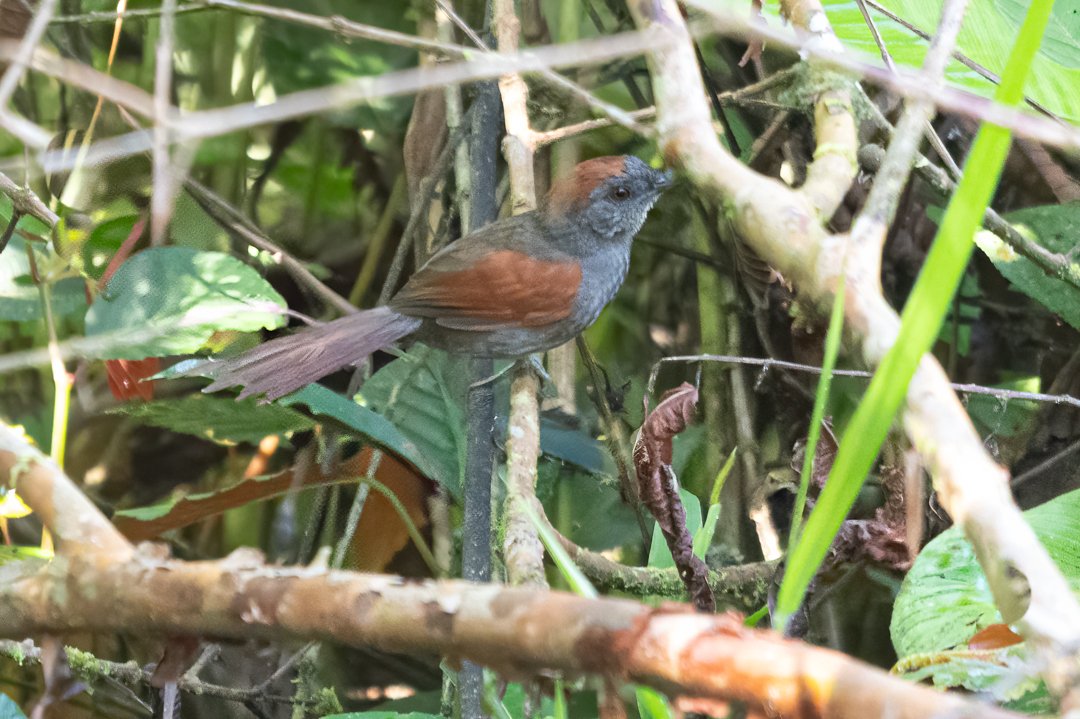
The Dusky Spinetail is one of the darkest spinetails: sooty grey, with a chestnut crown, wings and tail. It lives in dense undergrowth at forest edges in a narrow elevational belt along the foot of the Andes, from Colombia to northern Peru. Little is known about its habits.
Voice
A low, nasal chatter or churr; it is not known whether this is song or call.
Recording: GABRIEL LEITE — CC BY-NC-SA 4.0 · xeno-canto
Identification
16 cm, with a thin bill and a long, graduated, chestnut tail with spiny tips. The face is dark sooty grey, the hindcrown chestnut. Back and underparts are dark sooty grey, the wings chestnut; the chin is finely frosted white. Birds in the south of the range (Ecuador and Peru) are darker and uniformly grey below. The sexes are alike. Juveniles have a grey crown, greyer underparts and a faintly barred throat.
Confusion species
Dark-breasted Spinetail Synallaxis albigularis lives lower, in grassy clearings and young scrub, and is paler, with a white throat and a grey-brown tail. Azara's Spinetail Synallaxis azarae is paler grey and lives higher in the Andes. Ruddy Spinetail Synallaxis rutilans has a rufous head and breast with a black throat and lives inside lowland forest.
Habitat
Edges of riverine and evergreen tropical forest, and secondary forest, favouring dense undergrowth, sometimes in bamboo; mostly between 250 and 1350 m, in Colombia up to 1600 m. It presumably forages in pairs for arthropods in foliage and on thin branches, about 1–2 m above the ground. The only described nest was a ball of twigs with a side entrance tube in a dense vine tangle.
Where the bird is most at home, classified by the vegetation units of the Andes and the west coast.


Range and movements
Colombia: at the foot of the eastern slope of the Eastern Andes, from Casanare and Meta south through Caquetá and Putumayo to south-eastern Nariño. Ecuador: at the foot of the eastern slope of the Andes. Peru: in the north, south to northern San Martín. Absent from Bolivia and the Galápagos. Does not occur outside the guide area.
- Resident
- dark = core range, pale = thinly spread
How and when to look
Listen for the low, nasal chatter at overgrown forest edges, along rivers and in dense thickets in the foothills of the eastern slope. The bird usually stays low in dense vegetation.
Conservation status
Least Concern; until 2021 the species was listed as Near Threatened. The range is large, but the population is thought to be declining through deforestation. The species is sensitive to fragmentation and edge effects and is mostly uncommon and local; the narrow elevational belt it occupies is under heavy pressure from agriculture.
Scientific name
Synallaxis moesta | Sclater, 1856
Sclater described the species in 1856 and placed it straight away in the genus where it still stands. The genus Synallaxis was introduced in 1818 by Vieillot. The genus name comes from Ancient Greek sunallaxis, 'exchange'. The species name comes from Latin maestus, 'sad, gloomy', for the dark plumage. The specimen the first description was based on came from Bogotá, Colombia.