All species › Passerines › Ovenbirds and woodcreepers › Silvery-throated Spinetail
Silvery-throated Spinetail | Synallaxis subpudica
Zilverkeelstekelstaart | Pijuí de Cundinamarca | João-teneném-de-garganta-prateada
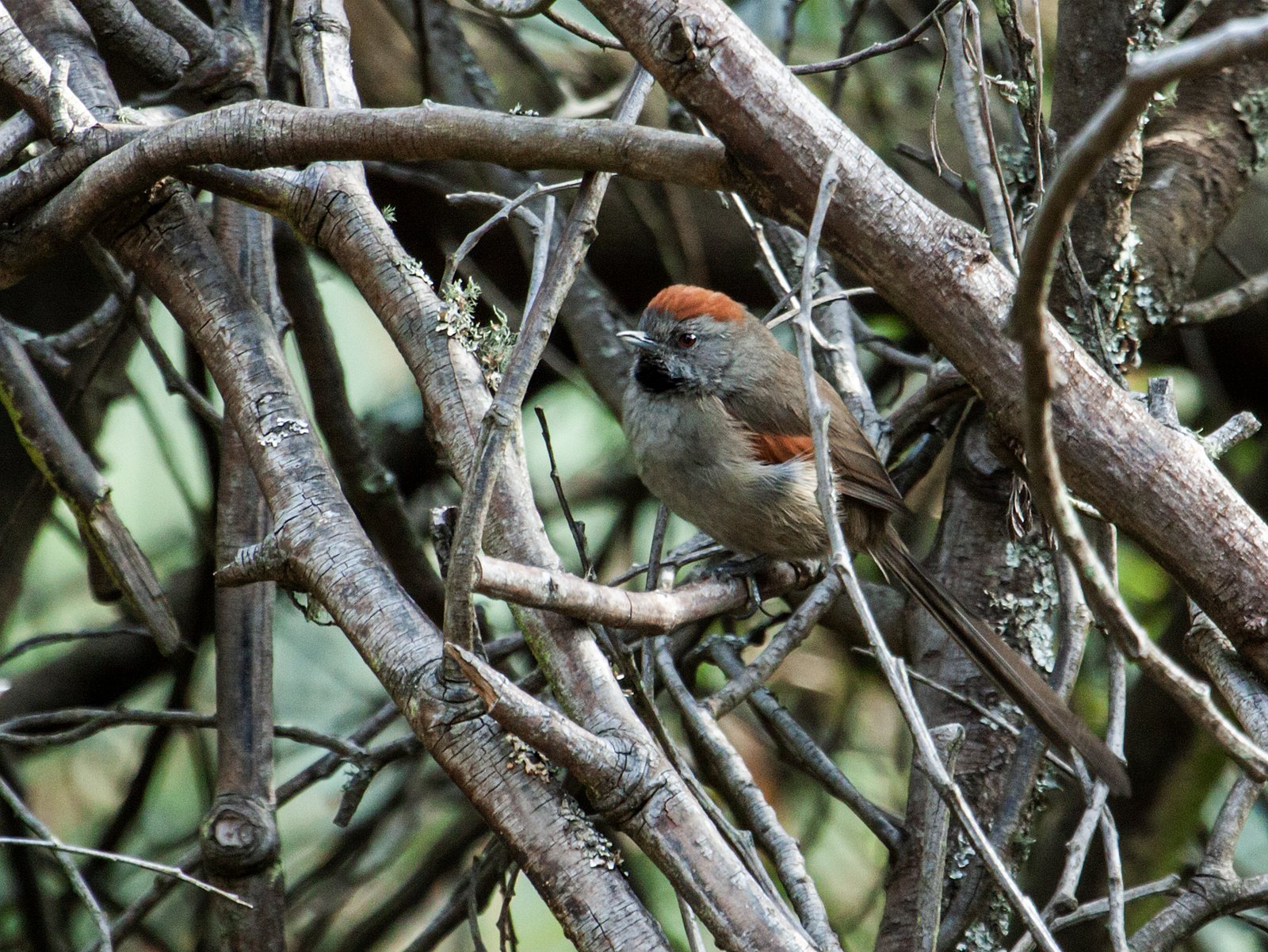
The Silvery-throated Spinetail is a long-tailed, grey-brown spinetail found only in the Eastern Andes of Colombia. It lives in scrub and forest edges at high elevations, including the heavily modified landscape around Bogotá. With a tail almost as long as its body it is one of the longest-tailed members of the genus.
Voice
The song is a fast, accelerating, descending and fading series of chattering notes, often given as a duet. The call is a sharp kik; the alarm a low trill.
Recording: Mauricio Cuellar Ramirez (@Birding.travel) — CC BY-NC-SA 4.0 · xeno-canto
Identification
17–19 cm, with a thin bill and a very long, graduated tail with spiny tips. A narrow cinnamon supercilium on a grey-brown face. Hindcrown and nape are rufous to chestnut, the back brown, the wing coverts chestnut. The throat is paler, silvery grey; the underparts are dull grey-brown with an olive tinge, the belly paler. The sexes are alike. Juveniles have a grey crown.
Confusion species
Azara's Spinetail Synallaxis azarae is smaller, with a shorter, rufous tail, and more often lives in humid montane forest. Pale-breasted Spinetail Synallaxis albescens is smaller and much paler below and lives lower, in open grassland with shrubs. Rufous Spinetail Synallaxis unirufa is uniformly rufous, with black lores, and lives inside wet montane forest.
Habitat
Edges of humid montane forest, both primary and secondary, overgrown scrub, cloud-forest edges and regenerating clearings, mostly between 2100 and 3200 m, occasionally down to 1300 m. It forages in pairs for arthropods in foliage and on thin branches, usually 1–2 m above the ground. The nest is a bulky mass of thorny twigs with a horizontal entrance tube and a moss-lined chamber, usually about 2 m up in a shrub.
Where the bird is most at home, classified by the vegetation units of the Andes and the west coast.


Range and movements
Colombia: endemic to the Eastern Andes, in Cundinamarca, Boyacá and Santander. Absent from Ecuador, Peru, Bolivia and the Galápagos. Does not occur outside the guide area.
- Resident
- dark = core range, pale = thinly spread
How and when to look
Walk along hedges, scrub and forest edges on the high plateau and mountain slopes around Bogotá and listen for the accelerating, chattering duet. Pairs forage low in the shrubs.
Conservation status
Least Concern. The range is limited, but the population is believed to be stable; the species is fairly common to common, tolerates heavy disturbance of its habitat and may benefit from forest fragmentation.
Scientific name
Synallaxis subpudica | Sclater, 1874
Sclater described the species in 1874 and placed it straight away in the genus where it still stands. The genus Synallaxis was introduced in 1818 by Vieillot. The genus name comes from Ancient Greek sunallaxis, 'exchange'. The species name comes from Latin sub, 'near to', and the species name pudica of Synallaxis pudica P. Sclater, 1859 (now a synonym of Synallaxis brachyura), because Sclater at first took the bird for a young pudica. The specimen the first description was based on came from Bogotá, Colombia.