All species › Passerines › Ovenbirds and woodcreepers › Slaty Spinetail
Slaty Spinetail | Synallaxis brachyura
Leikleurige stekelstaart | Pijuí pizarroso | João-teneném-ardósia
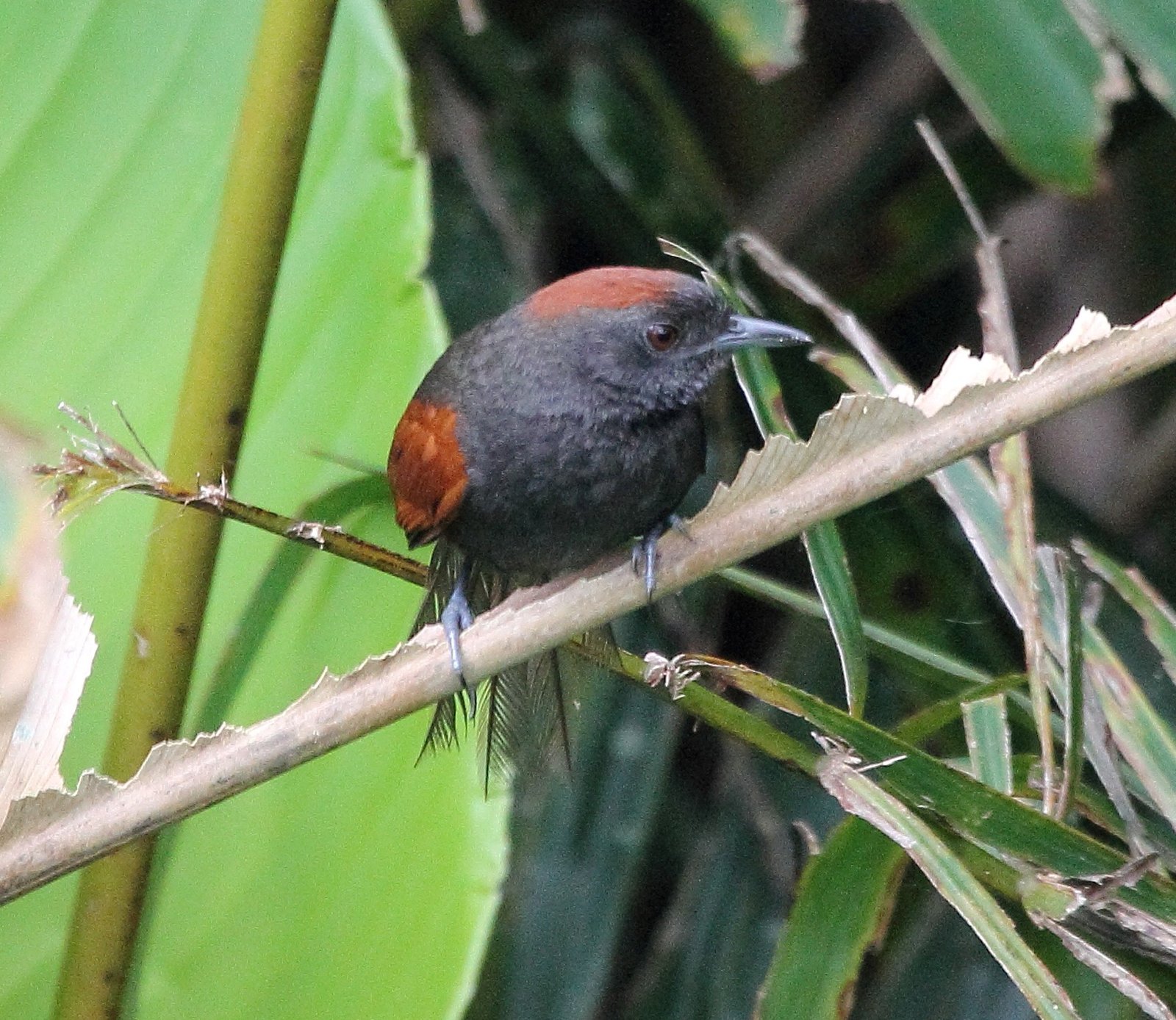
The Slaty Spinetail is a dark, slate-grey spinetail with a rufous crown and wings, of overgrown forest edges, scrub and abandoned clearings in western Colombia and Ecuador. It tolerates disturbance well and even benefits from forest fragmentation. Like other spinetails it does not build a mud nest but a large structure of thorny twigs.
Voice
The song is a hard, wren-like trill or a series of rattling, chattering phrases. Gives a short chk while foraging and a chee-ah.
Recording: José María Loaiza B. — CC BY-NC-SA 4.0 · xeno-canto
Identification
15 cm, with a thin bill and a long, graduated, dark tail with spiny tips. Crown and nape are rufous to chestnut, as are the wing coverts. The face is dark grey, with a faint grey supercilium. The back is dark sooty brown to slate. The throat is blackish, the breast dark sooty grey, the belly paler grey. The sexes are alike. Juveniles have a grey crown and are duller and more olive.
Confusion species
Azara's Spinetail Synallaxis azarae has a rufous tail, paler grey-brown underparts and lives higher in the Andes. Blackish-headed Spinetail Synallaxis tithys of the dry forest of south-western Ecuador and Tumbes has a blackish face but no rufous crown. Pale-breasted Spinetail Synallaxis albescens has much paler, whitish underparts and lives in open grassland with shrubs.
Habitat
Places with dense undergrowth: overgrown second-growth scrub, riverside thickets, overgrown clearings, forest edges, thorn scrub, marsh edges and gardens, mostly below 1400 m, in Colombia up to 2000 m. It forages in pairs for arthropods, sometimes seeds, in foliage, on thin branches, in low vegetation and in leaf litter. The nest is a bulky mass of thorny twigs with a horizontal entrance tube, 0.5–5 m up in dense shrubs or vine-covered trees.
Where the bird is most at home, classified by the vegetation units of the Andes and the west coast.


Range and movements
Colombia: on the Pacific slope and in the northern lowlands, from Antioquia east to the Magdalena valley, and in the Cauca valley. Ecuador: in the west, in the lowlands and foothills. Peru: only in the far north-west, in Tumbes. Absent from Bolivia and the Galápagos. Outside the guide area in Central America north to Honduras.
- Resident
- dark = core range, pale = thinly spread
How and when to look
Listen for the hard trill in overgrown forest edges, scrub and abandoned pastures in the western lowlands of Ecuador or Colombia. Pairs stay low in dense vegetation but, with patience, show at the edge.
Conservation status
Least Concern. The species has a very large range and a stable population, is fairly common to common and tolerates moderate human disturbance.
Scientific name
Synallaxis brachyura | de Lafresnaye, 1843
De Lafresnaye described the species in 1843 and placed it straight away in the genus where it still stands. The genus Synallaxis was introduced in 1818 by Vieillot. The genus name comes from Ancient Greek sunallaxis, 'exchange'. The species name comes from Greek brakhus, 'short', and oura, 'tail'. The specimen the first description was based on came from Bogotá, Colombia.