All species › Passerines › Ovenbirds and woodcreepers › Russet-bellied Spinetail
Russet-bellied Spinetail | Synallaxis zimmeri
Roodbuikstekelstaart | Pijuí de Ancash | João-teneném-de-barriga-ferrugínea
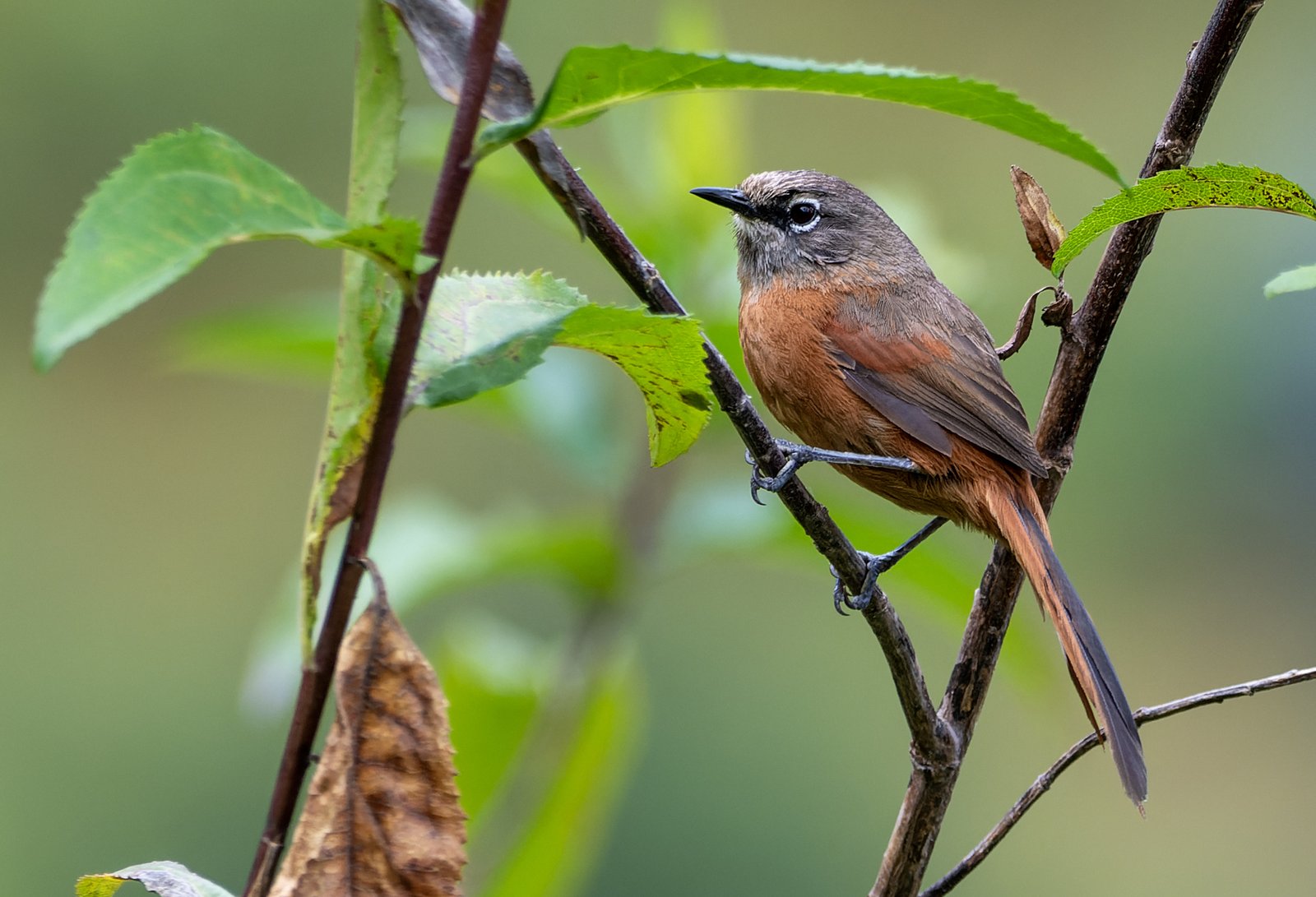
The Russet-bellied Spinetail is a grey spinetail with a rusty belly, endemic to the western slope of the Andes in central Peru. It is the southernmost Synallaxis on the west side of the Andes. It lives in dense, thorny scrub in dry mountain valleys and usually keeps deep in the vegetation.
Voice
The song is a mewing, nasal prr-kweet kweet, usually from deep in the vegetation. Also gives a nasal too-veet and a squeakier djweet.
Recording: Fabrice Schmitt — CC BY-NC-SA 4.0 · xeno-canto
Identification
16–17 cm, with a thin, pointed bill and a long, graduated tail with spiny tips. Head and crown are grey, with a faint greyish-white supercilium and a broken white eye-ring. The back is olive-grey, the uppertail coverts bright rufous and the wing coverts nearly chestnut. The throat and upper breast are grey-brown; the rest of the underparts is rusty, darkest under the tail. The sexes are alike.
Confusion species
Canyon Canastero Asthenes pudibunda lives in the same dry valleys but is plain brown, without a rusty belly, with a rufous tail and a small orange chin patch. Rusty-crowned Tit-Spinetail Leptasthenura pileata has a rufous crown, a streaked back and a long, pointed tail, and clambers through shrubs like a tit. No other spinetails occur on the west side of the Andes in this part of Peru.
Habitat
Dry, dense scrub with low, thorny trees and shrubs in mountain valleys and ravines, often along small streams, mainly between about 2000 and 2900 m, locally lower. It forages alone, in pairs or in small family groups for arthropods, seeds and plant material in foliage, on moss and branches, and also scratches in the leaf litter on the ground. The nest is a woven ball of twigs with a side tunnel leading to the nest chamber.
Where the bird is most at home, classified by the vegetation units of the Andes and the west coast.


Range and movements
Peru: endemic to the western slope of the Andes in the centre of the country, from western La Libertad south through Ancash. Absent from Colombia, Ecuador, Bolivia and the Galápagos. Does not occur outside the guide area.
- Resident
- dark = core range, pale = thinly spread
How and when to look
In the dry side valleys on the western slope of the Cordillera Negra and in the valleys towards the Callejón de Huaylas, listen for the nasal song from dense scrub. The bird sometimes comes briefly to the edge of a shrub.
Conservation status
Vulnerable. The population is small, estimated at 600–1,700 mature individuals, and is declining. The dense undergrowth within its range is severely degraded by grazing of cattle and goats and by clearance for fields and plantations.
Scientific name
Synallaxis zimmeri | Koepcke, 1957
Koepcke described the species in 1957 and placed it straight away in the genus where it still stands. The genus Synallaxis was introduced in 1818 by Vieillot. The genus name comes from Ancient Greek sunallaxis, 'exchange'. The species name honours John Todd Zimmer (1889–1957), an American ornithologist who published widely on Peruvian birds. The specimen the first description was based on came from Colcabamba, Áncash, Peru.