All species › Passerines › Ovenbirds and woodcreepers › Chinchipe Spinetail
Chinchipe Spinetail | Synallaxis chinchipensis
Chinchipestekelstaart | Pijuí del Chinchipe | João-teneném-do-chinchipe
The Chinchipe Spinetail is a small, rufous-tailed spinetail of dry scrub in the valleys of the Marañón and the Chinchipe in northern Peru. It was long treated as a subspecies of Necklaced Spinetail; since 2021 it has been recognized as a separate species on the basis of differences in plumage, song and DNA.
Voice
The song is a short, rhythmic phrase of a rising trill, a loud squeak and a stuttering trill. Also gives rattling series. Pairs often sing in duet, mainly in the morning, usually from dense scrub.
Recording: Ross Gallardy — CC BY-NC-SA 4.0 · xeno-canto
Identification
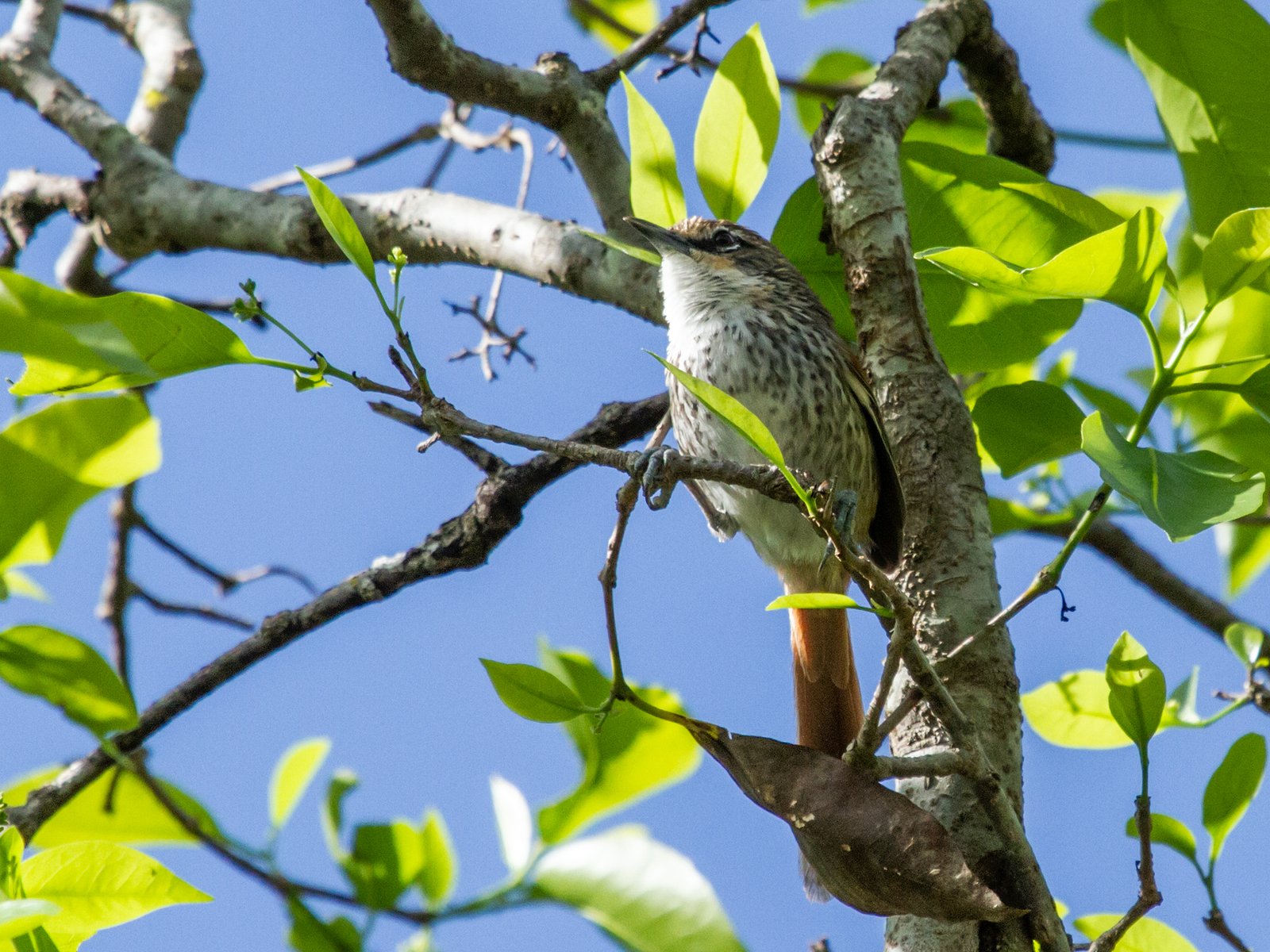
12–13 cm, with a short, black bill and a fairly short tail with spiny tips. The face is blackish, with a buffy supercilium and faint white streaks. The forecrown is streaked black and white, the rest of the crown and the back are dull grey-brown. Uppertail coverts and tail are bright rufous, with dark brown central tail feathers. The wings are rufous, with a whitish bend of the wing and dark primaries. The throat is white, the breast buffy white with black spots, the flanks greyish. The sexes are alike.
Confusion species
Necklaced Spinetail Synallaxis stictothorax has a white supercilium and fine streaks rather than spots on the breast, and lives in the lowlands of the west coast. Marañón Spinetail Synallaxis maranonica is larger, plain grey-brown without spots, and lives in dense undergrowth of gallery forest. Great Spinetail Synallaxis hypochondriaca is much larger, with white-streaked underparts, and lives much higher.
Habitat
Dry scrub and the edges of deciduous woodland, mostly between 400 and 600 m. It forages in pairs or with mixed flocks for arthropods and their larvae on moss, leaves and thin branches, usually 1–2 m above the ground. Nothing is known about its breeding biology.
Where the bird is most at home, classified by the vegetation units of the Andes and the west coast.


Range and movements
Peru: endemic to the north-west, in the drainages of the Marañón and the Chinchipe in Cajamarca. Absent from Colombia, Ecuador, Bolivia and the Galápagos. Does not occur outside the guide area.
- Resident
- dark = core range, pale = thinly spread
How and when to look
Search scrub and forest edges in the dry, hot valley around Jaén and along the lower Chinchipe, especially in the early morning, when pairs sing in duet.
Conservation status
Least Concern. The range is limited and the population size is unknown but believed to be stable; the species is locally fairly common and tolerates some degradation of its habitat.
Scientific name
Synallaxis chinchipensis | Chapman, 1925
Chapman described the species in 1925 and placed it straight away in the genus where it still stands. The genus Synallaxis was introduced in 1818 by Vieillot. The genus name comes from Ancient Greek sunallaxis, 'exchange'. The species name refers to the Río Chinchipe in northern Peru. The specimen the first description was based on came from Perico, Río Chinchipe, Peru.