All species › Passerines › Ovenbirds and woodcreepers › Necklaced Spinetail
Necklaced Spinetail | Synallaxis stictothorax
Halsbandstekelstaart | Pijuí collarejo | João-teneném-de-colar
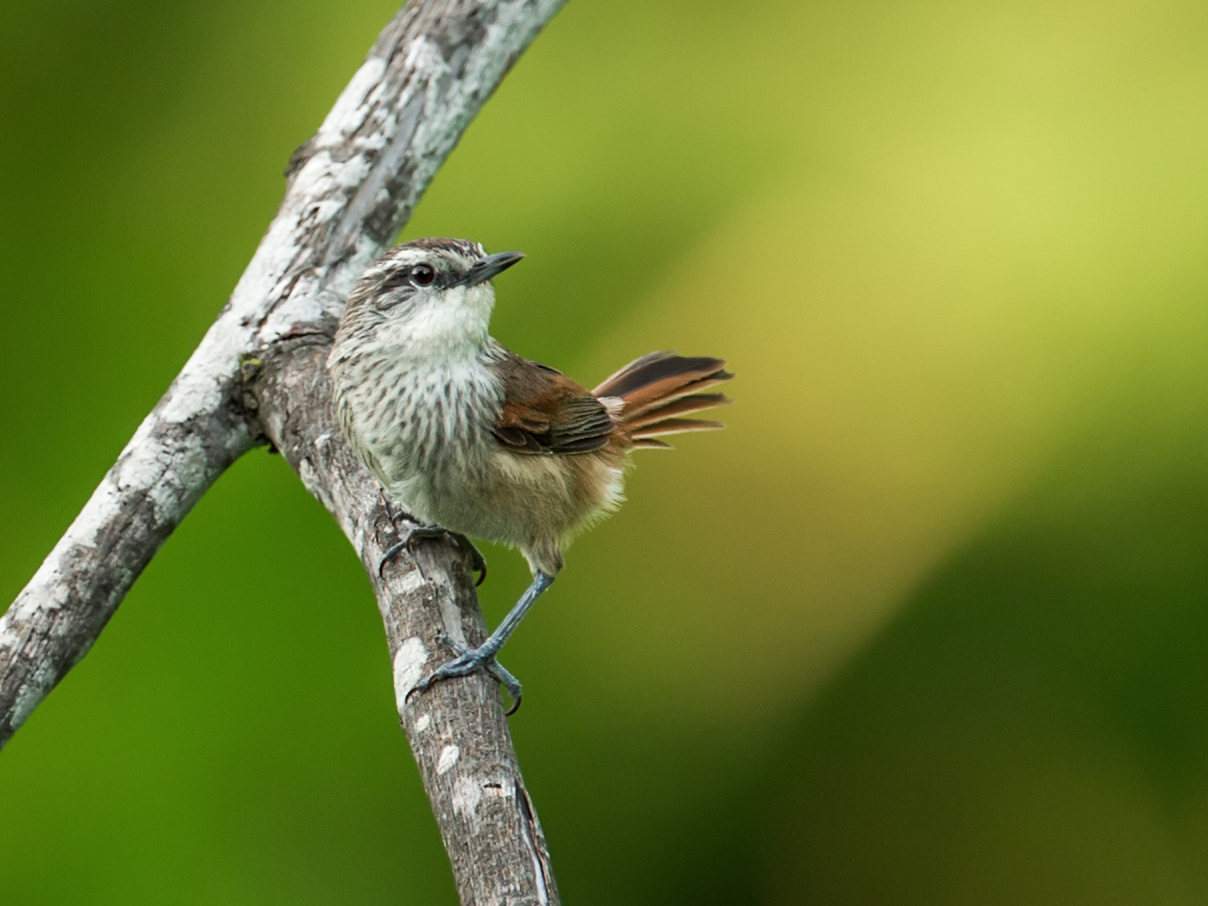
The Necklaced Spinetail is one of the smallest spinetails, a bird of dry scrub and dry forest in the lowlands of south-western Ecuador and north-western Peru. The finely black-streaked, buffy breast forms the 'necklace' that gives the bird its name. It is less secretive than most relatives and often forages somewhat higher in shrubs and trees.
Voice
The song is a short, stuttering chatter ending in squeaky, emphatic notes; pairs sing in duet, mainly early in the morning and late in the afternoon, usually from cover. Also gives rattling series, a nasal, rising kweet and a squeaky di-vot.
Recording: Juan Freile — CC BY-NC-SA 4.0 · xeno-canto
Identification
12–13 cm, with a short, black bill and a fairly short tail with spiny tips. A white supercilium above a largely blackish face; the forehead and forecrown are streaked black and white. The back is grey-brown, the tail bright rufous with dark central feathers. The throat is white, the breast buffy with fine black streaks. The subspecies maculata in southern Ecuador and Peru has a more rufous back and wing. The sexes are alike.
Confusion species
Chinchipe Spinetail Synallaxis chinchipensis is very similar, but has a buffy supercilium and black spots rather than streaks on the breast, and occurs only in the Marañón valley. Blackish-headed Spinetail Synallaxis tithys lives in the same dry forest but is grey with a blackish head and throat, without breast streaks. Great Spinetail Synallaxis hypochondriaca is much larger and lives high in the Marañón valley.
Habitat
Dry scrub, thorn forest and the edges of deciduous forest, from sea level up to about 300 m in Ecuador and 400 m in Peru. It forages in pairs, often with mixed flocks, on moss, leaves and thin branches, usually 1–2 m above the ground, for arthropods. The nest is a ball of twigs with a side entrance and a chamber lined with feathers and down, usually in a thorny tree or cactus, up to 12 m high.
Where the bird is most at home, classified by the vegetation units of the Andes and the west coast.


Range and movements
Ecuador: in the south-west, from central Manabí south to western Guayas and Puná Island, and in southern Loja. Peru: in the north-west, from Tumbes and Piura south to La Libertad. Absent from Colombia, Bolivia and the Galápagos. Does not occur outside the guide area.
- Resident
- dark = core range, pale = thinly spread
How and when to look
Walk along dry, thorny shrubs and forest edges in the coastal plain of south-western Ecuador or north-western Peru in the early morning and listen for the stuttering duet. Pairs often forage in view on the outside of shrubs.
Conservation status
Least Concern. The species has a fairly large range, occurs in several protected areas and tolerates moderate degradation of the dry forest.
Scientific name
Synallaxis stictothorax | Sclater, 1859
Sclater described the species in 1859 and placed it straight away in the genus where it still stands. The genus Synallaxis was introduced in 1818 by Vieillot. The genus name comes from Ancient Greek sunallaxis, 'exchange'. The species name comes from Greek stiktos, 'spotted', and thōrax, 'breast', for the streaked breast. The specimen the first description was based on came from Guayaquil, Ecuador.