All species › Passerines › Ovenbirds and woodcreepers › Great Spinetail
Great Spinetail | Synallaxis hypochondriaca
Grote stekelstaart | Pijuí grande | João-teneném-grande
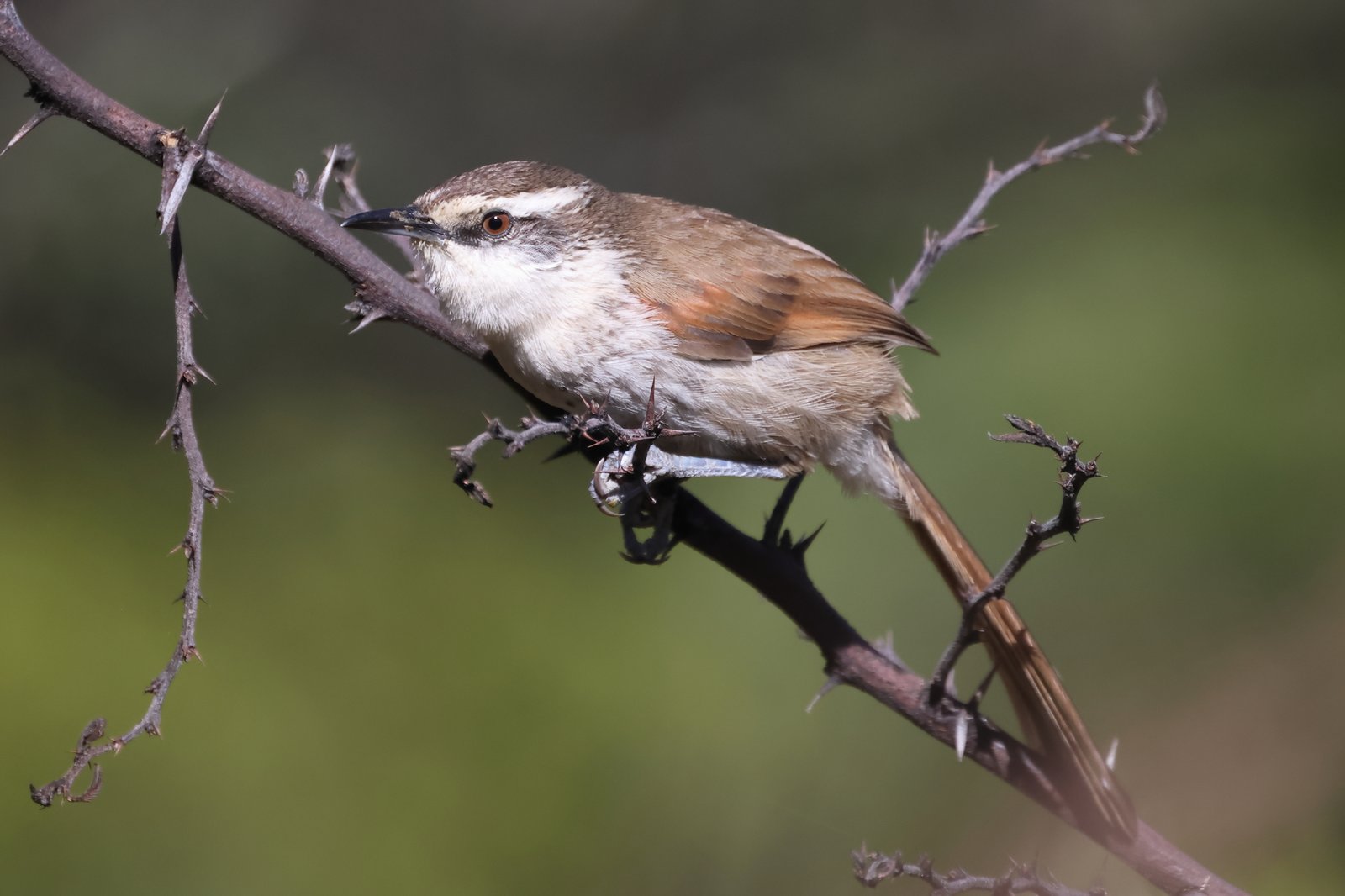
The Great Spinetail is the largest spinetail of the guide area and an endemic of the higher, dry parts of the Marañón valley in Peru. With its white-streaked underparts and long tail it looks more like a canastero than most of its relatives; it was formerly placed in its own genus, Siptornopsis.
Voice
The song is a loud, fast, rising and falling chatter with nasal notes, often given as a duet. Also gives sharp, metallic notes and longer series of chee notes.
Recording: Ross Gallardy — CC BY-NC-SA 4.0 · xeno-canto
Identification
18–19 cm, with a fairly long, thin bill and a long, graduated tail. A white supercilium, a dark patch through the eye and a creamy white cheek. Crown and back are dull olive-brown, the wing coverts rufous, the tail brown. The throat and centre of the belly are white; breast and flanks are white with grey-brown streaks. The sexes are alike. Juveniles are less streaked and have a paler, pinkish lower mandible.
Confusion species
Chinchipe Spinetail Synallaxis chinchipensis is much smaller, with a rufous tail and black spots on a white breast, and lives lower in the valley. Necklaced Spinetail Synallaxis stictothorax is also much smaller and occurs only in the lowlands of the west coast. Canasteros, such as Sharp-billed Canastero Asthenes pyrrholeuca, lack the bold white streaks on the underparts.
Habitat
Dry montane scrub with cacti, acacias and scattered trees, such as Bombax and alder, roughly between 2000 and 2800 m, possibly up to 3000 m. It forages alone, in pairs or in small family groups for arthropods in foliage and on thin branches up to about 2 m, sometimes on the ground. The nest is a large ball of thorny twigs with a side entrance.
Where the bird is most at home, classified by the vegetation units of the Andes and the west coast.


Range and movements
Peru: endemic to the upper Marañón, in southern Amazonas, south-eastern Cajamarca, eastern La Libertad and northern Ancash. Absent from Colombia, Ecuador, Bolivia and the Galápagos. Does not occur outside the guide area.
- Resident
- dark = core range, pale = thinly spread
How and when to look
Search dry, thorny scrub on the slopes above the Marañón, for example around Balsas and Celendín or near San Marcos (Cajamarca). In the early morning pairs give themselves away by their loud duets.
Conservation status
Near Threatened. The population is estimated at 6,000–15,000 mature individuals and is declining. The range is small and the species is strictly tied to dry montane scrub, which is continuously degraded by centuries of farming in the valley.
Scientific name
Synallaxis hypochondriaca | (Salvin, 1895) (GBIF: Siptornopsis hypochondriaca)
Salvin described the species in 1895 as Siptornis hypochondriacus; because it was later moved to another genus, the author and year stand in brackets. The genus Synallaxis was introduced in 1818 by Vieillot. The genus name comes from Ancient Greek sunallaxis, 'exchange'. The species name comes from Greek hupokhondria, 'belly, the part below the ribs', probably for the colour of the belly or flanks. The specimen the first description was based on came from Malca and Cajabamba, Cajamarca, Peru.