All species › Passerines › Ovenbirds and woodcreepers › Maranon Spinetail
Maranon Spinetail | Synallaxis maranonica
Marañónstekelstaart | Pijuí del Marañón | João-teneném-do-marañón
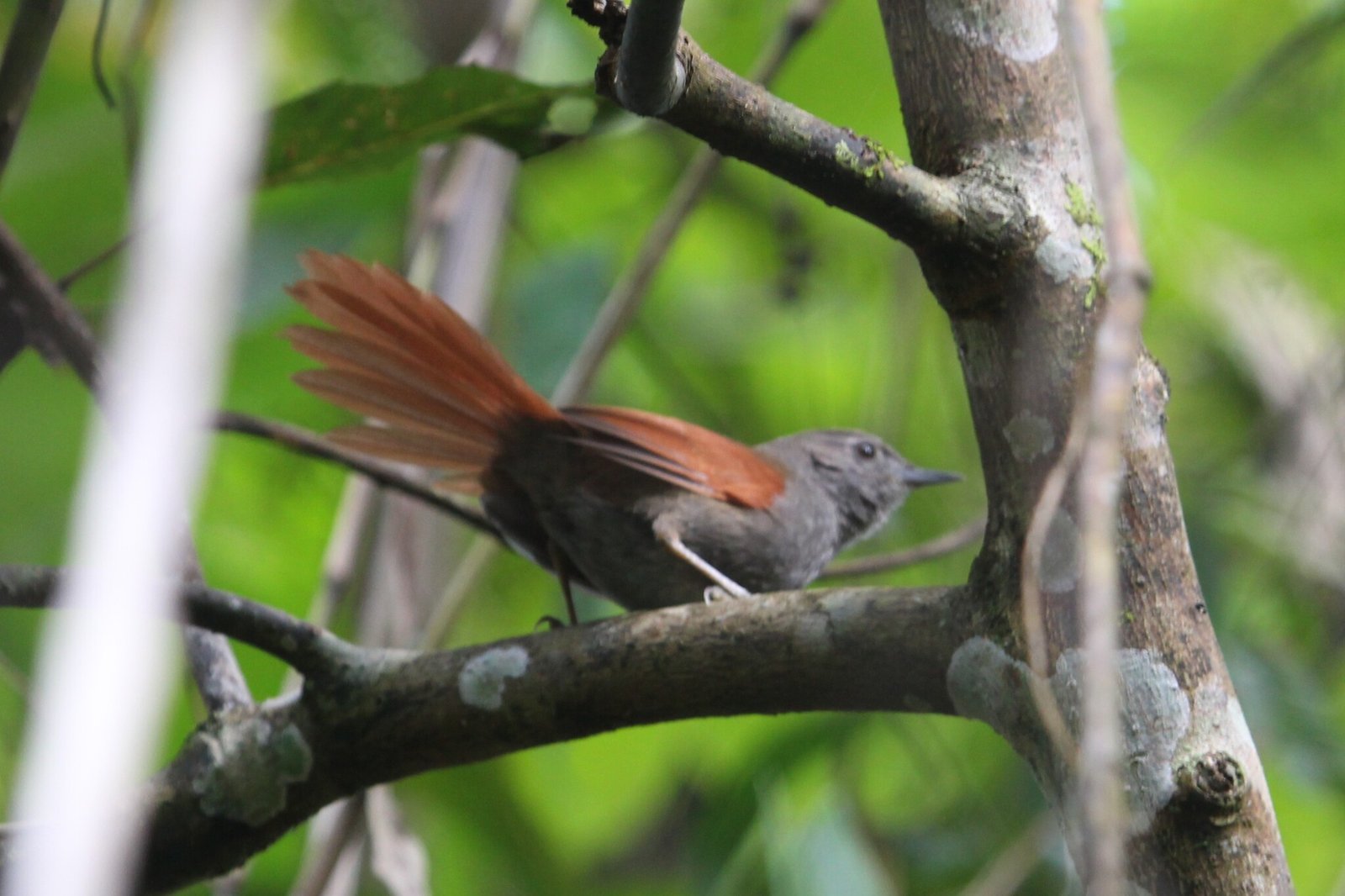
The Marañón Spinetail is a grey-brown spinetail with rufous wings and tail, restricted to the valley of the Marañón and its tributaries in northern Peru and the far south-east of Ecuador. It lives hidden in the dense undergrowth of gallery forest and dry forest. Because of its small and rapidly shrinking habitat it is one of the most threatened ovenbirds of the guide area.
Voice
A slow, somewhat nasal short phrase, repeated with pauses of several seconds; both sexes sing. Usually sings from dense cover.
Recording: GABRIEL LEITE — CC BY-NC-SA 4.0 · xeno-canto
Identification
15–16 cm, with a thin, pointed bill and a long, graduated tail with spiny tips. Head, crown and back are grey-brown, the face and forehead darker brownish grey, with a faint, pale supercilium. Wings and tail are dark rufous. The throat is pale greyish, the underparts are brownish grey, greyer towards the flanks with an olive tinge. The sexes are alike. Juveniles show faint dark scalloping on breast and belly and a paler lower mandible.
Confusion species
Azara's Spinetail Synallaxis azarae has a rufous crown, paler grey underparts and lives higher, in humid montane forest and scrub. Chinchipe Spinetail Synallaxis chinchipensis is smaller, with a blackish face, a pale supercilium and a white throat with black spots on the breast, and occurs in open, dry scrub. Great Spinetail Synallaxis hypochondriaca is larger, with white-streaked underparts, and lives higher up the valley.
Habitat
Dense undergrowth of semi-humid gallery forest along rivers, secondary forest and deciduous woodland, less often at the edge of humid forest; in Ecuador roughly between 650 and 1200 m, in Peru between 450 and 1850 m. It usually forages in pairs on the ground, in foliage and on thin branches up to about 2 m, for arthropods. The nest is, as in its relatives, presumably a ball of twigs with a side entrance.
Where the bird is most at home, classified by the vegetation units of the Andes and the west coast.


Range and movements
Ecuador: only in the far south-east, in the Chinchipe valley in Zamora-Chinchipe. Peru: in the Marañón valley and side valleys in northern Cajamarca and in Amazonas. Absent from Colombia, Bolivia and the Galápagos. Does not occur outside the guide area.
- Resident
- dark = core range, pale = thinly spread
How and when to look
In the early morning, listen for the slow, nasal song in gallery forest and overgrown forest edges along the rivers around Jaén and Bagua and near Zumba. The bird usually stays low in dense vegetation.
Conservation status
Critically Endangered. The range is small and the population is declining. Forest in the Marañón valley has long been converted to fields, pasture and plantations and is being logged; oil extraction is a possible further threat.
Scientific name
Synallaxis maranonica | Taczanowski, 1879
Taczanowski described the species in 1879 and placed it straight away in the genus where it still stands. The genus Synallaxis was introduced in 1818 by Vieillot. The genus name comes from Ancient Greek sunallaxis, 'exchange'. The species name refers to the Río Marañón in Peru. The specimen the first description was based on came from Guajango, Río Marañón, Peru.