All species › Passerines › Ovenbirds and woodcreepers › White-lored Spinetail
White-lored Spinetail | Synallaxis albilora
Okerborststekelstaart | Pijuí cariblanco | João-do-pantanal
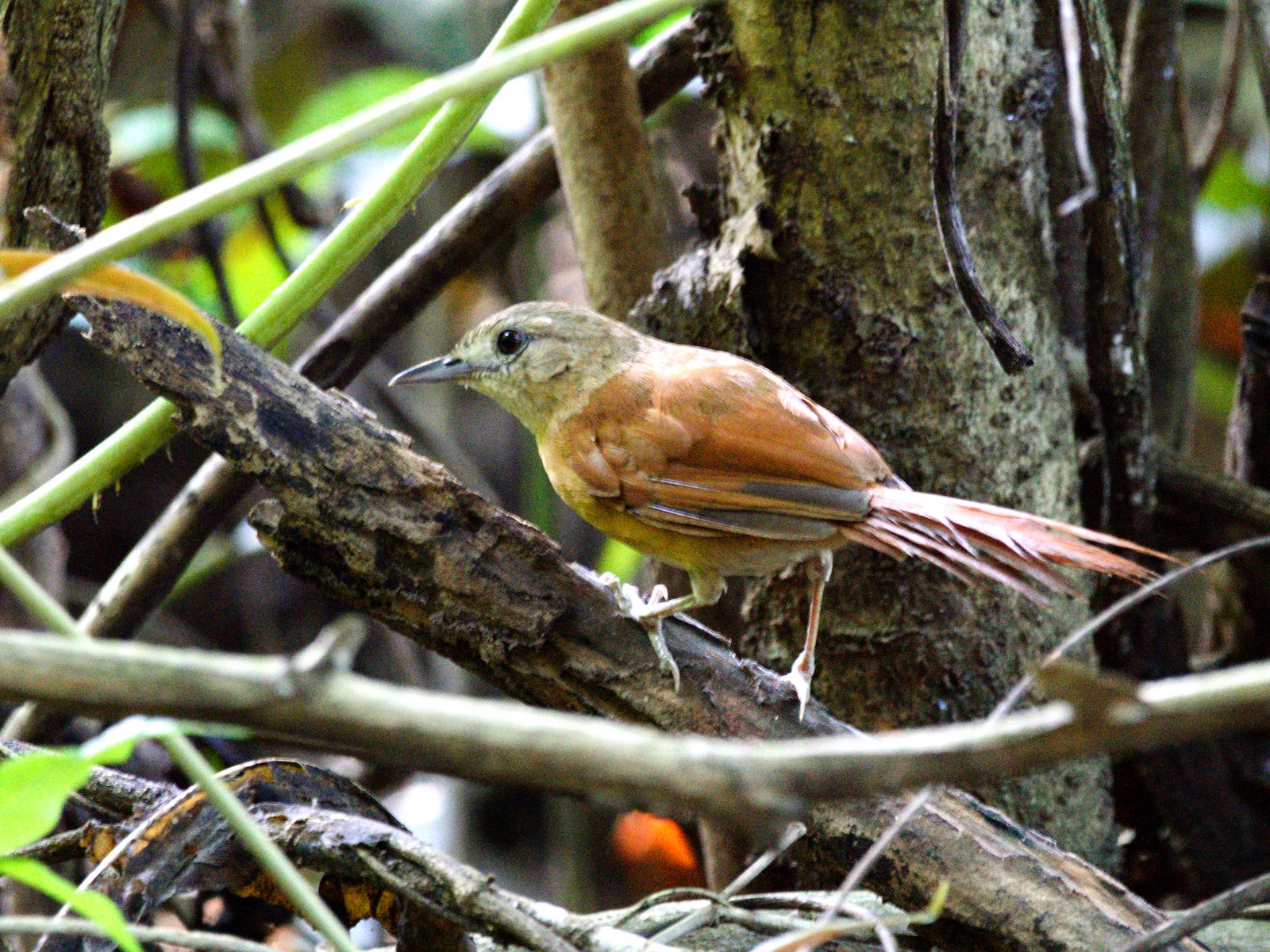
The White-lored Spinetail is a spinetail of the undergrowth of gallery forest and scrub in and around the Pantanal. It was formerly considered a subspecies of Plain-crowned Spinetail. In the guide area it lives only in eastern Bolivia.
Voice
Both sexes sing, mainly in the morning from a hidden perch. The song consists of sharp notes, keeew kiw-kweet, and a repeated nasal, level-pitched note.
Recording: Jacob Wijpkema — CC BY-NC-SA 4.0 · xeno-canto
Identification
15–16 cm. Dull whitish lores on a brownish-grey face. Crown and back are greyish brown; the lower back, rump, wings and tail are rufous. The throat is white, the rest of the underparts largely orange-ochre. The sexes are alike.
Confusion species
Plain-crowned Spinetail Synallaxis gujanensis has pale, greyish underparts with only buff flanks and lives mainly in the Amazonian lowlands. Ochre-cheeked Spinetail Synallaxis scutata is smaller, has a black crescent below the white throat and ochre cheeks, and lives in dry forest. Sooty-fronted Spinetail Synallaxis frontalis has a rufous crown and greyish underparts.
Habitat
Undergrowth of gallery forest, riparian woodland and scrub, below 1000 m. It searches for insects low in dense vegetation. Both sexes build the stick nest, with a leaf-lined chamber, usually no higher than 7 m; the breeding season is mainly from August to December.
Where the bird is most at home, classified by the vegetation units of the Andes and the west coast.


Range and movements
Bolivia: in the east and south-east, in the border region with Brazil and Paraguay. Absent from Colombia, Ecuador, Peru and the Galápagos. Outside the guide area in the Pantanal of Brazil (Mato Grosso and Mato Grosso do Sul) and northern Paraguay.
- Resident
- dark = core range, pale = thinly spread
How and when to look
In the morning, listen for the sharp song phrases in gallery forest and riverside scrub in eastern Santa Cruz. Birds usually stay low and hidden in the vegetation.
Conservation status
Least Concern. In suitable habitat in the Pantanal the species is numerous, and it occurs in several protected areas.
Scientific name
Synallaxis albilora | Pelzeln, 1856
Pelzeln described the species in 1856 and placed it straight away in the genus where it still stands. The genus Synallaxis was introduced in 1818 by Vieillot. The genus name comes from Ancient Greek sunallaxis, 'exchange'. The species name comes from Latin albus, 'white', and lorum, 'strap' (lores), for the white lores. The specimen the first description was based on came from Cuiabá, Mato Grosso, Brazil.