All species › Passerines › Ovenbirds and woodcreepers › Plain-crowned Spinetail
Plain-crowned Spinetail | Synallaxis gujanensis
Cayennestekelstaart | Pijuí coronipardo | João-teneném-becuá
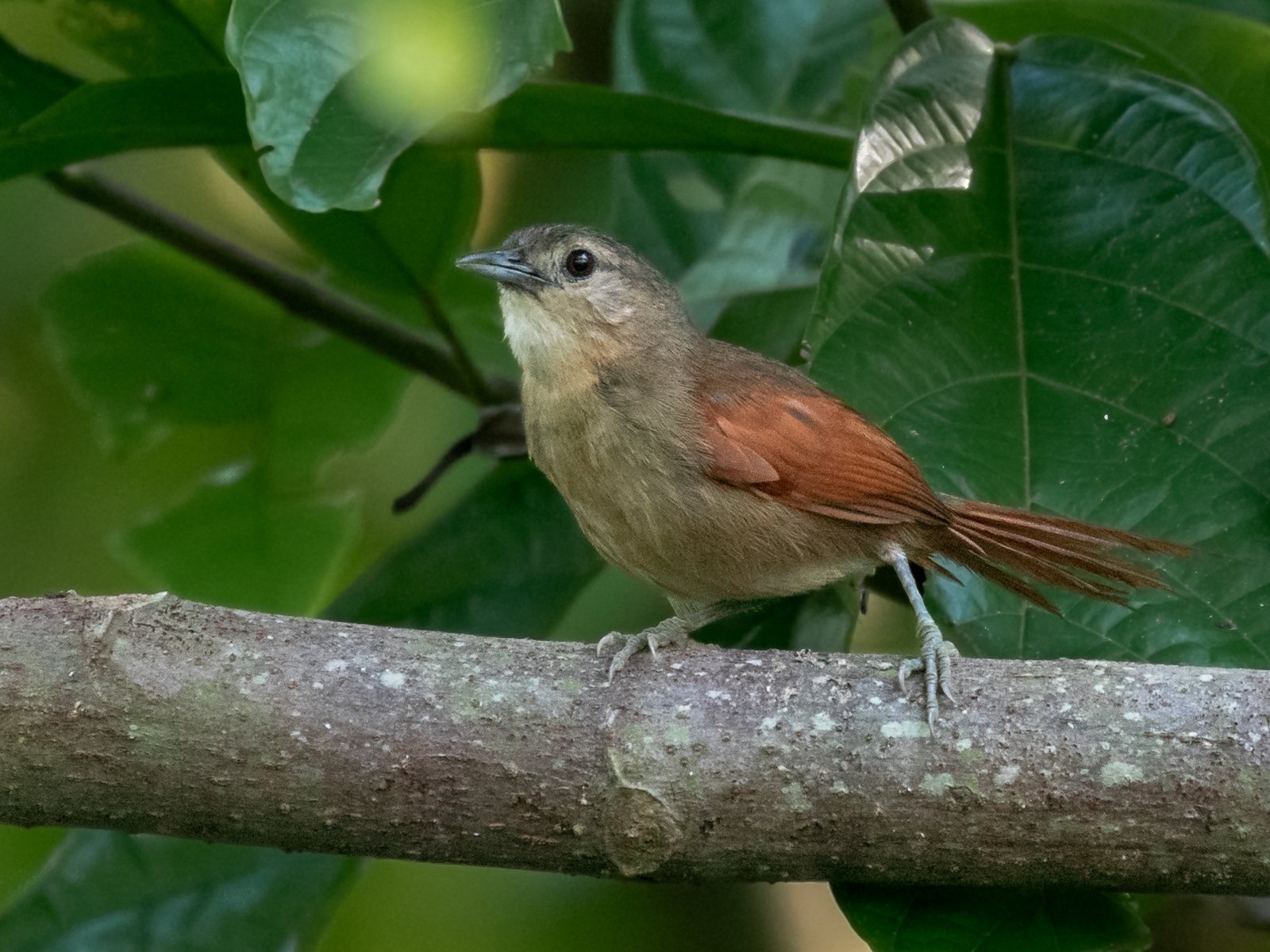
The Plain-crowned Spinetail is a spinetail of riverside scrub and young secondary forest in the Amazonian lowlands. Its English and Spanish names refer to the plain, brownish crown, which separates it from related species with a rufous crown. It keeps to dense vegetation, but sings a great deal.
Voice
The song is a two-noted phrase, kee-kweeu, with the second note falling, often repeated at length from dense cover.
Recording: Pritam Baruah — CC BY-NC-SA 4.0 · xeno-canto
Identification
15–16 cm. Crown and back are plain greyish brown to olive-brown, without rufous on the crown. The face is greyish, with pale lores. The wings and tail are rufous; the tail is fairly long and graduated, with pointed feathers. Throat whitish, breast and belly pale grey to whitish with buff flanks. The sexes are alike.
Confusion species
Pale-breasted Spinetail Synallaxis albescens has a rufous crown and rufous wing coverts, a greyish-brown tail and lives in open grassland. Dark-breasted Spinetail Synallaxis albigularis has a rufous crown and a dark grey breast. Maranon Spinetail Synallaxis maranonica is darker, with greyer underparts, and lives only in the dry Marañón valley. White-lored Spinetail Synallaxis albilora has white lores and orange-ochre underparts and lives in eastern Bolivia.
Habitat
Riverside scrub, young secondary forest, river islands, forest edges, overgrown pasture and gardens in the lowlands, locally up into the Andean foothills. It searches for insects low in dense vegetation. The nest is a globular stick structure with an entrance tube, in a bush.
Where the bird is most at home, classified by the vegetation units of the Andes and the west coast.


Range and movements
Colombia: in the eastern lowlands, east of the Andes. Ecuador: in the Amazonian lowlands. Peru: throughout the eastern lowlands. Bolivia: in the lowlands of the north and centre. Absent from the Galápagos. Outside the guide area in Venezuela, the Guianas and Amazonian Brazil.
- Resident
- dark = core range, pale = thinly spread
How and when to look
Listen for the two-noted song in overgrown vegetation along rivers and forest edges in the Amazonian lowlands. The bird stays low in dense cover and sometimes comes briefly to the edge.
Conservation status
Least Concern. The species benefits from young regrowth and overgrown land created by human use.
Scientific name
Synallaxis gujanensis | (Gmelin, 1789)
Gmelin described the species in 1789 as Motacilla gujanensis; because it was later moved to another genus, the author and year stand in brackets. The genus Synallaxis was introduced in 1818 by Vieillot. The genus name comes from Ancient Greek sunallaxis, 'exchange'. The species name refers to Guiana in the old, broad sense (the Guianas). The specimen the first description was based on came from Cayenne, French Guiana.