All species › Passerines › New World warblers › Cerulean Warbler
Cerulean Warbler | Setophaga cerulea
Azuurzanger | Reinita cerúlea | Mariquita-azul
The Cerulean Warbler is a small North American canopy warbler that winters almost entirely in the northern Andes. The guide area is therefore its main wintering ground. The North American population has declined sharply, and the conservation of montane forest on the Andean slopes is of great importance to the species.
Voice
The call is a soft chip; in flight a thin zeet. The song, a series of buzzy notes that accelerates and ends in a high trill, is rarely heard in winter.
Recording: Bobby Wilcox — CC BY-NC-SA 4.0 · xeno-canto
Identification
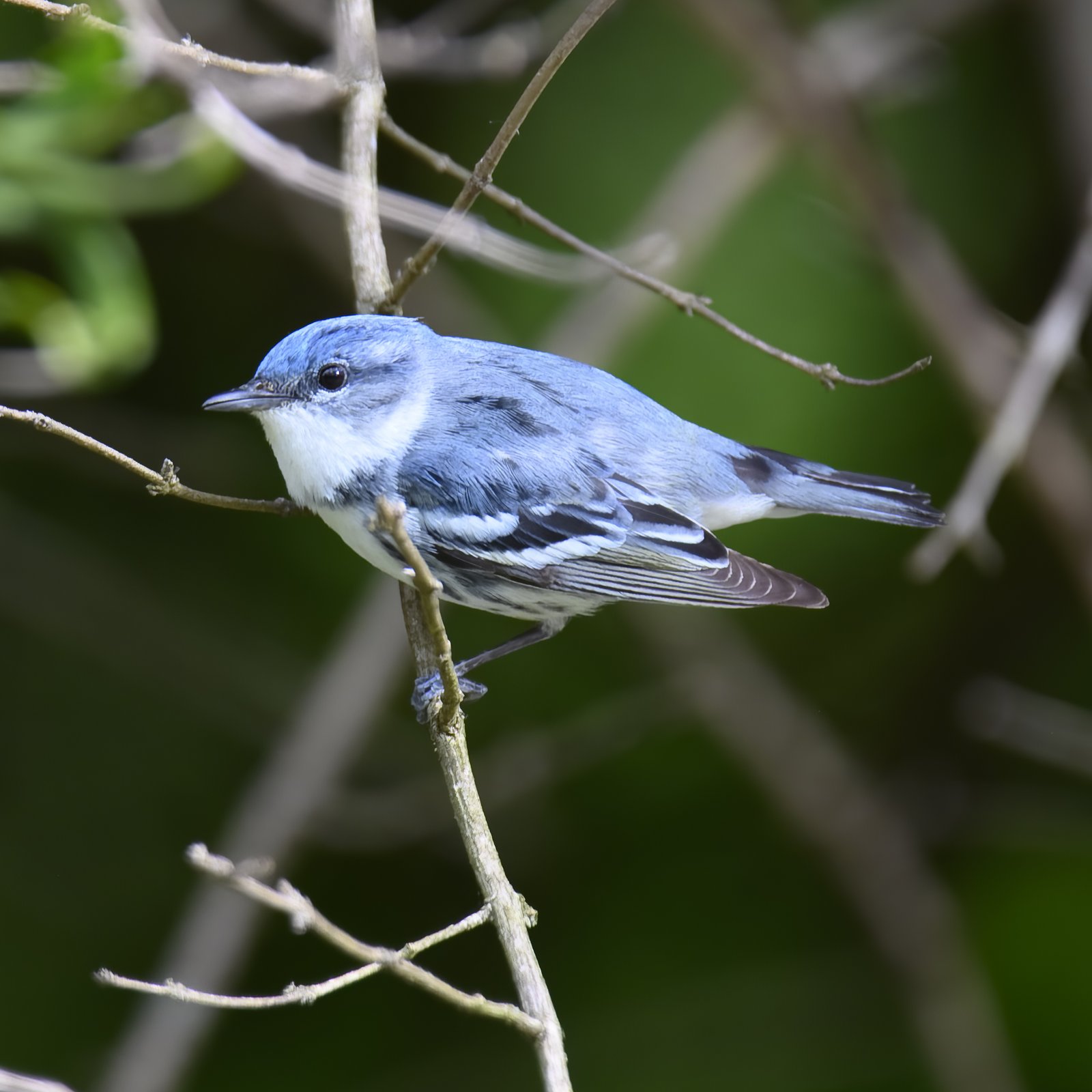
11.5–12 cm, with a short tail. The male is sky-blue above, with black streaks on the back, two white wing bars and white spots in the tail; the underparts are white, with a narrow dark blue band across the breast and blue-streaked flanks. The female is blue-green to turquoise above, with a pale, yellowish supercilium, pale yellow underparts with faint flank streaks and two white wing bars. Young birds are greener than the female.
Confusion species
Male Black-throated Blue Warbler Setophaga caerulescens is darker blue and has a black throat and no wing bars. Female Blackburnian Warbler Setophaga fusca has an orange-yellow throat and supercilium and a dark cheek patch. Female Tennessee Warbler Leiothlypis peregrina lacks clear wing bars and the blue tone. Tropical Parula Setophaga pitiayumi has a yellow throat and breast.
Habitat
In winter high in the canopy of humid montane and foothill forest, mainly on the eastern slope of the Andes, roughly between 500 and 2000 m, also in shade coffee and tall forest edges. It searches for insects among the leaves, often in mixed flocks with tanagers. It does not breed in the guide area.
Where the bird is most at home, classified by the vegetation units of the Andes and the west coast.


Range and movements
Winter visitor and passage migrant, mainly September to April. In Colombia on the slopes of all three Andean ranges and in the Serranía de los Yariguíes. In Ecuador and Peru mainly on the eastern slope of the Andes, scarce. In Bolivia scarce in the northern foothills. Absent from the Galápagos. Breeds in eastern North America and winters almost only in the Andes from Venezuela to Peru and Bolivia.
- Winter visitor (c. Oct–Mar)
- Passage (Mar–Apr, Oct–Nov)
- dark = core range, pale = thinly spread
How and when to look
In the winter months, look for mixed tanager flocks in tall forest and shade coffee on the Andean slopes of Colombia; follow the flock, as the bird usually stays high in the canopy.
Conservation status
Near Threatened. The North American population has declined sharply since the 1960s. The main threats are the loss of deciduous forest on the breeding grounds and the conversion of montane forest on the wintering grounds to farmland; shade coffee and forest reserves in the Andes provide some refuge.
Scientific name
Setophaga cerulea | (Wilson, 1810)
Wilson described the species in 1810 as Sylvia cerulea; because it was later moved to another genus, the author and year stand in brackets. The genus Setophaga was introduced in 1827 by Swainson. The genus name comes from Greek sēs (genitive sētos), 'moth', and -phagos, '-eating', so 'moth-eater'. The species name comes from Latin caeruleus, 'sky-blue', for the male's blue upperparts. The specimen the first description was based on came from Philadelphia, Pennsylvania, United States.