All species › Passerines › New World warblers › American Redstart
American Redstart | Setophaga ruticilla
Amerikaanse roodstaart | Candelita norteña | Mariquita-de-rabo-vermelho
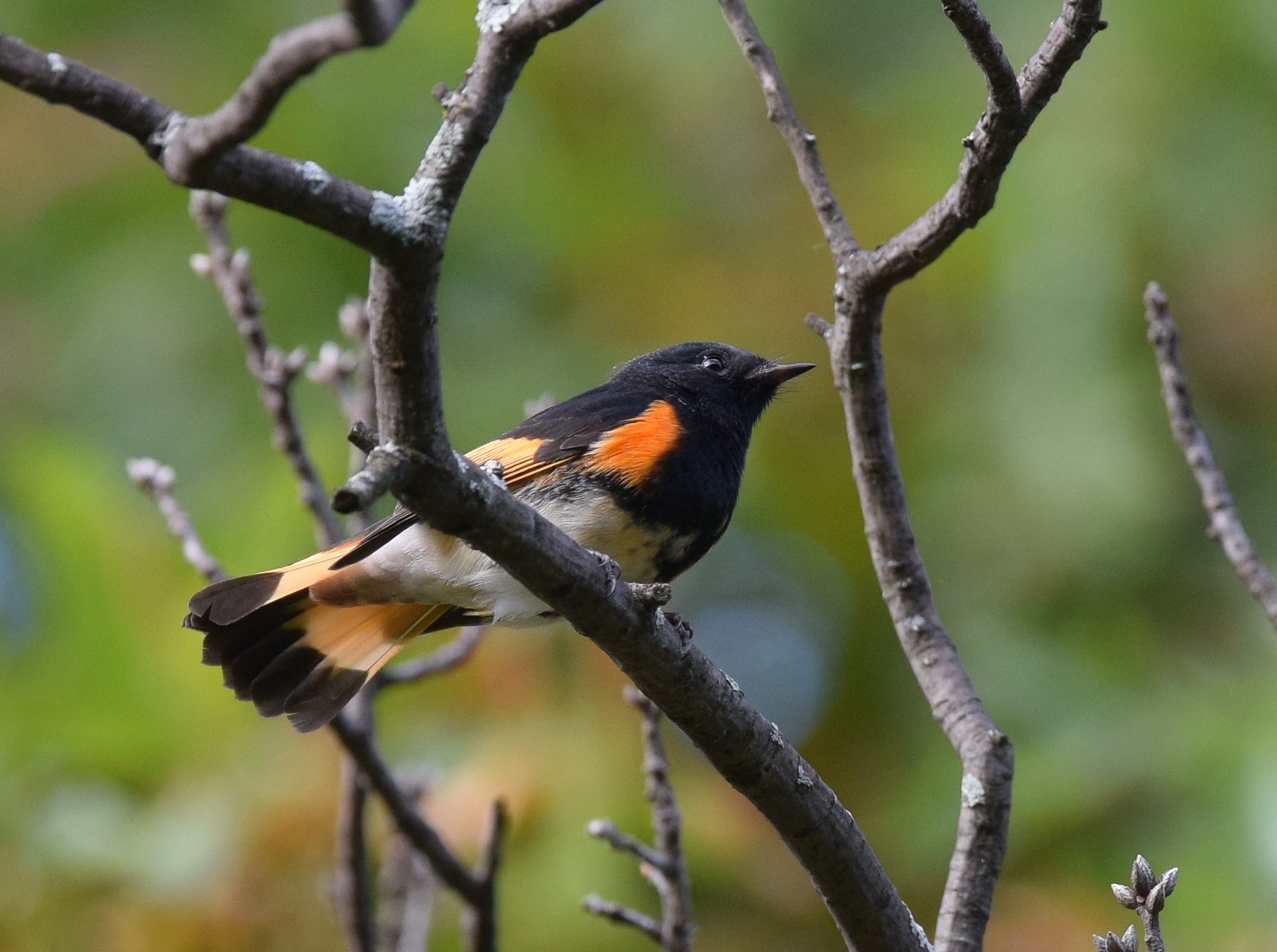
The American Redstart is a North American warbler that spends the northern winter in large numbers in northern South America. It is constantly on the move: it fans its tail, droops its wings and sallies after flying insects. In Colombia it is one of the most widespread wintering warblers.
Voice
The call is a sharp, high tsip. The song, a series of high, thin notes with a variable, often down-slurred ending, is sometimes heard on the wintering grounds from February.
Recording: Scott Olmstead — CC BY-NC-SA 4.0 · xeno-canto
Identification
12–13 cm, with a rather long tail and a broad, flat bill with bristles at the base. The male is glossy black, with orange patches on the breast sides, an orange band across the wing and orange panels at the base of the tail; the belly is white. The female has a grey head, olive-grey upperparts, white underparts and yellow patches in the same places. First-winter males resemble the female, with orange-yellow patches and sometimes a few black feathers.
Confusion species
Slate-throated Whitestart Myioborus miniatus behaves similarly and also fans its tail, but is slate-grey above, with a yellow or orange-yellow belly, a chestnut crown patch and white outer tail feathers; it is a resident of montane forest. Black-and-white Warbler Mniotilta varia is streaked black and white and creeps along branches. Females of other wintering warblers, such as Blackburnian Warbler Setophaga fusca, lack the yellow tail panels.
Habitat
In winter in forest edges, secondary forest, semi-open country with trees, shade coffee, riverine forest, mangroves, dry forest, gardens and parks, mainly below 1500 m, but also higher to about 2500 m. It catches insects in short sallies and by flushing them with its fanned tail; in winter it often holds a territory and also joins mixed flocks. It does not breed in the guide area.
Where the bird is most at home, classified by the vegetation units of the Andes and the west coast.


Range and movements
Winter visitor, mainly September to April. In Colombia common and widespread in the lowlands, the valleys and on the Andean slopes. In Ecuador fairly scarce, mainly in the north and on both sides of the Andes. In Peru scarce, mainly in the north; further south and in Bolivia only a few records. In the Galápagos an exceptional vagrant. Breeds over much of North America and winters from Mexico and the Caribbean to northern South America.
- Winter visitor (c. Oct–Mar)
- dark = core range, pale = thinly spread
How and when to look
In winter, in forest edges, coffee plantations and gardens in Colombia, watch for a small warbler that constantly flashes its fanned tail; the orange or yellow patches in tail and wing are also visible in flight.
Conservation status
Least Concern. The species is numerous and on the wintering grounds also uses secondary growth, shade coffee and gardens.
Scientific name
Setophaga ruticilla | (Linnaeus, 1758)
Linnaeus described the species in 1758 as Motacilla ruticilla; because it was later moved to another genus, the author and year stand in brackets. The genus Setophaga was introduced in 1827 by Swainson. The genus name comes from Greek sēs (genitive sētos), 'moth', and -phagos, '-eating', so 'moth-eater'. The species name is New Latin ruticilla, 'redstart', from Latin rutilus, 'red', and -cilla, 'tail'. The specimen the first description was based on came from Virginia, United States.