All species › Passerines › Mockingbirds and thrashers › Chalk-browed Mockingbird
Chalk-browed Mockingbird | Mimus saturninus
Campospotlijster | Calandria grande | Sabiá-do-campo
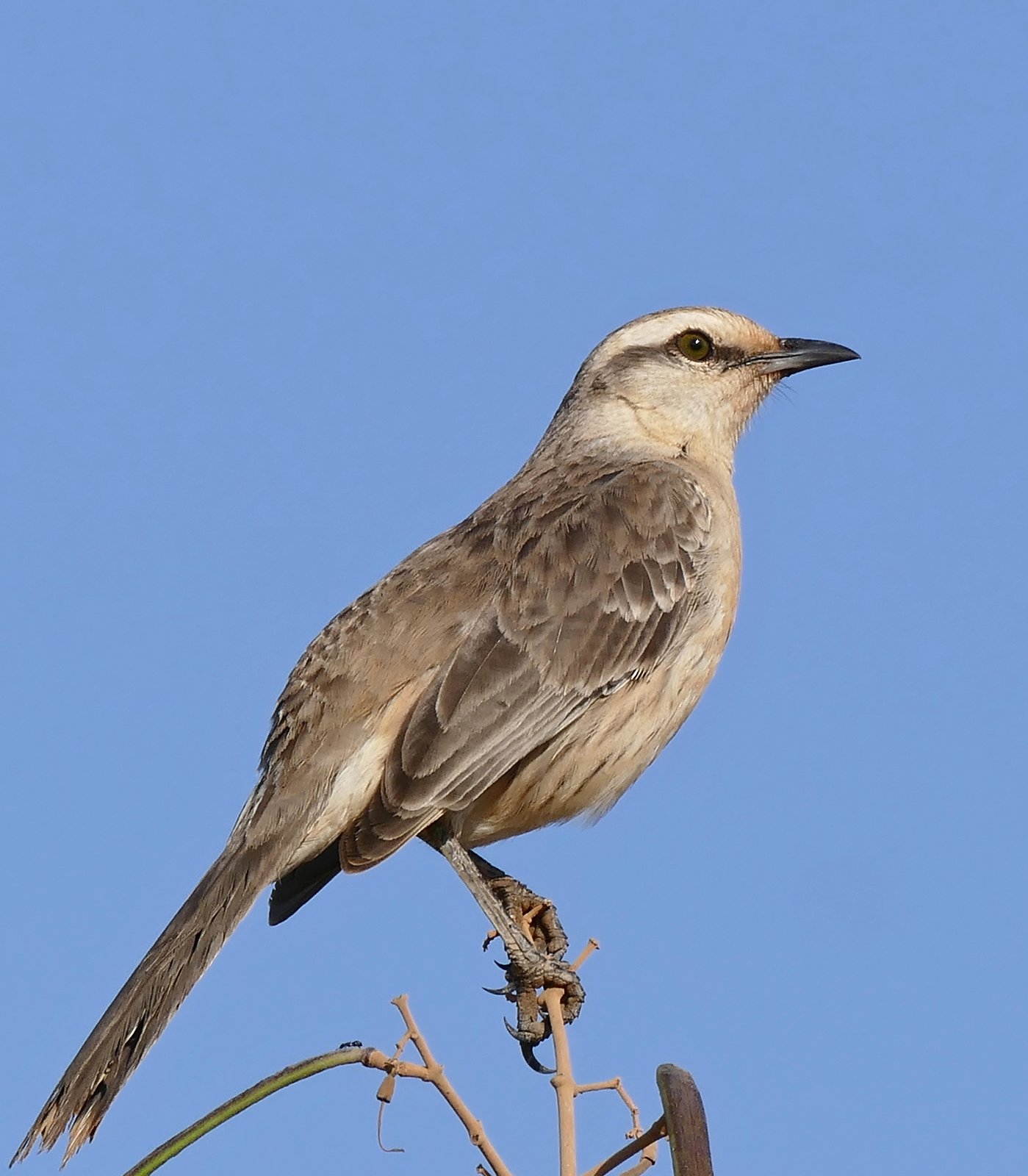
The Chalk-browed Mockingbird is the large, grey-brown mockingbird of the open grasslands and savannas of central and eastern South America. It often perches upright on a post, shrub or roof, with the long tail slightly raised, and gives a loud, varied song with much mimicry. In the guide area it lives only in the lowlands of Bolivia.
Voice
The song is a loud, long and varied series of whistled, rolling and scratchy phrases, with many imitations of other birds, often from a high perch and sometimes also at night. The call is a harsh, hoarse chek or a rasping scold.
Recording: Pedro Sanetti — CC0 1.0 · xeno-canto
Identification
23–26 cm, a slender, long-tailed mockingbird with long legs and a fairly long, slightly decurved black bill. The upperparts are grey-brown, with dark streaking on the back. A broad white supercilium contrasts with a dark eyestripe and dark cheeks. The underparts are dingy white, with a pale buff tinge on the breast and flanks. The wings are dark with pale edges to the coverts; the tail is blackish with broad white tips to the outer feathers. The sexes are alike; juveniles have dark spots on the breast.
Confusion species
White-banded Mockingbird Mimus triurus is smaller, with an unstreaked back, a rufous rump, a broad white band in the wing and largely white outer tail feathers. Brown-backed Mockingbird Mimus dorsalis has a chestnut-brown, unstreaked back and lives in the dry Andean valleys. Grey Monjita Nengetus cinereus is a tyrant flycatcher with a shorter tail, a black malar stripe and a white patch at the base of the primaries.
Habitat
Open and semi-open country: savannas, cerrado, pasture with scattered trees and shrubs, forest edges, open scrub, villages and gardens, in the guide area mainly in the lowlands, locally up into the lower Andean valleys. It forages much on the ground for insects and other invertebrates and also eats fruit. It often lives in pairs or small groups; the nest is a cup of twigs in a shrub or low tree.
Where the bird is most at home, classified by the vegetation units of the Andes and the west coast.


Range and movements
Bolivia: common in the eastern and northern lowlands, including Beni and Santa Cruz, and in the Chaco, locally up into the lower Andean valleys. Absent from Colombia, Ecuador and Peru and from the Galápagos. Outside the guide area over much of Brazil, in Paraguay, Uruguay and north-eastern Argentina.
- Resident
- dark = core range, pale = thinly spread
How and when to look
In the savannas and pastures around Santa Cruz and in Beni, check posts, fences, shrubs and roofs; the birds often perch in the open and draw attention by their song and the white tail tips in flight.
Conservation status
Least Concern. Widespread and common; the species benefits from forest clearance and the creation of pasture.
Scientific name
Mimus saturninus | (Lichtenstein, 1823)
Lichtenstein described the species in 1823 as Turdus saturninus; because it was later moved to another genus, the author and year stand in brackets. The genus Mimus was introduced in 1826 by Boie. The genus name is Latin mimus, 'mimic', after the imitation of other sounds. The species name is Medieval Latin saturninus, 'gloomy, leaden'; in alchemy Saturn was identified with lead. The specimen the first description was based on came from Rio Tapajós, Pará, Brazil.