All species › Passerines › Mockingbirds and thrashers › White-banded Mockingbird
White-banded Mockingbird | Mimus triurus
Witbandspotlijster | Calandria real | Calhandra-de-três-rabos
The White-banded Mockingbird is a medium-sized mockingbird of dry scrub and open woodland in southern South America, with a broad white band in the dark wing. Most of the population breeds in Argentina and moves north in the austral winter. In flight it draws attention by its black-and-white wings and tail.
Voice
The song is a long, varied and loud series of whistled and scratchy phrases, with many imitations of other birds, often from the top of a shrub. The call is a harsh chak and a hoarse scold.
Recording: Luciano Buck — CC BY-NC-SA 4.0 · xeno-canto
Identification
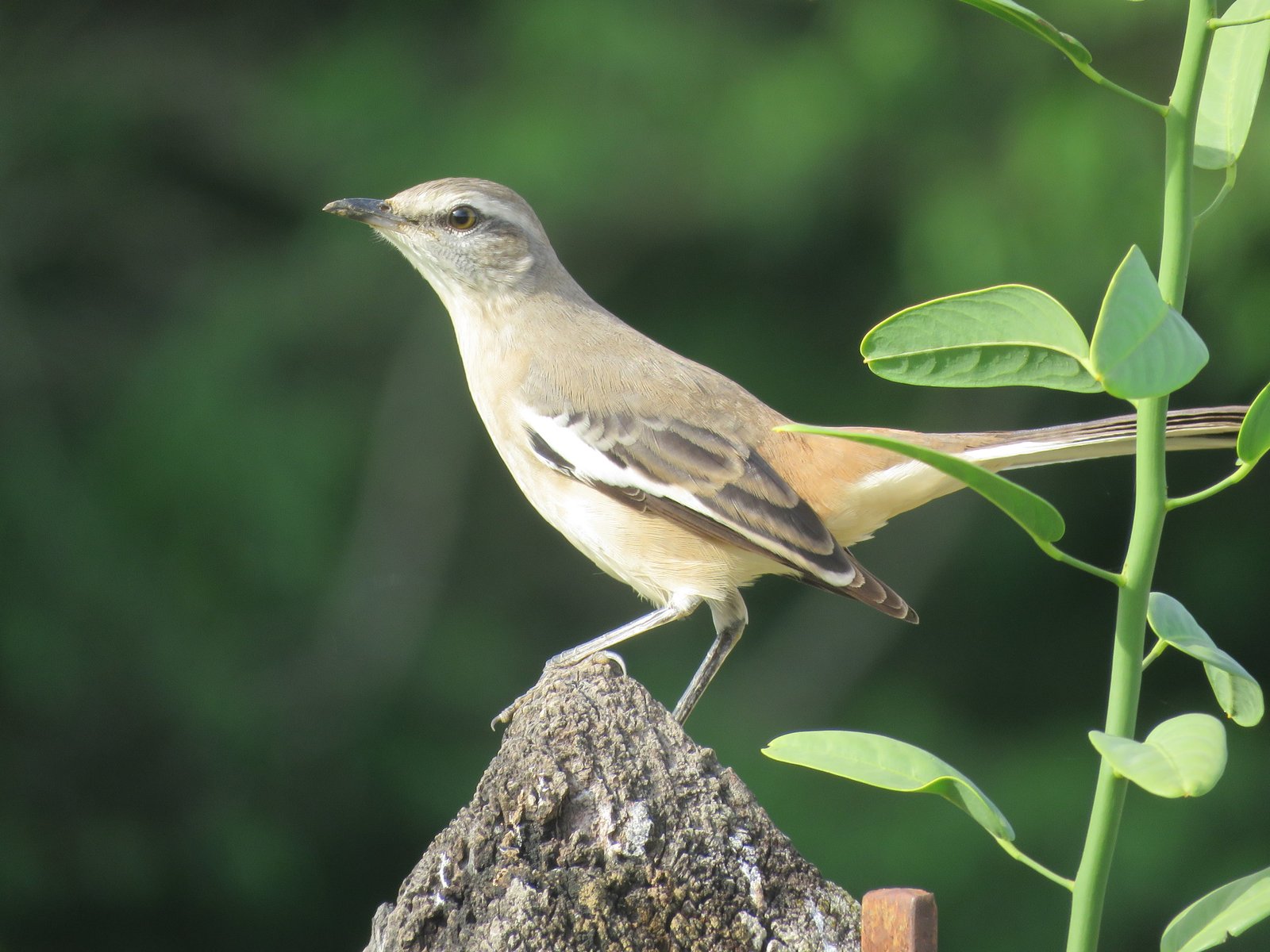
20–23 cm, a slender mockingbird with a long tail and a thin, slightly decurved black bill. The upperparts are grey-brown and unstreaked, with a rufous tinge on the rump and lower back. A white supercilium, a dark eyestripe and pale cheeks. The underparts are whitish, buff on the flanks. The wings are blackish with white wing bars and a broad white band across the secondaries, also clearly visible at rest. The central tail feathers are black, the outer ones largely white. The sexes are alike; juveniles have dark spots on the breast.
Confusion species
Chalk-browed Mockingbird Mimus saturninus is larger, with a streaked back, no white wing band, and only white tips to the tail feathers. Brown-backed Mockingbird Mimus dorsalis has a warmer chestnut-brown back and less white in the wing, and lives mainly higher, in the dry Andean valleys. Outside the guide area Patagonian Mockingbird Mimus patagonicus is similar but has less white in the wing and tail.
Habitat
Dry thorn scrub and open dry woodland of the Chaco, shrubby savanna, pasture with hedgerows, riparian scrub and the edges of fields and villages, mainly in the lowlands, locally in the lower dry valleys. It forages on the ground and in shrubs for insects and also eats fruit. The nest is a cup of twigs in a thorny shrub.
Where the bird is most at home, classified by the vegetation units of the Andes and the west coast.


Range and movements
Bolivia: breeds in the Chaco and the dry scrub of the south-east; in the austral winter migrants from Argentina join them and spread farther north, to Santa Cruz and sometimes Beni. Peru: very rare vagrant in the south-east, with a few records. Absent from Colombia and Ecuador and from the Galápagos. Outside the guide area it breeds in Argentina and western Paraguay; in winter it reaches south-western Brazil and Uruguay.
- Summer visitor (c. Apr–Sep)
- dark = core range, pale = thinly spread
How and when to look
Search the dry Chaco scrub of south-eastern Bolivia, especially in the austral winter (about May–September), when the species is most numerous. In flight the white wing band is the best feature.
Conservation status
Least Concern. Widespread and locally common; the species tolerates farmland with shrubs and hedgerows.
Scientific name
Mimus triurus | (Vieillot, 1818)
Vieillot described the species in 1818 as Turdus triurus; because it was later moved to another genus, the author and year stand in brackets. The genus Mimus was introduced in 1826 by Boie. The genus name is Latin mimus, 'mimic', after the imitation of other sounds. The species name comes from Greek tri-, 'three', and -ouros, '-tailed', after 'Tres Colas', the name Félix de Azara gave the bird. The specimen the first description was based on came from Paraguay.