All species › Passerines › Wrens › Spot-breasted Wren
Spot-breasted Wren | Pheugopedius maculipectus
Vlekborstwinterkoning | Chivirín moteado | Garrinchão-de-peito-pintado
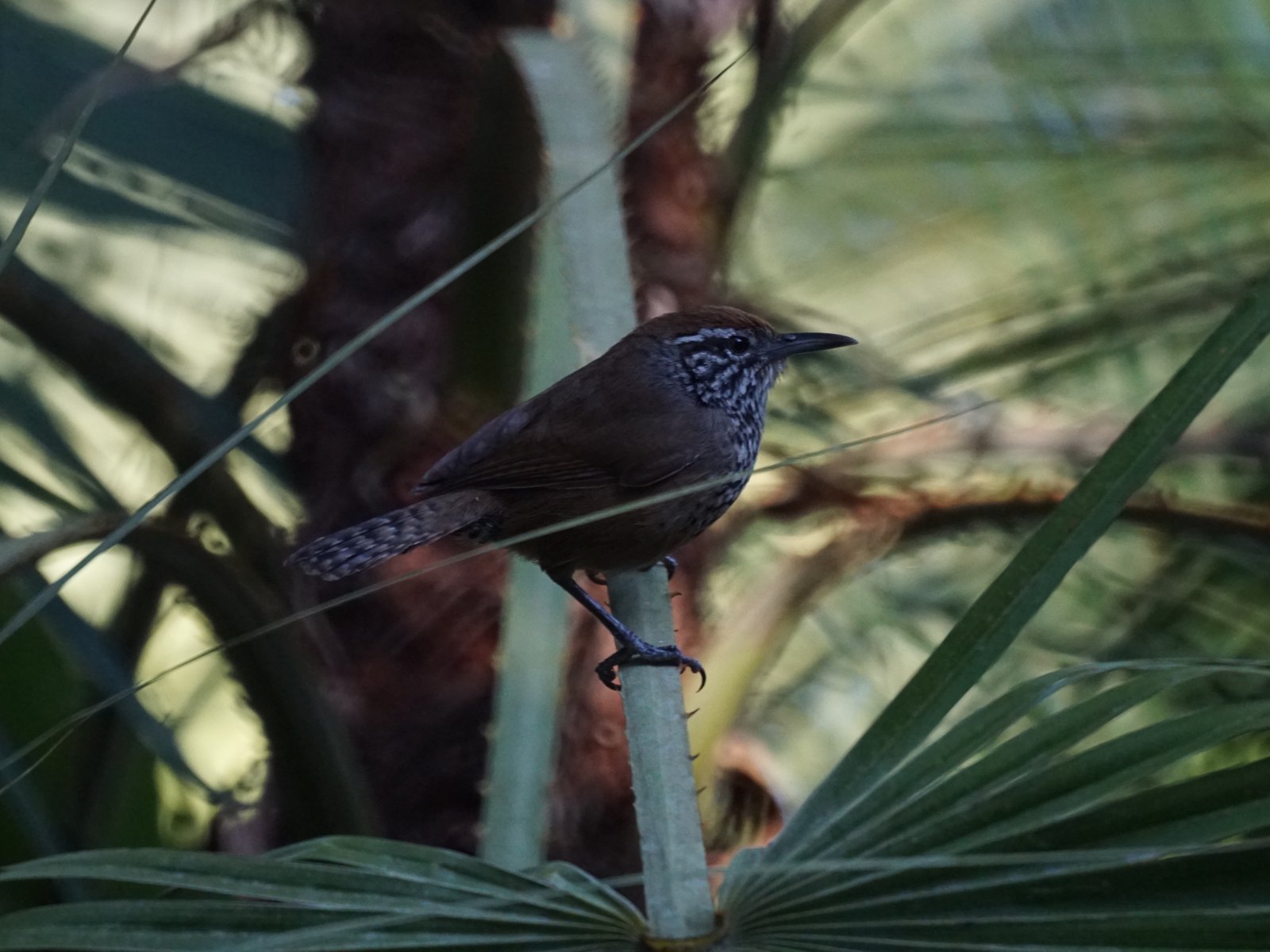
The Spot-breasted Wren is a wren of the lowlands of Mexico and northern Central America, with a white breast covered in black spots. In the guide area it has been reported only as a very rare vagrant, and none of the reports is well documented. Speckle-breasted Wren used to be included in this species, so old records often refer to that species.
Voice
Rich, whistled phrases, each repeated a few times, often in duet; also dry, rattling calls.
Recording: Manuel Grosselet — CC BY-NC-SA 4.0 · xeno-canto
Identification
13.5–14 cm. Upperparts warm brown, the crown slightly more rufous. White supercilium; sides of the head streaked black and white. Throat and breast white with dense, round black spots; flanks and lower belly cinnamon-brown. Tail brown with black bars. The sexes are alike; young birds have a more faintly spotted, greyer breast.
Confusion species
Speckle-breasted Wren Pheugopedius sclateri is very similar, but has finer speckling extending onto the belly and less cinnamon on the flanks; it is the species that occurs in the guide area. Rufous-breasted Wren Pheugopedius rutilus has only a speckled throat and an orange-rufous breast.
Habitat
Humid and semi-humid lowland forest, forest edges, scrub, secondary forest and plantations, from sea level to about 1500 m. It forages low in dense growth for insects and spiders. The nest is a globular structure with a side entrance.
Where the bird is most at home, classified by the vegetation units of the Andes and the west coast.


Range and movements
In the guide area reported only as a very rare vagrant, with unconfirmed records from Colombia and Peru that probably refer to Speckle-breasted Wren; not known from Ecuador, Bolivia or the Galápagos. Outside the guide area from eastern and southern Mexico to northern Costa Rica.
How and when to look
A heavily spotted wren in the guide area is almost always a Speckle-breasted Wren. A bird resembling this species needs photographs and sound recordings.
Conservation status
Least Concern. Within its range in Central America the species is common in forest edges and secondary forest.
Scientific name
Pheugopedius maculipectus | (de Lafresnaye, 1845)
De Lafresnaye described the species in 1845 as Thriothorus maculipectus; because it was later moved to another genus, the author and year stand in brackets. The genus Pheugopedius was introduced in 1851 by Cabanis. The genus name comes from Greek pheugō, 'to flee, to shun', and pedion, 'plain, open country', meaning 'shunning open country'. The species name comes from Latin macula, 'spot', and pectus, 'breast'. The specimen the first description was based on came from Veracruz, Mexico.