All species › Passerines › Tanagers and allies › Chestnut-bellied Flowerpiercer
Chestnut-bellied Flowerpiercer | Diglossa gloriosissima
Roestbuikberghoningkruiper | Pinchaflor ventrirrufo | Fura-flor-de-barriga-castanha
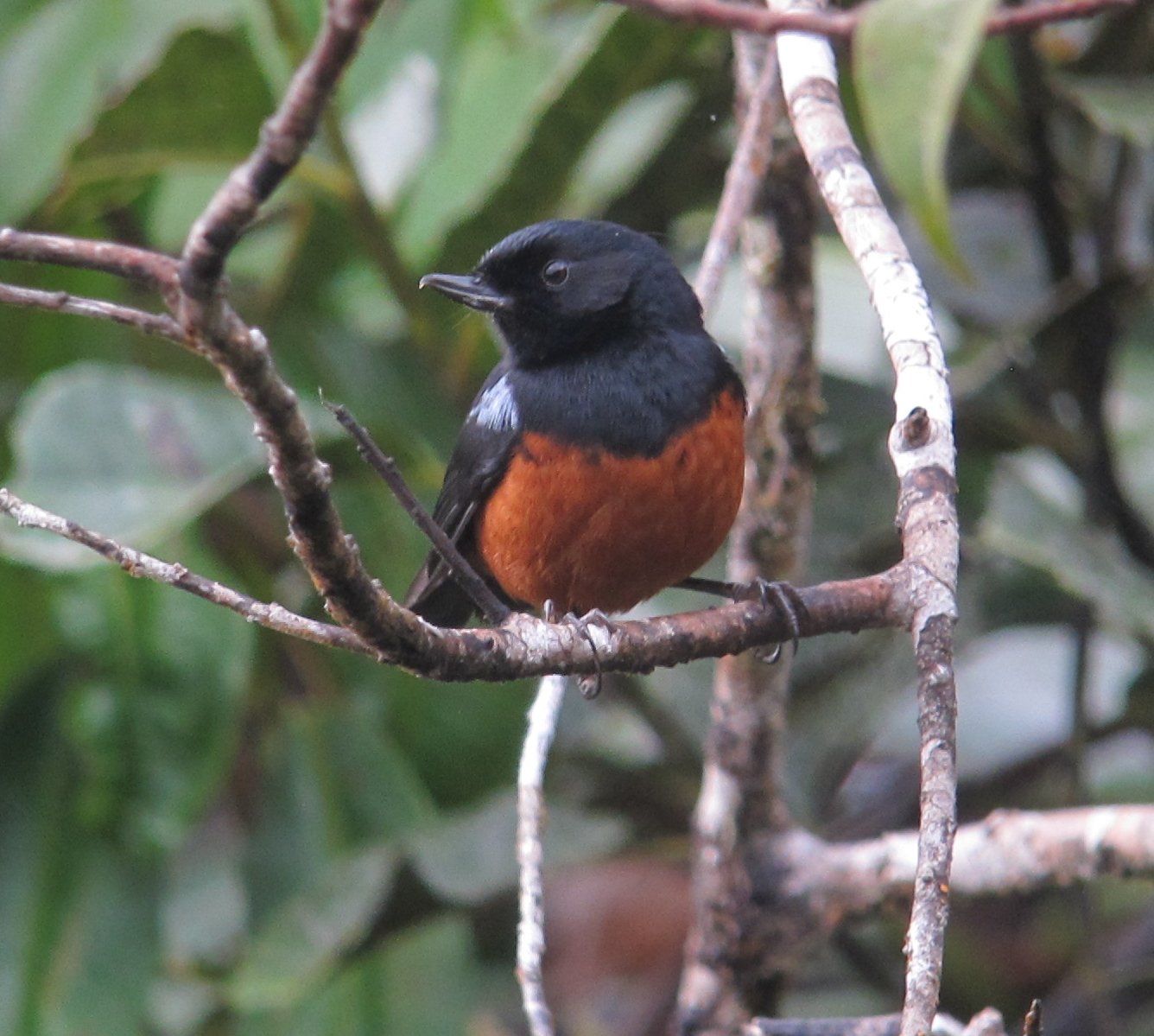
The Chestnut-bellied Flowerpiercer is a black flowerpiercer with a chestnut belly, found only in the Western Andes of Colombia. It lives in elfin forest and shrubbery at the treeline and around the páramo, on a few isolated peaks. Like other flowerpiercers, it uses its hooked bill to pierce flowers at the base to steal nectar.
Voice
The song is a fast, high, twittering series of thin notes. The call is a short, sharp tsit.
Recording: Oswaldo Cortes — CC BY-NC-SA 3.0 · xeno-canto
Identification
14 cm, with a black, upturned bill with a sharp hook at the tip of the upper mandible. The head, back, throat and breast are black, with a blue-grey patch on the shoulder. The lower breast, belly and undertail coverts are chestnut. The sexes are alike. Young birds are duller, with a browner belly.
Confusion species
Glossy Flowerpiercer Diglossa lafresnayii is entirely glossy black, without a chestnut belly. Black Flowerpiercer Diglossa humeralis is smaller and entirely dull black. Black-throated Flowerpiercer Diglossa brunneiventris has a grey back and a grey moustache stripe and in Colombia occurs only in the Central Andes. The male Rusty Flowerpiercer Diglossa sittoides is blue-grey above and cinnamon below, without black.
Habitat
Elfin forest, shrubbery and forest edges at the treeline and the edge of the páramo, roughly between 3000 and 3800 m. It lives alone or in pairs, often in mixed flocks. It eats nectar, which it steals by piercing flowers at the base, and small insects.
Where the bird is most at home, classified by the vegetation units of the Andes and the west coast.


Range and movements
Endemic to Colombia: only in the Western Andes, on a few peaks in Antioquia and in Cauca. Absent from Ecuador, Peru, Bolivia and the Galápagos.
- Resident
- dark = core range, pale = thinly spread
How and when to look
On the highest parts of the Western Andes, in shrubbery at the edge of the páramo, look for black flowerpiercers searching flowering shrubs; note the chestnut belly.
Conservation status
Near Threatened. The range is very small and fragmented over a few peaks; fires, grazing, mining and clearing at the treeline threaten its habitat. Part of its habitat lies in protected areas.
Scientific name
Diglossa gloriosissima | Chapman, 1912
Chapman described the species in 1912 and placed it straight away in the genus where it still stands. The genus Diglossa was introduced in 1832 by Wagler. The genus name comes from Greek diglōssos, 'double-tongued' or 'speaking two languages'. The specific name is Latin gloriosissimus, 'most glorious', the superlative of gloriosus, 'glorious', from gloria, 'glory'. The specimen the first description was based on came from west of Popayán, Cauca, Colombia.