All species › Passerines › Tanagers and allies › Magpie Tanager
Magpie Tanager | Cissopis leverianus
Eksterttangare | Tangara urraca | Tietinga
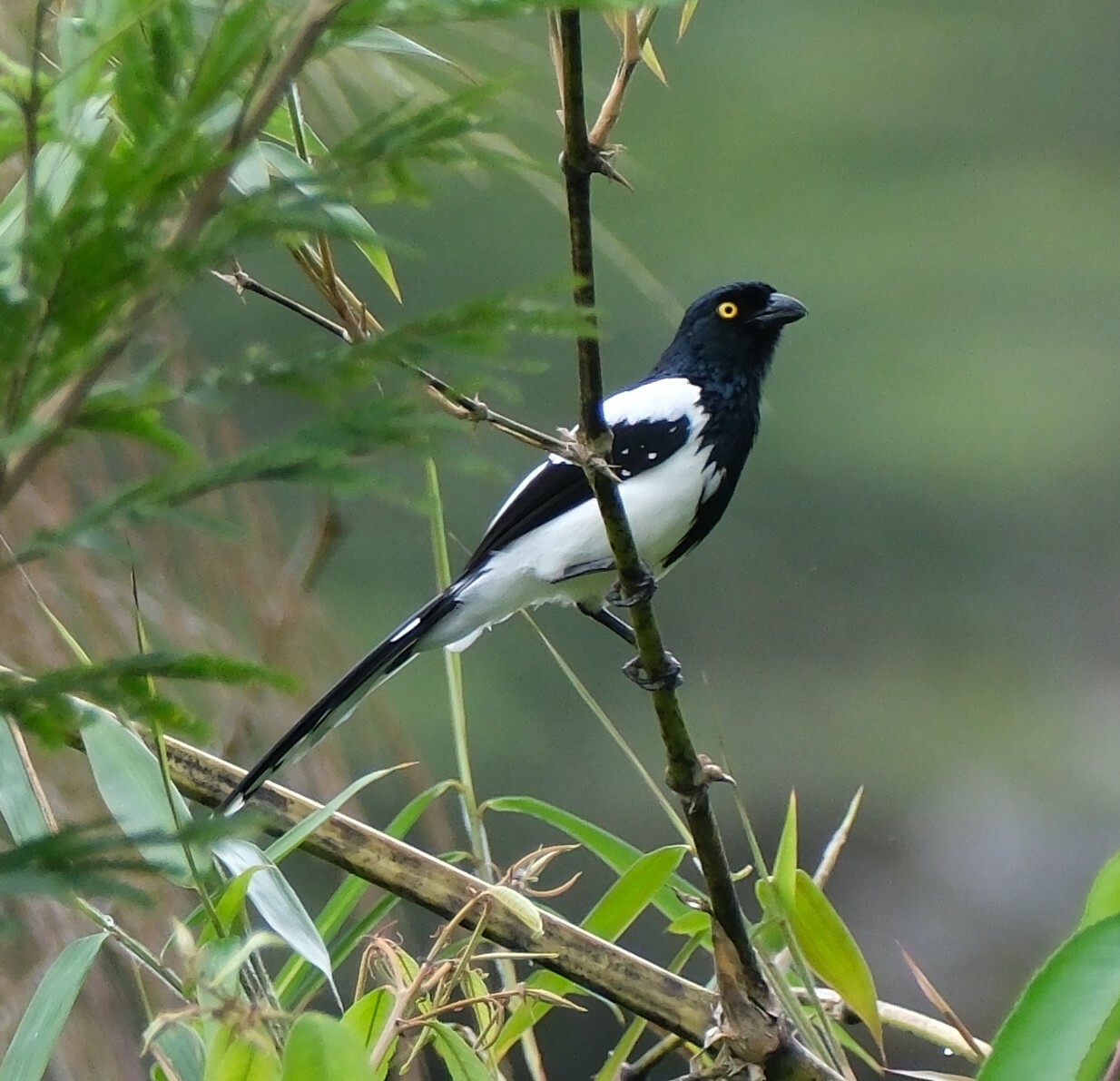
The Magpie Tanager is a large, black-and-white tanager with a long, graduated tail and yellow eyes, of forest edges and clearings in the lowlands and foothills east of the Andes. It lives in noisy small groups that move through shrubs and low tree crowns, swinging their tails from side to side. With its magpie-like pattern it differs strongly from most other tanagers.
Voice
Groups constantly give metallic chenk and chip calls. The song is a fast, somewhat jumbled series of chirping and whistled notes, often by several birds at once.
Recording: Fabrício Grigolin — CC BY-NC-SA 4.0 · xeno-canto
Identification
25–28 cm, about half of it tail, with a fairly stout black bill and a bright yellow iris. The head, throat and upper breast are glossy blue-black, ending in a point on the breast. The rest of the underparts is white; the back is white with black spots. The wings are black, the long, graduated tail black with broad white tips. The sexes are alike. Young birds are somewhat duller.
Confusion species
With its black-and-white plumage and long tail hardly confusable with other species. Black-capped Donacobius Donacobius atricapilla also has yellow eyes and a long white-tipped tail, but is buff below and lives in marsh vegetation along water.
Habitat
Forest edges, clearings, secondary forest, riverbanks, scrub and plantations and gardens with trees, from the lowlands up to about 1500 m in the Andean foothills, locally higher. It eats fruit and insects, which it searches for in shrubs and low to middle tree crowns. The nest is an open cup in a shrub or tree.
Where the bird is most at home, classified by the vegetation units of the Andes and the west coast.


Range and movements
In Colombia east of the Andes, in the Amazon and Orinoco basins and along the foot of the eastern slope. In Ecuador in the eastern lowlands and foothills. In Peru in the eastern lowlands and the valleys at the foot of the Andes. In Bolivia in the lowlands and foothills of the north and centre. Absent west of the Andes and from the Galápagos. Outside the guide area in Venezuela, the Guianas and Amazonian Brazil, with a separate population in the Atlantic Forest of eastern Brazil, Paraguay and north-eastern Argentina.
- Resident
- dark = core range, pale = thinly spread
How and when to look
Search along roads and rivers with forest edges and clearings in the foothills of the eastern slope; groups are often heard first and like to perch on open branches above the scrub.
Conservation status
Least Concern. Widespread and common; benefits from forest edges and secondary growth.
Scientific name
Cissopis leverianus | (Gmelin, 1788)
Gmelin described the species in 1788 as Lanius leverianus; because it was later moved to another genus, the author and year stand in brackets. The genus Cissopis was introduced in 1816 by Vieillot. The genus name comes from Greek kissa, 'magpie', and -ōpis, '-faced'. The species name honours the English collector Sir Ashton Lever (1729–1788), founder of the Leverian Museum in London. The specimen the first description was based on came from Cayenne, French Guiana.