All species › Passerines › Tanagers and allies › Cochabamba Mountain Finch
Cochabamba Mountain Finch | Poospiza garleppi
Cochabambaboomgors | Monterita de Cochabamba | Tico-tico-de-cochabamba
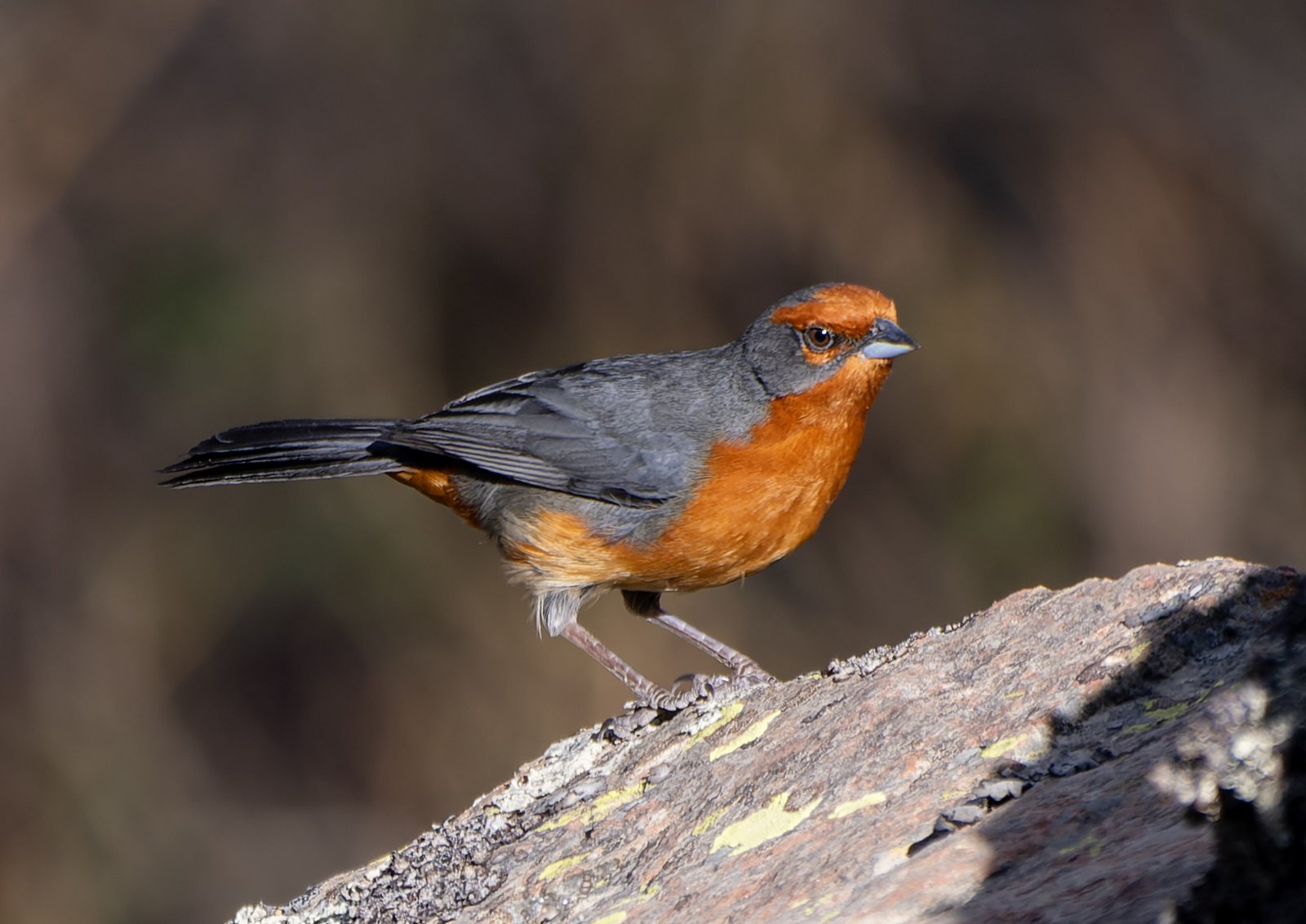
The Cochabamba Mountain Finch is a large finch endemic to the Andes of central Bolivia. It combines a grey back with a rufous-orange brow and underparts. The species is tied to semi-humid scrub and woodland with Polylepis and alder, a habitat that has shrunk considerably.
Voice
The song is a short, clear, whistled phrase, often repeated from the top of a shrub. The call is a metallic chip.
Recording: Ross Gallardy — CC BY-NC-SA 4.0 · xeno-canto
Identification
18 cm, with a conical, dark grey bill and a fairly long tail. The head and upperparts are grey, the cheeks darker grey. The supercilium and the underparts, from throat to undertail coverts, are deep rufous-orange; the flanks are washed grey. The wings and tail are dark grey. The sexes are alike. Young birds are duller and paler, with less rufous.
Confusion species
Rufous-sided Warbling Finch Poospizopsis hypocondria is smaller, has a white supercilium and throat, and only rufous flanks. Rusty-browed Warbling Finch Microspingus erythrophrys is much smaller, with an olive-grey back and a finer bill. Chestnut-breasted Mountain Finch Poospizopsis caesar of southern Peru has a white throat and brow and a chestnut breast.
Habitat
Semi-humid scrub, edges of Polylepis and alder woodland, often in ravines and along streams, also in hedges near fields, roughly between 2700 and 4000 m. It forages in shrubs and on the ground for seeds, buds and insects, mostly in pairs or small groups.
Where the bird is most at home, classified by the vegetation units of the Andes and the west coast.


Range and movements
Only in Bolivia, in the Andes of the departments of Cochabamba and Potosí, locally also adjacent Chuquisaca. Absent from Colombia, Ecuador, Peru and the Galápagos. Endemic to the guide area.
- Resident
- dark = core range, pale = thinly spread
How and when to look
Search the wooded ravines with Polylepis above the city of Cochabamba, for example in the Tunari range; the birds often sit on top of a shrub in the morning.
Conservation status
Near Threatened. Its habitat is small and fragmented and is declining through firewood cutting, grazing and fires.
Scientific name
Poospiza garleppi | (Berlepsch, 1893)
Berlepsch described the species in 1893 as Compsospiza garleppi; because it was later moved to another genus, the author and year stand in brackets. The genus Poospiza was introduced in 1847 by Cabanis. The genus name combines Ancient Greek poa, 'grass', and spiza, 'finch'. The species name honours the German brothers Gustav Garlepp (1862-1907) and Otto Garlepp (1864-1959), professional collectors in South America, including Bolivia. The specimen the first description was based on came from Vacas, Cochabamba, Bolivia.