All species › Passerines › Tanagers and allies › Collared Warbling Finch
Collared Warbling Finch | Poospiza hispaniolensis
Gekraagde boomgors | Monterita collareja | Quem-te-vestiu-de-colar
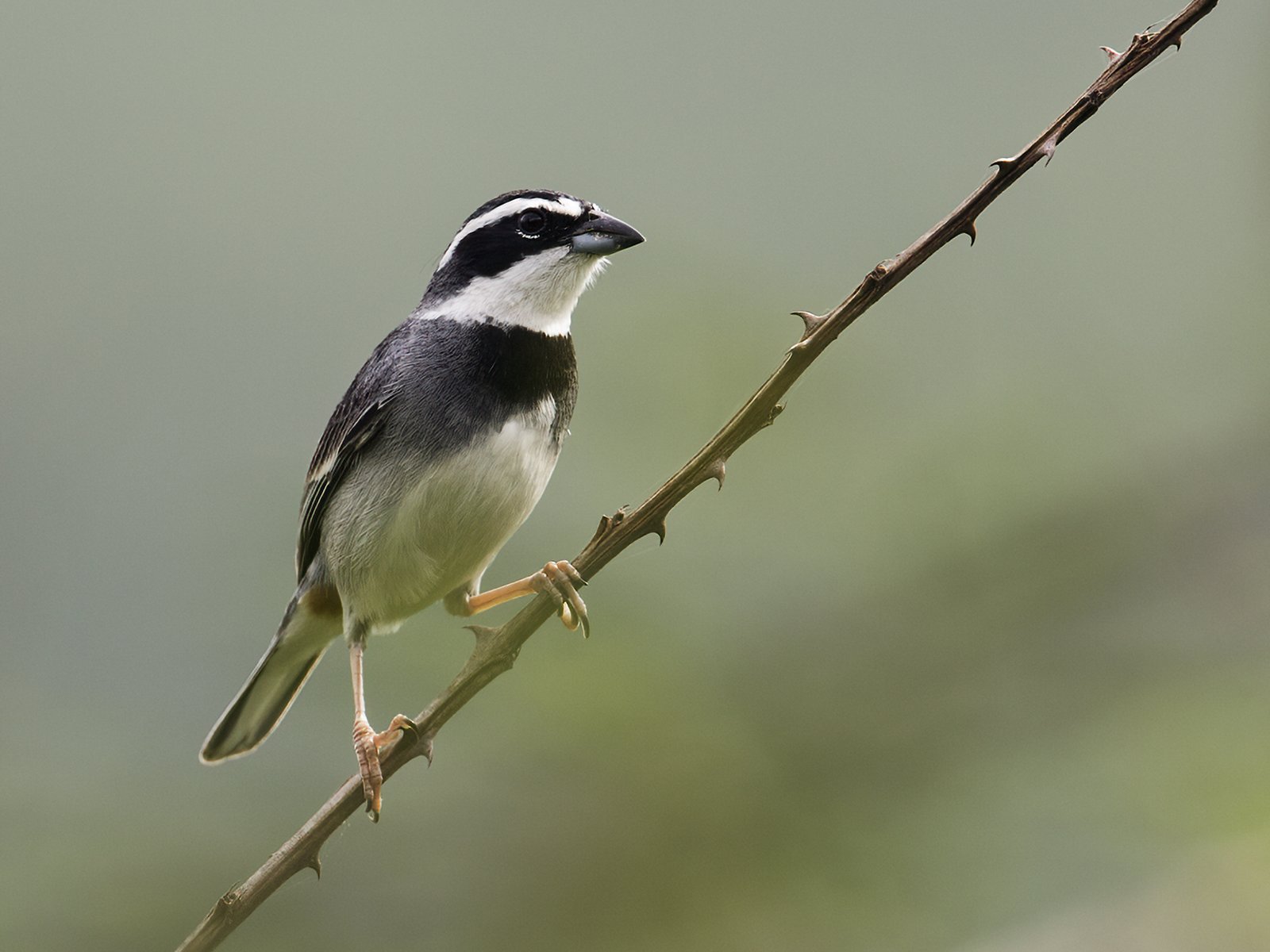
The Collared Warbling Finch is a small warbling finch of the dry lowlands along the Pacific coast of Ecuador and Peru. The male has a black mask and a black breast band between a white throat and a white belly. After wet years, such as during El Niño, it appears locally in larger numbers.
Voice
The song is a rapid, varied series of twittering and whistled notes, often from a shrub or wire. The call is a short tsip.
Recording: Paul Coopmans — CC BY-NC-SA 4.0 · xeno-canto
Identification
13–14 cm, with a pointed, grey bill. The male is grey above, with a blackish crown and cheeks, a long white supercilium, a white throat and a broad black breast band. The belly is white, the flanks grey. The tail is black with white corners. The female is greyish brown, with a whitish supercilium, fine grey streaks on the breast and a faint breast band. Young birds resemble the female.
Confusion species
Parrot-billed Seedeater Sporophila peruviana has a heavy, curved bill and a grey back without a white supercilium. Tumbes Sparrow Rhynchospiza stolzmanni is browner, with a rufous crown stripe and a pale bill. Rufous-breasted Warbling Finch Poospiza rubecula lives higher in the Andes and has rufous-orange underparts.
Habitat
Dry thorn scrub, dry forest, desert shrubs, lomas, riparian growth, and gardens and field edges in the coastal valleys, from sea level to about 2000 m, locally higher. It forages in shrubs and on the ground for seeds and insects, often in small groups outside the breeding season.
Where the bird is most at home, classified by the vegetation units of the Andes and the west coast.


Range and movements
In Ecuador in the dry south-west, from Manabí and Guayas to El Oro and Loja. In Peru along the coast and on the lower west slope from Tumbes south into the south of the country. Absent from Colombia, Bolivia and the Galápagos. Outside the guide area occasionally in the far north of Chile.
- Resident
- dark = core range, pale = thinly spread
How and when to look
Look in the shrubs of dry coastal valleys and lomas, especially after the rainy season, when the males sing from a high branch.
Conservation status
Least Concern. Widespread in the dry coastal region; numbers fluctuate with rainfall.
Scientific name
Poospiza hispaniolensis | Bonaparte, 1850
Bonaparte described the species in 1850 and placed it straight away in the genus where it still stands. The genus Poospiza was introduced in 1847 by Cabanis. The genus name combines Ancient Greek poa, 'grass', and spiza, 'finch'. The species name refers to Hispaniola, the supposed but erroneous origin of the type; the species lives in Ecuador and Peru. The specimen the first description was based on came from (per the description).