All species › Passerines › Tanagers and allies › Rufous-breasted Warbling Finch
Rufous-breasted Warbling Finch | Poospiza rubecula
Roodborstboomgors | Monterita pechirrufa | Quem-te-vestiu-de-peito-ruivo
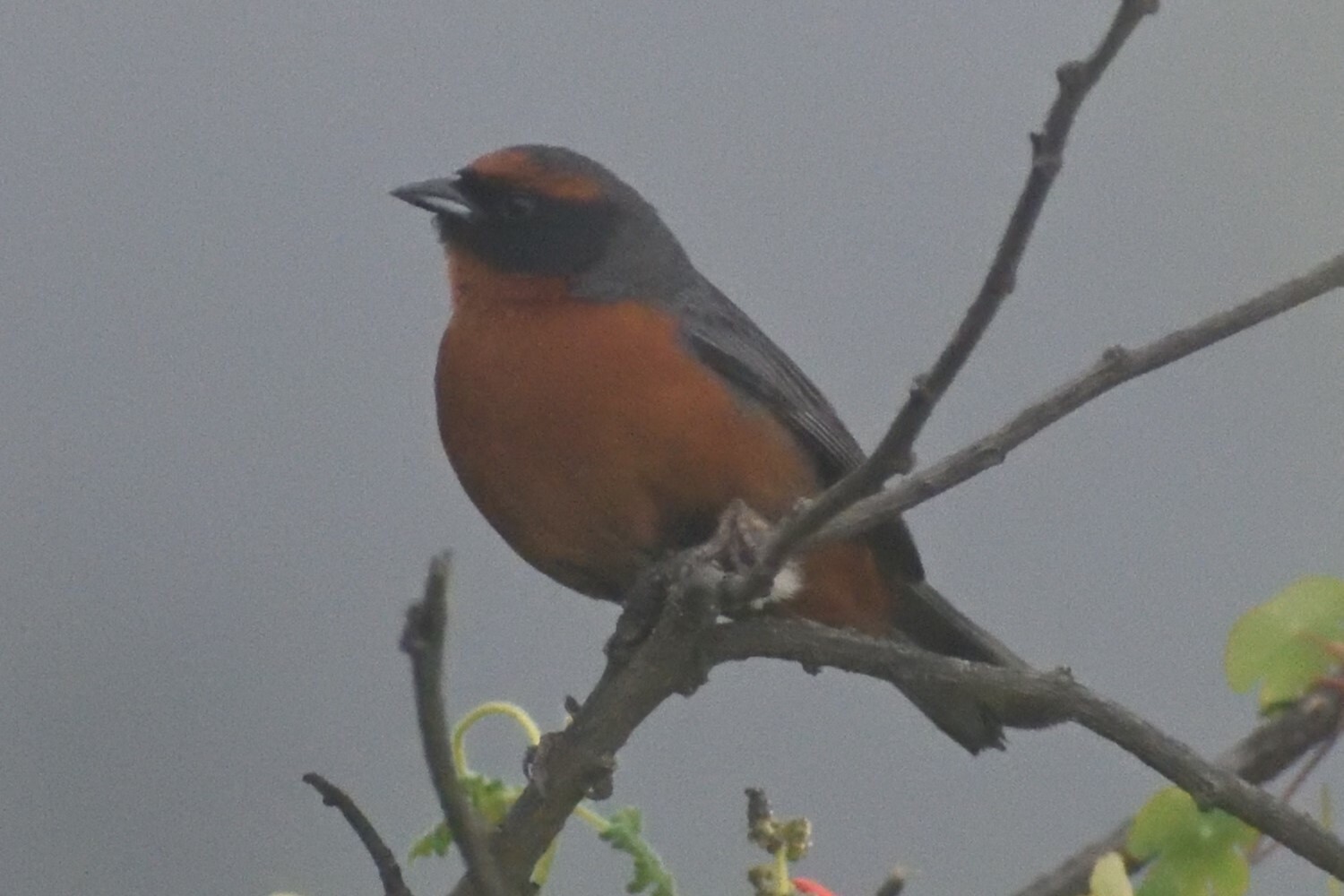
The Rufous-breasted Warbling Finch is a warbling finch endemic to the west slope of the Andes in Peru. The male combines a slate-grey back with a rufous-orange forehead, brow and underparts. The species is scarce and local, and lives in the remnants of native scrub and woodland.
Voice
The song is a short, rapid series of clear, chirping notes. The call is a thin, high tsit.
Recording: Juan Chalco — CC BY-NC-SA 4.0 · xeno-canto
Identification
16 cm, with a pointed, dark bill and a fairly long tail. The male is slate-grey above, with a rufous forehead and supercilium and blackish lores. The throat, breast and flanks are rufous-orange, the centre of the belly white. The tail is blackish with white corners. The female is duller, with a browner grey back and paler rufous underparts. Young birds are browner and faintly streaked on the breast.
Confusion species
Rufous-chested Tanager Thlypopsis ornata also has a rufous head and breast, but has an olive-grey back, a white belly, no black lores and a thinner bill, and lives in more humid forest. Collared Warbling Finch Poospiza hispaniolensis shows no rufous in the plumage and lives lower, in dry coastal country.
Habitat
Scrub and open native woodland on dry to semi-humid slopes and in ravines, also with Polylepis and along streams, roughly between 2000 and 3700 m. It forages in shrubs and low trees for insects and seeds, mostly in pairs, sometimes in small mixed groups.
Where the bird is most at home, classified by the vegetation units of the Andes and the west coast.


Range and movements
Only in Peru, on the west slope of the Andes from the north (Cajamarca) south to the department of Lima and locally further south. Absent from Colombia, Ecuador, Bolivia and the Galápagos. Endemic to the guide area.
- Resident
- dark = core range, pale = thinly spread
How and when to look
Search the wooded ravines and scrub above the western valleys, such as Bosque de Zárate near Lima. Pairs often show themselves early in the morning on top of a shrub.
Conservation status
Near Threatened. The population is small and fragmented; native scrub and woodland on the west slope are being lost to wood cutting, fires and grazing.
Scientific name
Poospiza rubecula | Salvin, 1895
Salvin described the species in 1895 and placed it straight away in the genus where it still stands. The genus Poospiza was introduced in 1847 by Cabanis. The genus name combines Ancient Greek poa, 'grass', and spiza, 'finch'. The species name is Latin rubecula, 'robin' (diminutive of ruber, 'red'), referring to the red breast. The specimen the first description was based on came from Huamachuco, La Libertad, Peru.