All species › Passerines › Tanagers and allies › Black-and-chestnut Warbling Finch
Black-and-chestnut Warbling Finch | Poospiza whitii
Kastanjebuikboomgors | Sietevestidos serrano | Quem-te-vestiu-serrano
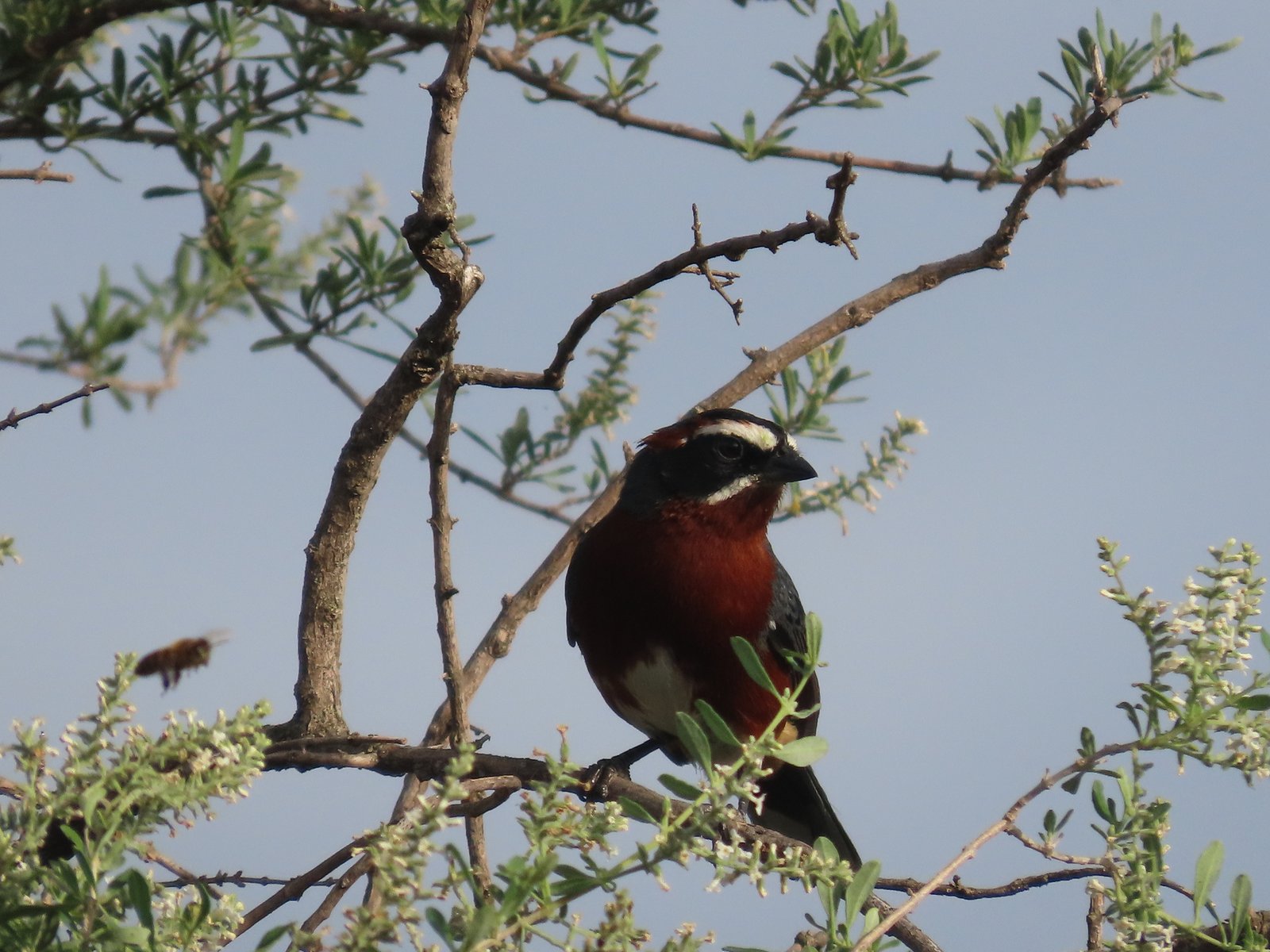
The Black-and-chestnut Warbling Finch is a dark warbling finch with chestnut underparts of scrub and forest edges on the slopes of the Andes in Bolivia and north-western Argentina. It was long included in Black-and-rufous Warbling Finch of the lowlands of Brazil and Paraguay and is now treated as a separate species. The contrast between the black head with white stripes and the chestnut breast is distinctive.
Voice
The song is a short, repeated series of clear, rather shrill notes, often given from a shrub. The call is a short chip.
Recording: Niels Krabbe — CC BY-NC-SA 3.0 · xeno-canto
Identification
14–15 cm, with a fairly long, pointed bill and a long, rounded tail with white corners. The male has a black head with a white eyebrow that turns dark chestnut at the rear, and a white moustachial stripe. Upperparts dark slate. Breast and flanks chestnut, belly whitish. The female is duller and browner. Young birds are browner, with faint streaks below.
Confusion species
Black-and-rufous Warbling Finch Poospiza nigrorufa is very similar, but lives in the lowlands of Brazil, Paraguay and Argentina, outside the guide area. Bolivian Warbling Finch Poospiza boliviana has a grey head, a white throat and greyish-brown upperparts. Rufous-breasted Warbling Finch Poospiza rubecula lives only in Peru and has a rufous forehead and a grey back. Rufous-sided Warbling Finch Poospizopsis hypocondria is grey above, with a white throat and a grey breast.
Habitat
Scrub, forest edges and open woodland on dry to semi-humid slopes, also thickets along streams and shrubby field edges, roughly between 1000 and 3500 m. It forages low in shrubs and on the ground, for insects and seeds. Little is known about the nest in the guide area.
Where the bird is most at home, classified by the vegetation units of the Andes and the west coast.


Range and movements
In Bolivia on the eastern slope and in the valleys of the Andes, from La Paz through Cochabamba and Santa Cruz to Chuquisaca and Tarija, with scattered records in Potosí. Absent from Colombia, Ecuador, Peru and the Galápagos. Outside the guide area in north-western Argentina, where it is more common.
- Resident
- dark = core range, pale = thinly spread
How and when to look
Search scrub and forest edges in the valleys of Santa Cruz and Cochabamba and in southern Tarija; the birds keep low in the shrubs.
Conservation status
Least Concern. The range is fairly large and the species tolerates some disturbance; it also occurs in secondary scrub and along fields.
Scientific name
Poospiza whitii | Sclater, 1883
Sclater described the species in 1883 and placed it straight away in the genus where it still stands. The genus Poospiza was introduced in 1847 by Cabanis. The genus name combines Ancient Greek poa, 'grass', and spiza, 'finch'. The species name honours Ernest William White, who collected several specimens in Argentina. The specimen the first description was based on came from Cosquín, Córdoba, Argentina.