All species › Passerines › Tanagers and allies › Bolivian Warbling Finch
Bolivian Warbling Finch | Poospiza boliviana
Boliviaanse boomgors | Monterita boliviana | Quem-te-vestiu-boliviano
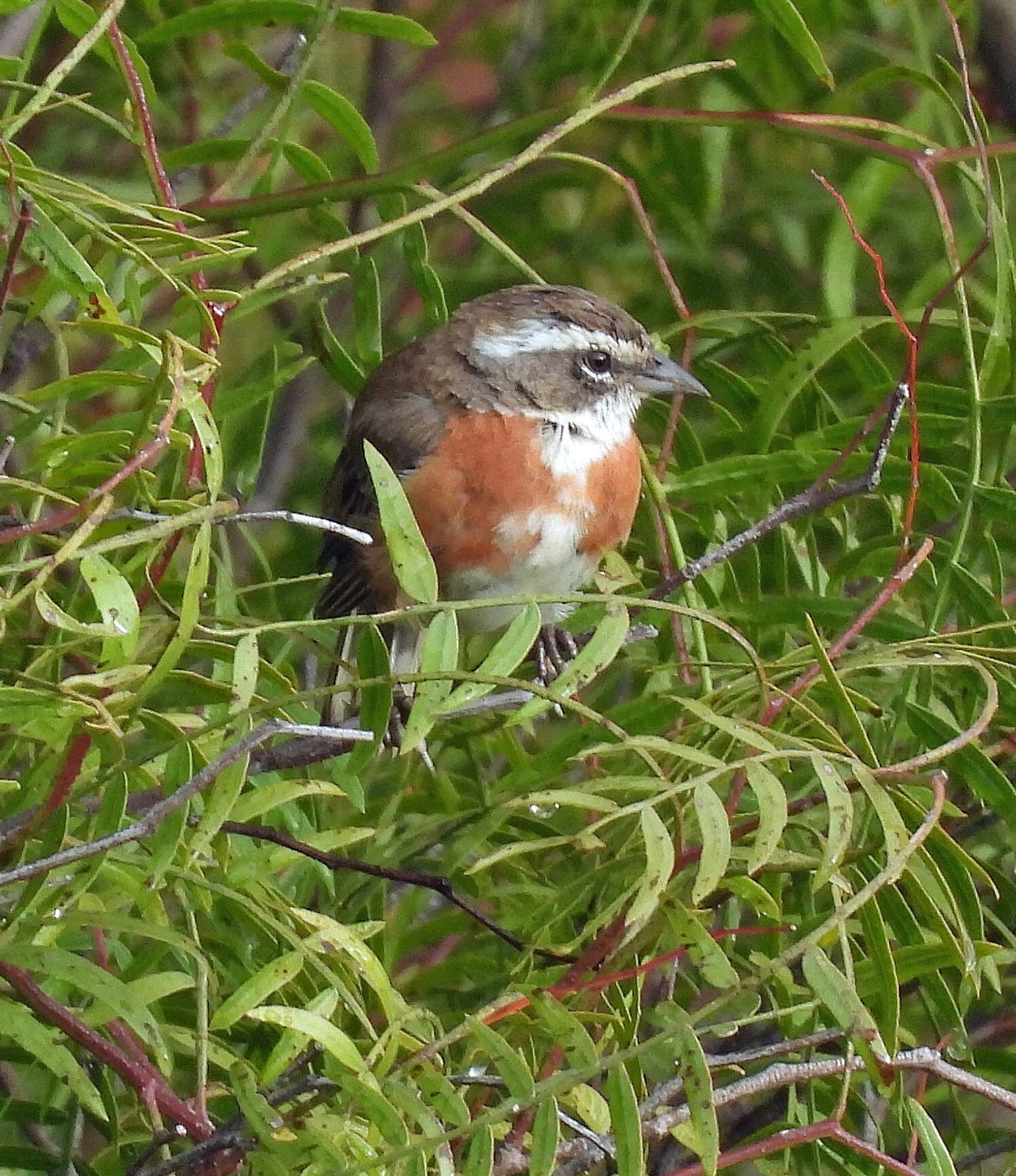
The Bolivian Warbling Finch is a fairly large warbling finch of scrub and dry valleys in the Andes, almost restricted to Bolivia. Grey upperparts, a long white eyebrow, a white throat and a rufous breast and flanks make up its appearance. It is related to the smaller Rufous-sided Warbling Finch, which occurs in the same region.
Voice
The song has hardly been described. The call is a sharp tweep.
Recording: GABRIEL LEITE — CC BY-NC-SA 4.0 · xeno-canto
Identification
15–16 cm, with a small, pointed, dark grey bill and blackish legs. Crown grey, with a long white eyebrow against a dark grey face. Upperparts greyish brown; wings greyish brown with rufous edges to the secondaries. Tail dusky, with broad white tips to the outer feathers. Throat white, breast and flanks rufous-chestnut, belly and undertail coverts white to buffy white. Sexes alike. Young birds are paler and duller, with a buffy eyebrow and faint streaks below.
Confusion species
Rufous-sided Warbling Finch Poospizopsis hypocondria is smaller, with a blackish moustachial stripe, a grey breast and rufous only on the flanks. Cochabamba Mountain Finch Poospiza garleppi is larger and has a rufous face and rufous underparts without a white throat; it lives in Polylepis woodland higher up. Black-and-chestnut Warbling Finch Poospiza whitii has a black head and dark slate upperparts. Collared Warbling Finch Poospiza hispaniolensis lacks rufous on the breast.
Habitat
Dry to semi-humid scrub, open woodland, shrubby slopes and thickets along streams in the dry valleys of the Andes, roughly between 1600 and 3100 m. It forages in shrubs and on the ground, for insects and seeds. Little is known about the nest.
Where the bird is most at home, classified by the vegetation units of the Andes and the west coast.


Range and movements
In Bolivia in the Andes, from eastern La Paz through Cochabamba and western Santa Cruz to western Chuquisaca and Tarija, with a few records in Potosí. Absent from Colombia, Ecuador, Peru and the Galápagos. Outside the guide area only in the far north-west of Argentina (Salta).
- Resident
- dark = core range, pale = thinly spread
How and when to look
Search shrubby dry valleys around Cochabamba and in western Santa Cruz; the birds forage in pairs or small groups in the shrubs and low on the ground.
Conservation status
Least Concern. The range is limited, but the species is locally fairly common and tolerates a degree of grazing and clearing.
Scientific name
Poospiza boliviana | Sharpe, 1888
Sharpe described the species in 1888 and placed it straight away in the genus where it still stands. The genus Poospiza was introduced in 1847 by Cabanis. The genus name combines Ancient Greek poa, 'grass', and spiza, 'finch'. The species name refers to Bolivia. The specimen the first description was based on came from Bolivia.