All species › Passerines › Gnateaters › Chestnut-belted Gnateater
Chestnut-belted Gnateater | Conopophaga aurita
Cayennemuggeneter | Jejenero fajicastaño | Chupa-dente-de-cinta
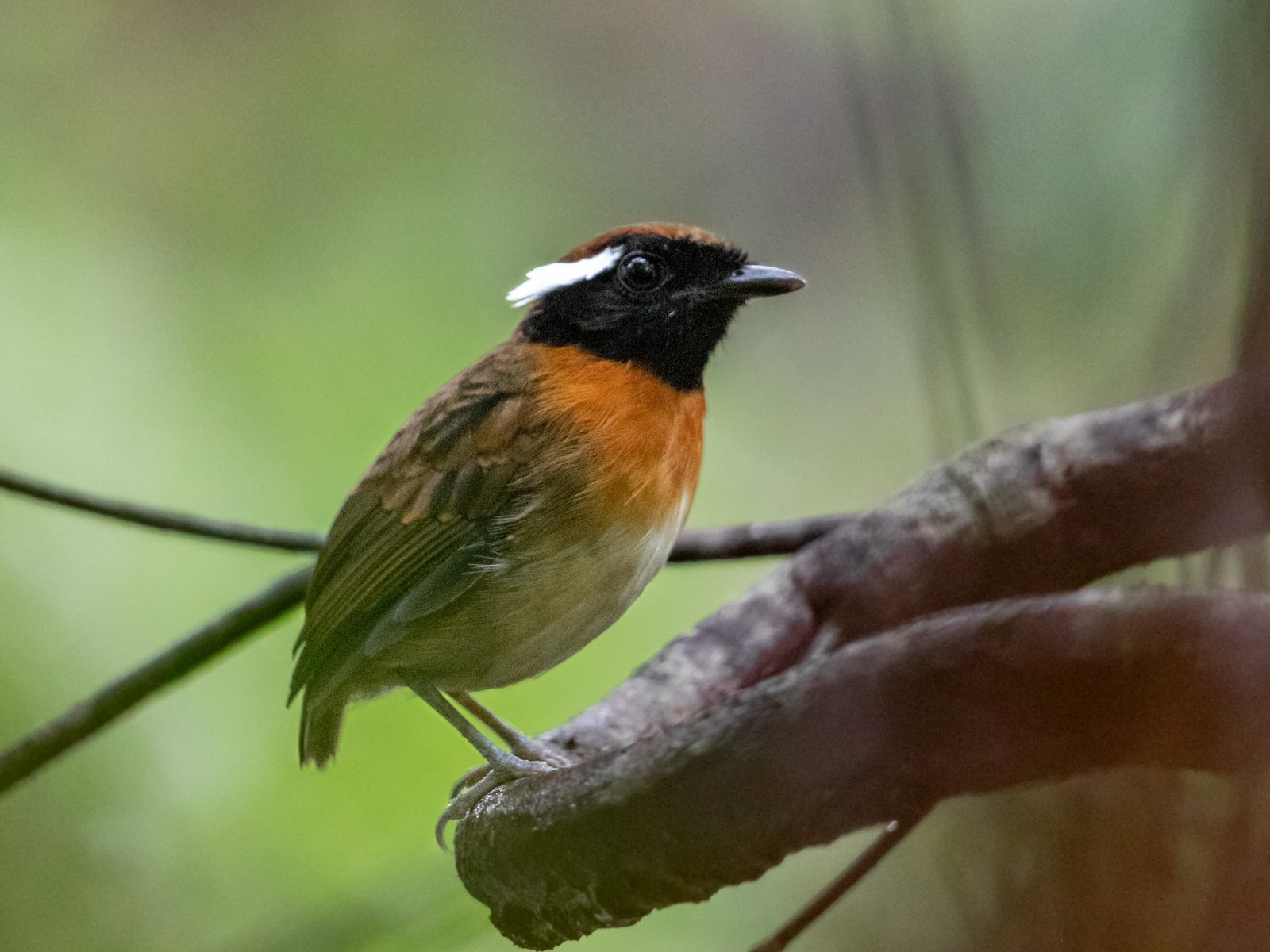
The Chestnut-belted Gnateater is a small, round ground bird of Amazonian lowland forest, with a conspicuous white tuft behind the eye. Gnateaters perch low, often crosswise on a vertical stem, and drop to the ground to take prey. The male stands out with a black face above a chestnut breast band.
Voice
The song is a series of short, somewhat hoarse, frog-like notes; the call is a short, sharp chek. On take-off the wings make a whirring sound.
Recording: Juan Freile — CC BY-NC-SA 4.0 · xeno-canto
Identification
12–13 cm, round and short-tailed, on long pinkish-grey legs, with a fairly stout bill. The crown and upperparts are brown, often tinged rufous, and behind the eye runs a white supercilium ending in a tuft. The male has a black forehead, face and throat, a chestnut breast and a white to buff belly. The female has a rufous face, throat and breast, with a pale belly.
Confusion species
Ash-throated Gnateater Conopophaga peruviana overlaps in Ecuador and Peru; the male has a grey face and grey breast without black. Females of the two species are very similar; look for an accompanying male and listen to the voice. Ringed Antpipit Corythopis torquatus walks on the ground, has a longer tail, a white throat and a black-streaked breast band, and no tuft behind the eye.
Habitat
The undergrowth of humid terra firme lowland forest, especially at treefalls and in vine tangles, up to about 600 m. It lives alone or in pairs, low above the ground, and eats small insects and spiders picked from leaves and the ground. The nest is a shallow cup low in the undergrowth.
Where the bird is most at home, classified by the vegetation units of the Andes and the west coast.


Range and movements
In Colombia in the Amazonian lowlands of the south-east. In Ecuador in the north-eastern lowlands. In Peru in the north-eastern lowlands, mainly in Loreto. Absent from Bolivia and the Galápagos. Outside the guide area in Brazilian Amazonia and the Guianas.
- Resident
- dark = core range, pale = thinly spread
How and when to look
Search at treefalls and dense spots along trails in terra firme forest and look low in the undergrowth. Birds often sit still on a stem for a long time and give themselves away by the whirr of their wings.
Conservation status
Least Concern. Widespread in large lowland forest.
Scientific name
Conopophaga aurita | (Gmelin, 1789)
Gmelin described the species in 1789 as Turdus auritus; because it was later moved to another genus, the author and year stand in brackets. The genus Conopophaga was introduced in 1816 by Vieillot. The genus name comes from Ancient Greek kōnōps, 'gnat', and -phagos, '-eating': 'gnat-eater'. The species name comes from Latin auritus, 'eared', for the white tufts behind the eye. The specimen the first description was based on came from Cayenne, French Guiana.