All species › Passerines › Gnateaters › Rufous-crowned Antpitta
Rufous-crowned Antpitta | Pittasoma rufopileatum
Roodkruinmierpitta | Tororoí cejinegro | Tovacuçu-de-coroa-ruiva
The Rufous-crowned Antpitta is a chunky ground bird of the Chocó rainforest, with a rufous crown above a broad black stripe. Despite the name, the genus Pittasoma does not belong to the true antpittas but to the gnateater family. It lives hidden on the forest floor and sometimes follows army-ant swarms.
Voice
The song is a piercing, descending whistle, keeee-yurh, repeated at intervals. When alarmed a decelerating chatter.
Recording: Iván Lau — CC BY-NC-SA 4.0 · xeno-canto
Identification
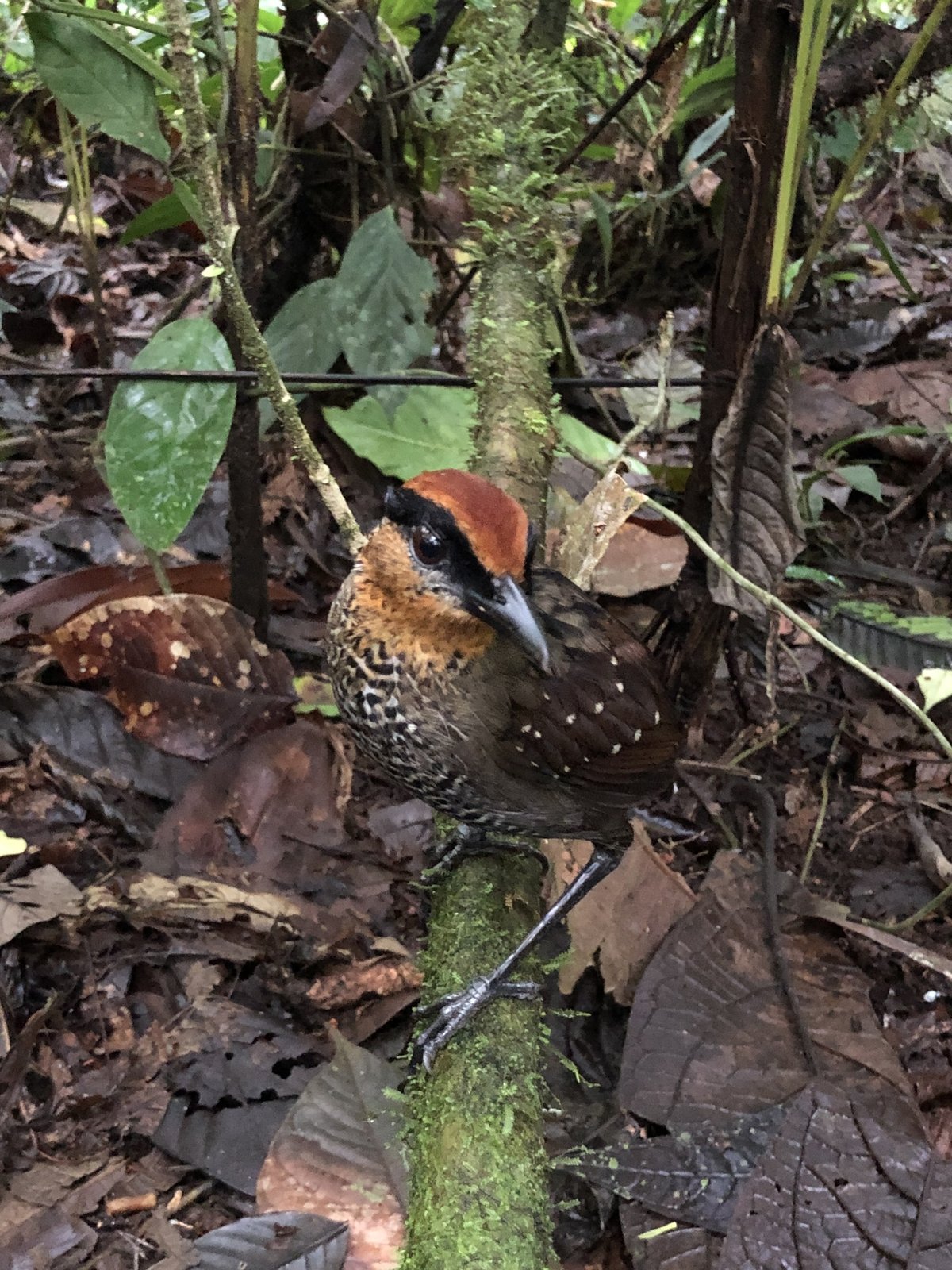
16–18 cm, round and almost tailless, on long grey legs, with a heavy bill. The male has a bright rufous crown, below it a broad black band from bill to nape, and a yellowish to rufous face. The upperparts are olive-brown with black scaling, and the wings have small white spots. The throat and undertail coverts are buff, the rest of the underparts yellowish with wavy black bars. The female has a duller crown, a narrower black band and less barring. In northern Colombia birds have a wholly rufous head and almost unbarred underparts.
Confusion species
Streak-chested Antpitta Hylopezus perspicillatus is smaller, with a grey crown, a pale eye-ring and black-streaked, whitish underparts. Thicket Antpitta Myrmothera dives is smaller and plain brown with orange-brown flanks. Black-headed Antthrush Formicarius nigricapillus is dark, with a black head, and walks with its tail cocked. The sister species Black-crowned Antpitta Pittasoma michleri of Central America has a black crown.
Habitat
The floor of humid lowland and foothill forest in the Chocó, up to about 1100 m. It lives alone or in pairs in the forest interior. Little is known about its diet; insects and spiders have been found in the stomach. Almost nothing is known about its breeding.
Where the bird is most at home, classified by the vegetation units of the Andes and the west coast.


Range and movements
In Colombia along the Pacific coast and on the western slope of the Western Andes, from Chocó south to Nariño. In Ecuador in the north-west, mainly in Esmeraldas and western Pichincha. Absent from Peru, Bolivia and the Galápagos. Does not occur outside the guide area.
- Resident
- dark = core range, pale = thinly spread
How and when to look
Listen early in the morning in large, undisturbed lowland and foothill forest in north-western Ecuador and the Colombian Chocó for the piercing whistle. Also watch army-ant swarms, where it sometimes forages on the ground together with antthrushes and woodcreepers.
Conservation status
Near Threatened. The population is declining because of rapid deforestation in the lowlands and foothills of the Chocó.
Scientific name
Pittasoma rufopileatum | Hartert, 1901
Hartert described the species in 1901 and placed it straight away in the genus where it still stands. The genus Pittasoma was introduced in 1860 by Cassin. The genus name is formed from the genus Pitta and Greek sōma, 'body', for the pitta-like build. The species name comes from Latin rufus, 'rufous', and pileatus, 'capped', for the rufous crown. The specimen the first description was based on came from Bulun, Esmeraldas, Ecuador.