All species › Passerines › Crescentchests › Elegant Crescentchest
Elegant Crescentchest | Melanopareia elegans
Bonte maansluiper | Pecholuna elegante | Tapaculo-de-tumbes
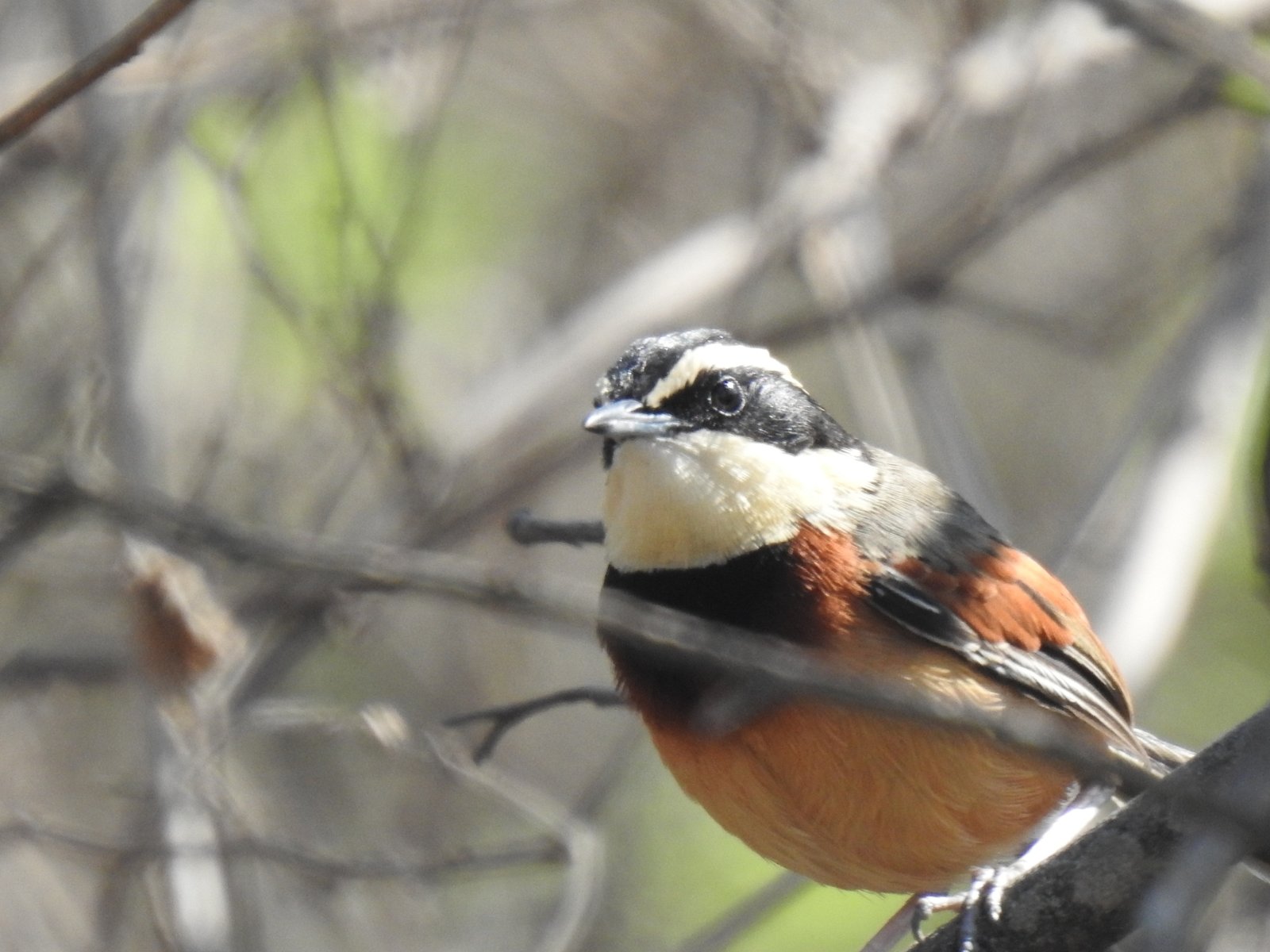
This crescentchest is a bird of Tumbesian dry forest in western Ecuador and north-western Peru. With its black crown, white wing stripe and black breast band it is the most contrastingly marked species in the family. It lives low in scrub and often sings from cover.
Voice
A fast series of dry, chipping notes, often repeated at length from scrub, mainly in the morning and after rain. Also short, dry calls.
Recording: Juan Freile — CC BY-NC-SA 4.0 · xeno-canto
Identification
14–15 cm, with a long tail, short, rounded wings and a thin bill. The crown is black, the upperparts greyish brown, with a conspicuous white stripe along the scapulars and wing coverts. A white supercilium separates the crown from a black mask. The throat is pale buff, the breast carries a black crescent, often with a narrow rufous zone below it, and the rest of the underparts are cinnamon to ochre. The female has a browner crown and is slightly duller.
Confusion species
Maranon Crescentchest Melanopareia maranonica is larger, with darker upperparts and deep chestnut underparts, and lives in the Marañón valley. No other crescentchest occurs in the Tumbesian region; other small birds of the dry forest lack the combination of black mask and black breast band.
Habitat
Dry forest and thorn scrub with dense undergrowth, shrubby forest edges and thickets, from sea level to about 2500 m in the mountains of south-western Ecuador and north-western Peru. It forages low in the vegetation and on the ground for insects. The nest is a cup of grass, low in a shrub or grass tussock.
Where the bird is most at home, classified by the vegetation units of the Andes and the west coast.


Range and movements
Ecuador: in the west, from Manabí and Guayas south through El Oro to Loja. Peru: in the north-west, in Tumbes, Piura, Lambayeque and Cajamarca, south to La Libertad, and in the upper Marañón. Absent from Colombia, Bolivia and the Galápagos. It does not occur outside the guide area.
- Resident
- dark = core range, pale = thinly spread
How and when to look
Listen in dry forest and scrub in south-western Ecuador or near Tumbes and Piura in Peru for the fast, dry series. After the first rains the bird is more active; wait near an opening in the scrub until it appears low down.
Conservation status
Least Concern. Tumbesian dry forest is heavily fragmented by woodcutting, agriculture and goat grazing, but the species also occurs in degraded scrub.
Scientific name
Melanopareia elegans | (Lesson, 1844)
Lesson described the species in 1844 as Synallaxis elegans; because it was later moved to another genus, the author and year stand in brackets. The genus Melanopareia was introduced in 1853 by Reichenbach. The genus name combines Greek melas, 'black', with parēion, 'cheek'. The species name is Latin elegans, 'fine, neatly marked'. The specimen the first description was based on came from Guayaquil, Ecuador.