All species › Passerines › Crescentchests › Maranon Crescentchest
Maranon Crescentchest | Melanopareia maranonica
Marañónmaansluiper | Pecholuna del Marañón | Tapaculo-do-marañón
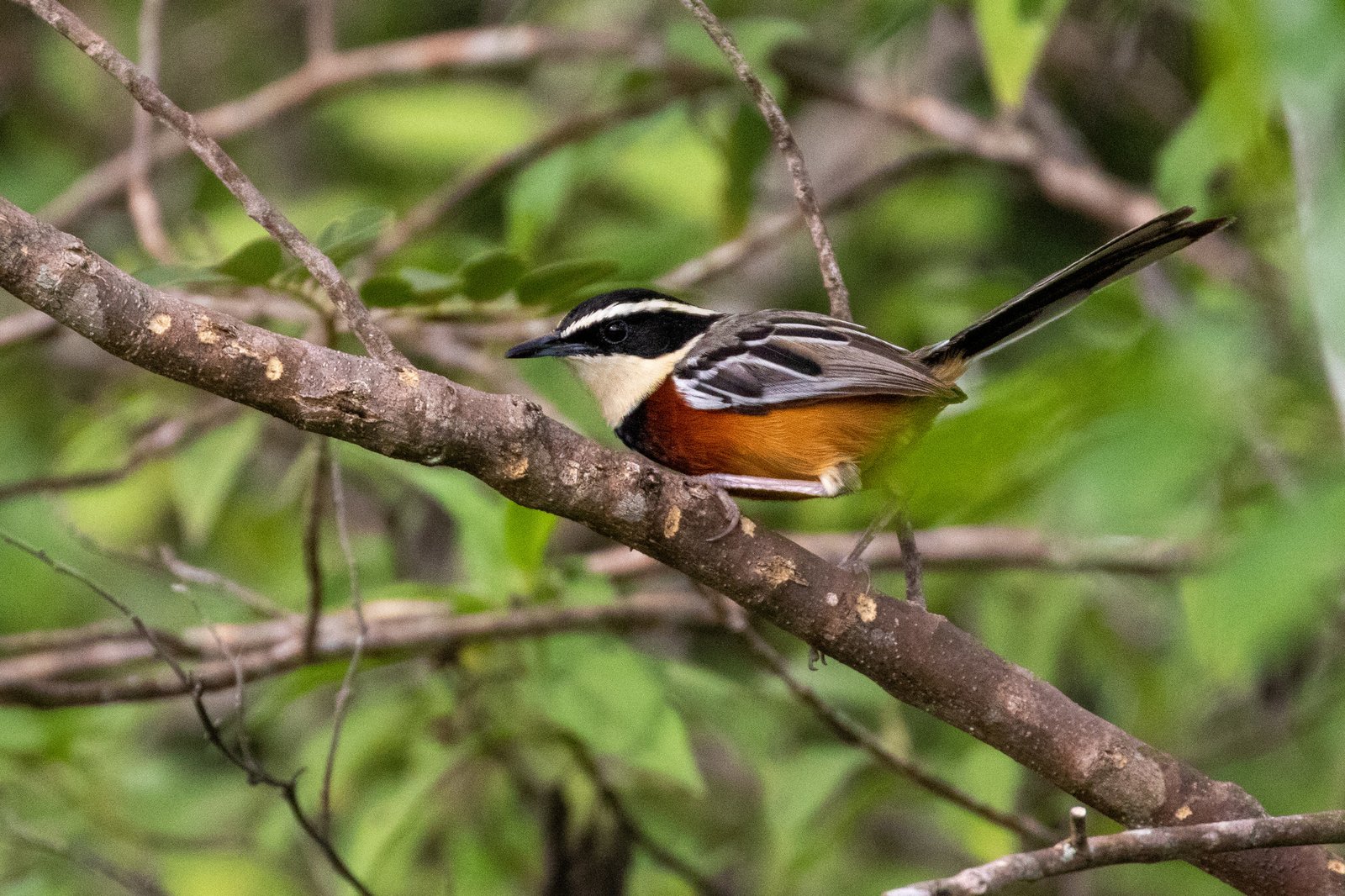
The Maranon Crescentchest is the largest crescentchest and lives only in the dry scrub of the Marañón valley and adjacent valleys in northern Peru and southern Ecuador. It is one of the many birds restricted to this isolated dry valley. It keeps hidden in dense scrub.
Voice
A series of hollow, short notes that accelerate, often sung from cover, mainly in the early morning. Also dry, short calls.
Recording: Jerome Fischer — CC BY-NC-SA 4.0 · xeno-canto
Identification
16 cm, with a long tail, short, rounded wings and a thin bill. The crown and upperparts are dark brown to blackish, with a white stripe along the scapulars and wing coverts. A narrow white supercilium lies above a black mask. The throat is pale buff, below it a broad black crescent across the breast; the rest of the underparts are deep rufous to chestnut. The sexes are nearly alike.
Confusion species
Elegant Crescentchest Melanopareia elegans is smaller, with greyer upperparts and paler, cinnamon underparts, and lives mainly west of the Andes; a form of that species occurs in the upper Marañón, but the ranges barely meet. No other bird in this valley combines a black breast band with rufous underparts.
Habitat
Dry scrub, thorn scrub and dry forest with dense undergrowth on the slopes of the Marañón valley and side valleys, roughly between 400 and 1800 m. It forages low in the vegetation and on the ground for insects. Little is known of the nest; it is presumably placed low in dense scrub.
Where the bird is most at home, classified by the vegetation units of the Andes and the west coast.

Range and movements
Peru: in the Marañón valley and side valleys in Cajamarca and Amazonas, and the Chinchipe valley. Ecuador: only in the far south, in the Chinchipe valley in Zamora-Chinchipe. Absent from Colombia, Bolivia and the Galápagos. It does not occur outside the guide area.
- Resident
- dark = core range, pale = thinly spread
How and when to look
Visit the dry slopes along the Marañón near Jaén and Bagua or the Chinchipe valley near Zumba and listen in the early morning for the hollow, accelerating series. The bird usually stays low and hidden; wait near an opening in the scrub.
Conservation status
Least Concern according to the current assessment, but with a small range. The dry scrub of the Marañón valley is disappearing through expansion of rice and fruit growing, grazing and woodcutting.
Scientific name
Melanopareia maranonica | Chapman, 1924
Chapman described the species in 1924 and placed it straight away in the genus where it still stands. The genus Melanopareia was introduced in 1853 by Reichenbach. The genus name combines Greek melas, 'black', with parēion, 'cheek'. The species name refers to the Marañón valley in Peru. The specimen the first description was based on came from Perico, Río Chinchipe, Peru.