All species › Passerines › Crescentchests › Olive-crowned Crescentchest
Olive-crowned Crescentchest | Melanopareia maximiliani
Olijfkruinmaansluiper | Pecholuna del Chaco | Tapaculo-de-coroa-oliva
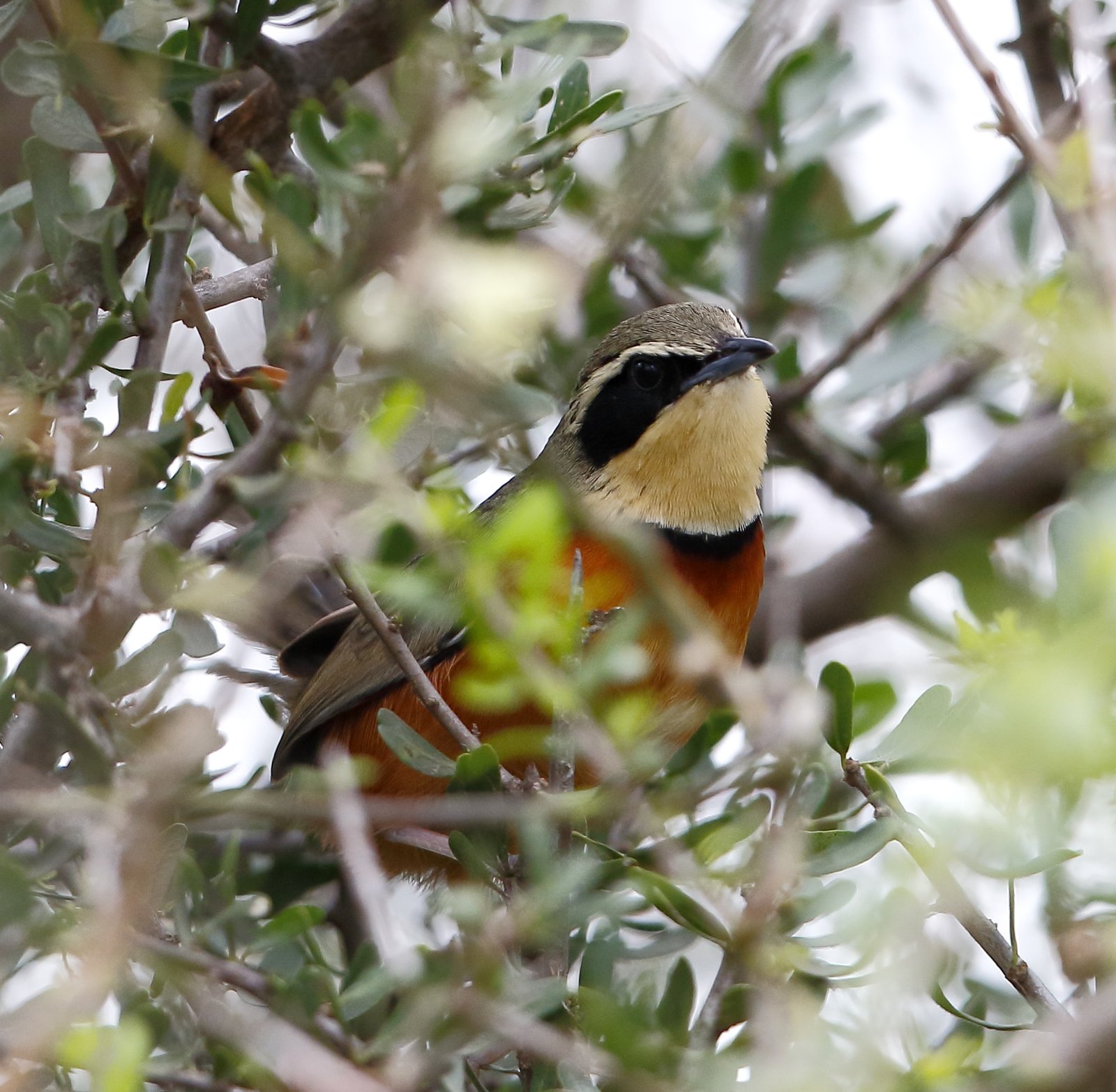
The Olive-crowned Crescentchest is the crescentchest of Bolivia, where it lives both in the Chaco and on the shrubby Andean slopes. It keeps low in dense vegetation and is mainly noticed by its song. The black crescent on the breast contrasts with the deep cinnamon underparts.
Voice
A series of clear, short notes in an even rhythm, often repeated at length from cover, mainly in the morning. Also dry, ticking calls.
Recording: Niels Krabbe — CC BY-NC-SA 4.0 · xeno-canto
Identification
15 cm, with a long, narrow tail, short, rounded wings and a thin bill. The crown and upperparts are olive-brown. A pale, white to yellowish supercilium runs above a black mask. The throat is pale buff, the breast carries a black crescent, and the rest of the underparts are deep cinnamon to rusty brown. The sexes are nearly alike; juveniles are duller, with a fainter breast band.
Confusion species
Collared Crescentchest Melanopareia torquata, in the cerrado of eastern Bolivia, has a rufous nape band, a browner crown and paler, ochre-buff underparts. No other crescentchests occur in Bolivia. Tapaculos such as the Scytalopus species are dark grey and lack the black breast band.
Habitat
Dry to fairly humid scrub, grassland with shrubs and forest edges, both in the dry inter-Andean valleys and on the eastern slope, locally up to about 3000 m, and in the shrubby lowlands of the Chaco. It forages low in the vegetation and on the ground for insects. The nest is placed low in a grass tussock or shrub.
Where the bird is most at home, classified by the vegetation units of the Andes and the west coast.


Range and movements
Only in Bolivia: in the Andes and dry valleys from La Paz south through Cochabamba and western Santa Cruz to Chuquisaca and Tarija, and in the Chaco in the south-east. Absent from Colombia, Ecuador, Peru and the Galápagos. Outside the guide area in the Chaco of Paraguay and northern Argentina.
- Resident
- dark = core range, pale = thinly spread
How and when to look
In the morning, listen along shrubby slopes in the dry valleys of Cochabamba and Chuquisaca, or in Chaco scrub, for the repeated clear notes. Wait quietly near the source of the song; the bird sometimes climbs briefly to a higher branch.
Conservation status
Least Concern. The species has a large range and tolerates some disturbance of scrub; conversion of the Chaco to farmland reduces its habitat locally.
Scientific name
Melanopareia maximiliani | (d'Orbigny, ACVMD, 1838)
D'Orbigny, ACVMD described the species in 1838 as Synallaxis Maximiliani; because it was later moved to another genus, the author and year stand in brackets. The genus Melanopareia was introduced in 1853 by Reichenbach. The genus name combines Greek melas, 'black', with parēion, 'cheek'. The species name honours Prince Maximilian of Wied-Neuwied (1782–1867), German naturalist who explored Brazil and North America. The specimen the first description was based on came from Yungas, Bolivia.