All species › Passerines › Crescentchests › Collared Crescentchest
Collared Crescentchest | Melanopareia torquata
Diadeemmaansluiper | Pecholuna brasileño | Tapaculo-de-colarinho
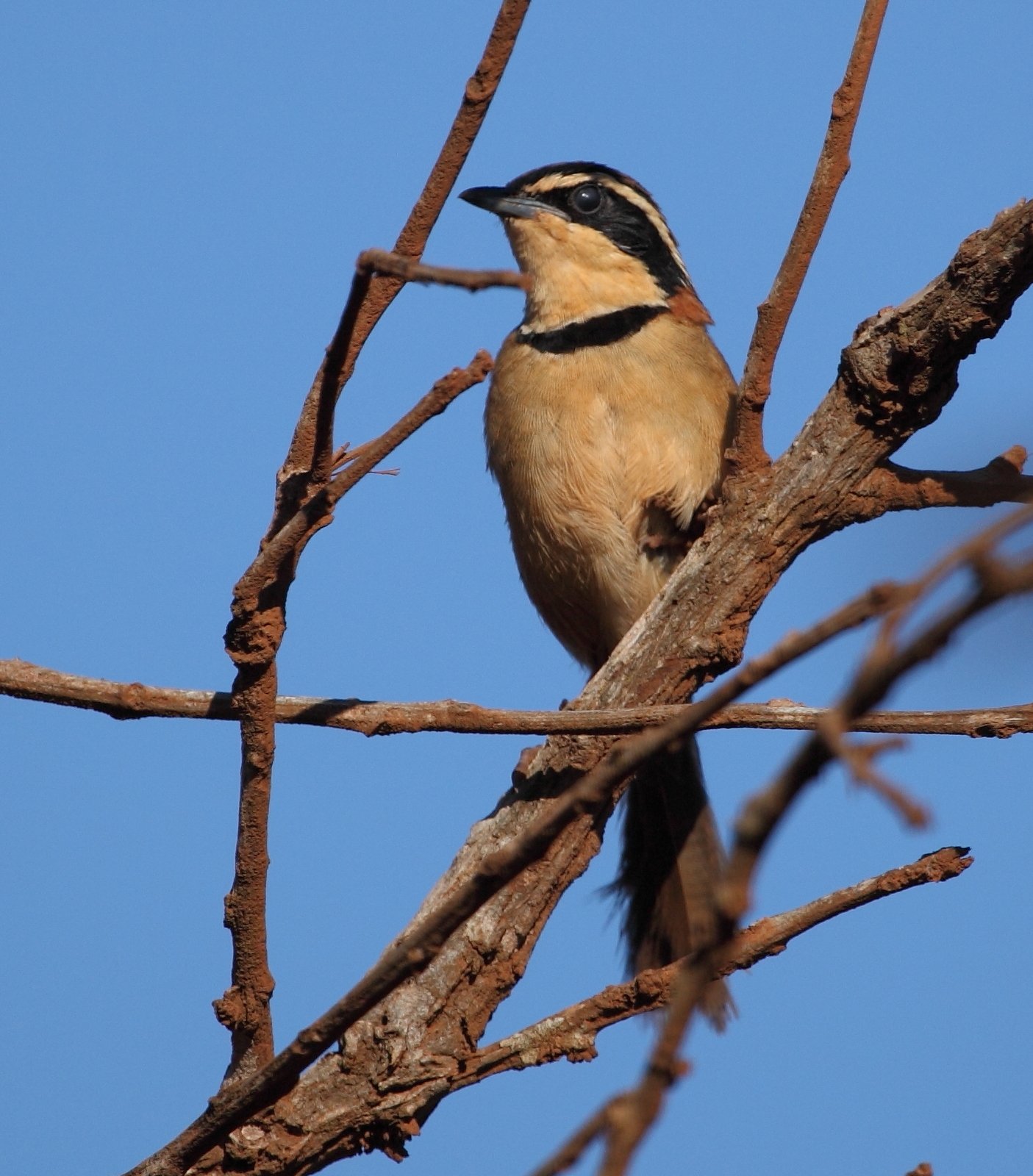
The Collared Crescentchest is a small, shy songbird of the cerrado in the heart of South America. Together with the other crescentchests it forms a family of its own, related to the tapaculos, and it is named after the black crescent across the breast. In the guide area it occurs only in the cerrado of eastern Bolivia.
Voice
A series of short, dry, high notes, often repeated at length from cover or from a low lookout, mainly in the early morning. Also short, shrill calls.
Recording: Jacob Wijpkema — CC BY-NC-SA 4.0 · xeno-canto
Identification
14–15 cm, with a fairly long, narrow tail that is often slightly cocked, short, rounded wings and a thin bill. The crown and upperparts are brown, with a rufous band across the nape. A white supercilium separates the crown from a black mask. The throat is pale buff, below it lies a broad black breast band shaped like a crescent; the rest of the underparts are warm ochre-buff. The wings show pale edges. The sexes are nearly alike; juveniles are duller, with an indistinct breast band.
Confusion species
Olive-crowned Crescentchest Melanopareia maximiliani lacks the rufous nape band, has an olive-brown crown and deep cinnamon underparts, and lives in the Chaco and on the Andean slopes, not in the cerrado. Other birds with a black breast band in the same habitat are much larger or have a thick seed-eater bill.
Habitat
Open cerrado with grassland, scattered shrubs and low trees, often on rocky or sandy soil, also campo rupestre on plateaus; in the guide area in the lowlands and on low plateaus. It feeds on insects and other small invertebrates on and just above the ground. The nest is a cup of grass, low in a grass tussock or shrub.
Where the bird is most at home, classified by the vegetation units of the Andes and the west coast.


Range and movements
In Bolivia only in the east of Santa Cruz department, in the cerrado of the plateaus and savannas near the Brazilian border. Absent from Colombia, Ecuador, Peru and the Galápagos. Outside the guide area in the cerrado of central Brazil and north-eastern Paraguay.
- Resident
- dark = core range, pale = thinly spread
How and when to look
In the early morning, listen in open cerrado with shrubs for the series of dry notes. A singing bird sometimes sits briefly in the open on top of a shrub or grass tussock; afterwards it quickly disappears into the vegetation.
Conservation status
Least Concern. Its habitat, the cerrado, is disappearing on a large scale through conversion to cropland and pasture and through frequent fires; in Bolivia the species is confined to a small area.
Scientific name
Melanopareia torquata | (Wied-Neuwied, 1831)
Wied-Neuwied described the species in 1831 as Synallaxis torquatus; because it was later moved to another genus, the author and year stand in brackets. The genus Melanopareia was introduced in 1853 by Reichenbach. The genus name combines Greek melas, 'black', with parēion, 'cheek'. The species name is Latin torquatus, 'collared', after the breast band. The specimen the first description was based on came from Bahia–Minas Gerais border, Brazil.