All species › Passerines › Tyrant flycatchers and allies › Least Flycatcher
Least Flycatcher | Empidonax minimus
Kleine feetiran | Mosquero mínimo | Papa-moscas-mínimo
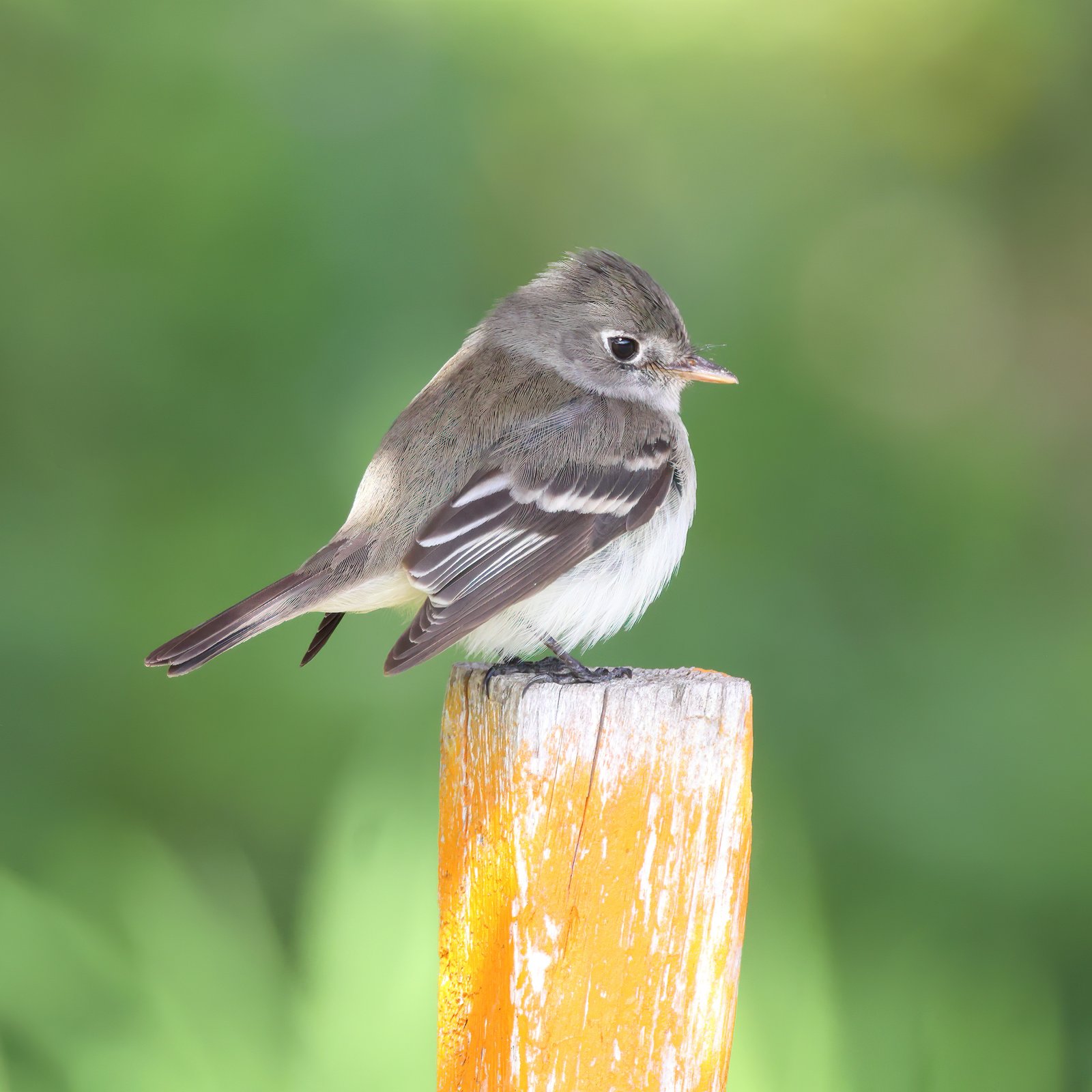
The Least Flycatcher is the smallest Empidonax of eastern North America. It breeds in deciduous and mixed woodland of Canada and the northern United States and winters from Mexico to Panama. In the guide area it is only a very rare vagrant.
Voice
The call is a dry, sharp whit. The song, a rapidly repeated, dry che-BEK, is sometimes heard on the wintering grounds in spring.
Recording: Mario Reyes Jr — CC BY-NC-SA 4.0 · xeno-canto
Identification
13 cm. Small and compact, with a relatively large head, a small bill and short primary projection. The upperparts are greyish olive, the head often greyer. A bold, broad white eye-ring gives a 'spectacled' look. Throat white, breast pale grey, belly whitish with a faint yellow tinge. The dark wings show two sharp white wing-bars. It often flicks its tail and wings. Sexes alike.
Confusion species
Alder Flycatcher Empidonax alnorum and Willow Flycatcher Empidonax traillii are larger and browner, with a broader bill, longer primary projection and a weak eye-ring. Yellow-bellied Flycatcher Empidonax flaviventris has a yellow throat and belly. Euler's Flycatcher Lathrotriccus euleri is browner, with cinnamon-buff wing-bars.
Habitat
On the wintering grounds in forest edges, secondary forest, scrub, gardens and plantations with shade trees, mostly in the lower and middle storeys. It catches insects with short sallies and often returns to a different twig. Breeds in North America in a cup in a tree fork.
Where the bird is most at home, classified by the vegetation units of the Andes and the west coast.


Range and movements
Colombia: very rare vagrant, with only a few records. No or hardly any records are known from Ecuador, Peru and Bolivia. Absent from the Galápagos. Winters from Mexico to Panama, scarce as far as Costa Rica and Panama.
How and when to look
A record in the guide area is exceptional. With a small, greyish Empidonax, check for the broad white eye-ring and the dry whit, and document the bird with photographs and sound recordings.
Conservation status
Least Concern. Common on the breeding grounds, with a decline in the east; in the guide area a very rare vagrant.
Scientific name
Empidonax minimus | (Baird & Baird, 1843)
Baird & Baird described the species in 1843 as Tyrannula minima; because it was later moved to another genus, the author and year stand in brackets. The genus Empidonax was introduced in 1855 by Cabanis. The genus name combines Ancient Greek empis, 'gnat', with anax, 'lord' or 'master': 'lord of the gnats'. Latin minimus, 'smallest'. The specimen the first description was based on came from Carlisle, Pennsylvania, United States.