All species › Passerines › Tyrant flycatchers and allies › Yellow-bellied Flycatcher
Yellow-bellied Flycatcher | Empidonax flaviventris
Berkenfeetiran | Mosquero ventriamarillo | Papa-moscas-de-ventre-amarelo
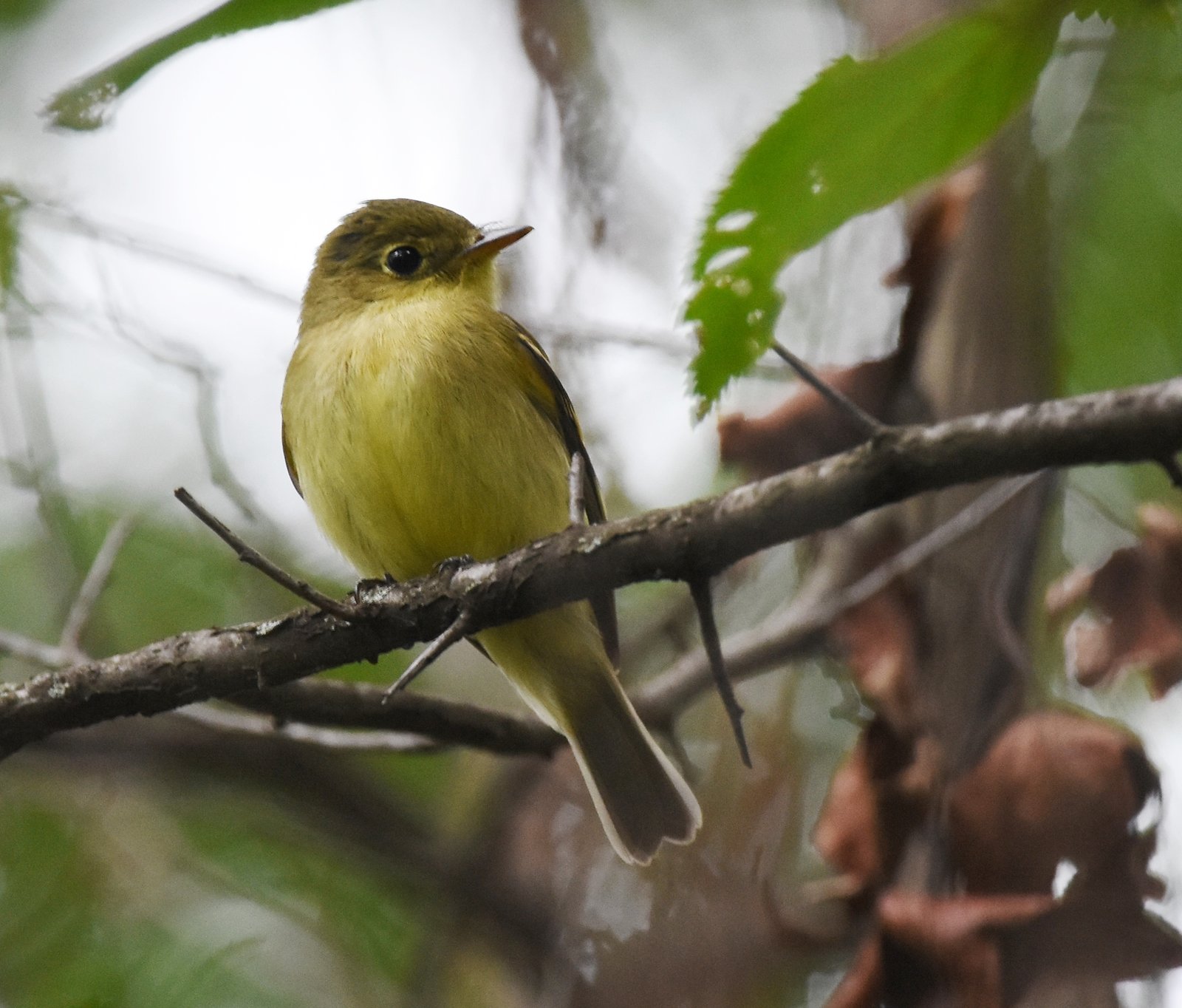
The Yellow-bellied Flycatcher breeds in damp coniferous forest and bogs of Canada and the north-eastern United States and winters from Mexico to Panama. In the guide area it is only a rare vagrant. It is the only Empidonax of the region with a yellowish throat.
Voice
The call is an upslurred, whistled chu-wee, also a short chip. The song, a short che-bunk, is rarely heard away from the breeding grounds.
Recording: Stanislas Wroza — CC BY-NC-SA 4.0 · xeno-canto
Identification
13–14 cm. Small, with a fairly large, round head. The upperparts are olive-green, the eye-ring distinct and yellowish white. Throat and belly are yellow, the breast with an olive-green band. The blackish wings show two sharp whitish wing-bars and pale edges to the secondaries. The lower mandible is pale orange. Sexes alike.
Confusion species
Acadian Flycatcher Empidonax virescens has a white throat and longer wings. Alder Flycatcher Empidonax alnorum and Willow Flycatcher Empidonax traillii are browner, with a white throat and a weak eye-ring. Euler's Flycatcher Lathrotriccus euleri is browner, with cinnamon-buff wing-bars.
Habitat
On the wintering grounds in the understorey of humid forest, shady secondary forest and dense forest edges, usually low. It catches insects with short sallies from the lower storey. Breeds in North America on the ground among moss in coniferous forest.
Where the bird is most at home, classified by the vegetation units of the Andes and the west coast.


Range and movements
Colombia: rare vagrant, with only a few records in the north and north-west, near Panama. No or hardly any records are known from Ecuador, Peru and Bolivia. Absent from the Galápagos. Winters from southern Mexico to Panama.
How and when to look
A record in the guide area is exceptional. With a small Empidonax in the understorey of northern Colombia, check for the yellow throat and the whistled call, and document a bird with photographs and sound recordings.
Conservation status
Least Concern. Common on the breeding grounds; in the guide area a very rare vagrant beyond the normal wintering range.
Scientific name
Empidonax flaviventris | (Baird & Baird, 1843)
Baird & Baird described the species in 1843 as Tyrannula flaviventris; because it was later moved to another genus, the author and year stand in brackets. The genus Empidonax was introduced in 1855 by Cabanis. The genus name combines Ancient Greek empis, 'gnat', with anax, 'lord' or 'master': 'lord of the gnats'. From Latin flavus, 'yellow', and venter, 'belly': 'yellow-bellied'. The specimen the first description was based on came from Carlisle, Pennsylvania, United States.