All species › Passerines › Tyrant flycatchers and allies › Crested Doradito
Crested Doradito | Pseudocolopteryx sclateri
Kuifdoradito | Doradito copetón | Tricolino
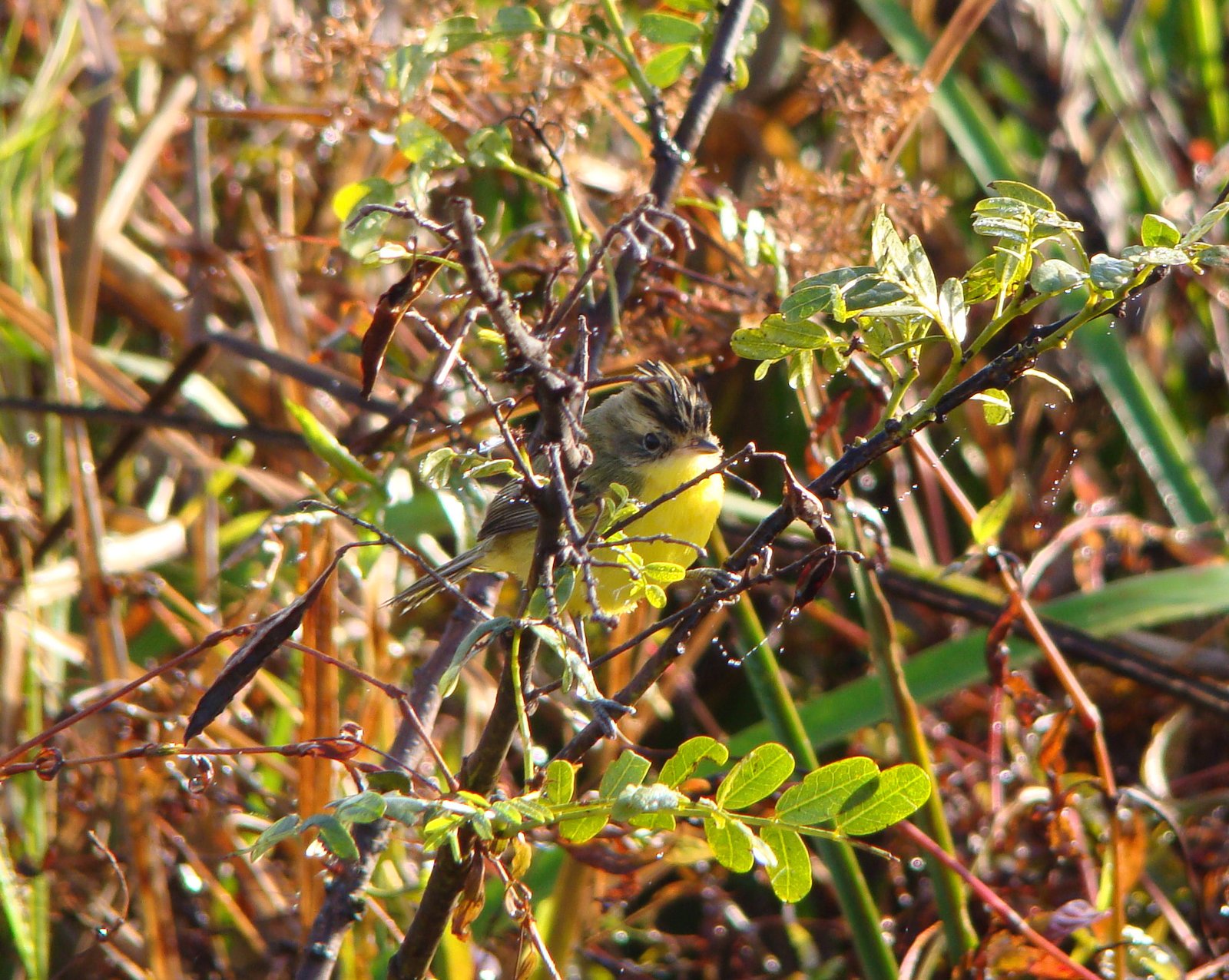
The Crested Doradito is a small yellow tyrant of marshes in south-eastern South America. The male has a dark, streaked crest. In the guide area it has been recorded only as a rare vagrant in the eastern lowlands of Bolivia.
Voice
Soft, high, ticking or squeaky calls; not very vocal.
Recording: Bernabe Lopez-Lanus — CC BY-NC-SA 3.0 · xeno-canto
Identification
10 cm, with a small, pointed bill. The crown is blackish streaked olive and forms an erect, split crest in the male; the face is greyish. The back is olive, with dark streaks. The wings are dark, with two pale wing bars and pale edges to the secondaries. The underparts are bright yellow. The female has a smaller crest.
Confusion species
Subtropical Doradito Pseudocolopteryx acutipennis has a plain olive-green crown and back, without a crest or streaks and without distinct wing bars. Ticking Doradito Pseudocolopteryx citreola also has an unstreaked brownish-olive crown and back.
Habitat
Marshes with rushes, reeds and tall grass, wet grasslands and rank lagoon margins in the lowlands. It searches for small insects low in the vegetation. The nest is a cup among stems in the marsh vegetation.
Where the bird is most at home, classified by the vegetation units of the Andes and the west coast.


Range and movements
In Bolivia only a few records of vagrants in the eastern lowlands, in Santa Cruz and Beni. Not recorded in Colombia, Ecuador, Peru or the Galápagos. Outside the guide area in Paraguay, north-eastern Argentina, Uruguay and south-eastern Brazil, with scattered records further north.
How and when to look
Records in the guide area are rare and unpredictable; search marshes and wet grasslands in eastern Santa Cruz and Beni, especially in the austral winter.
Conservation status
Least Concern. The species is locally fairly common in its core range, but is losing habitat through drainage of marshes.
Scientific name
Pseudocolopteryx sclateri | (Oustalet, J-FÉ, 1892)
Oustalet, J-FÉ described the species in 1892 as Anaeretes sclateri; because it was later moved to another genus, the author and year stand in brackets. The genus Pseudocolopteryx was introduced in 1905 by Lillo. The genus name comes from Greek pseudos, 'false', and the genus Colopteryx, from Greek kolos, 'stunted', and pterux, 'wing'. The species name honours the British ornithologist Philip Lutley Sclater (1829–1913). The specimen the first description was based on came from Probably Buenos Aires Province, Argentina.