All species › Passerines › Tyrant flycatchers and allies › Maracaibo Tody-Flycatcher
Maracaibo Tody-Flycatcher | Todirostrum viridanum
Kortstaartschoffelsnavel | Titirijí de Maracaibo | Ferreirinho-de-maracaibo
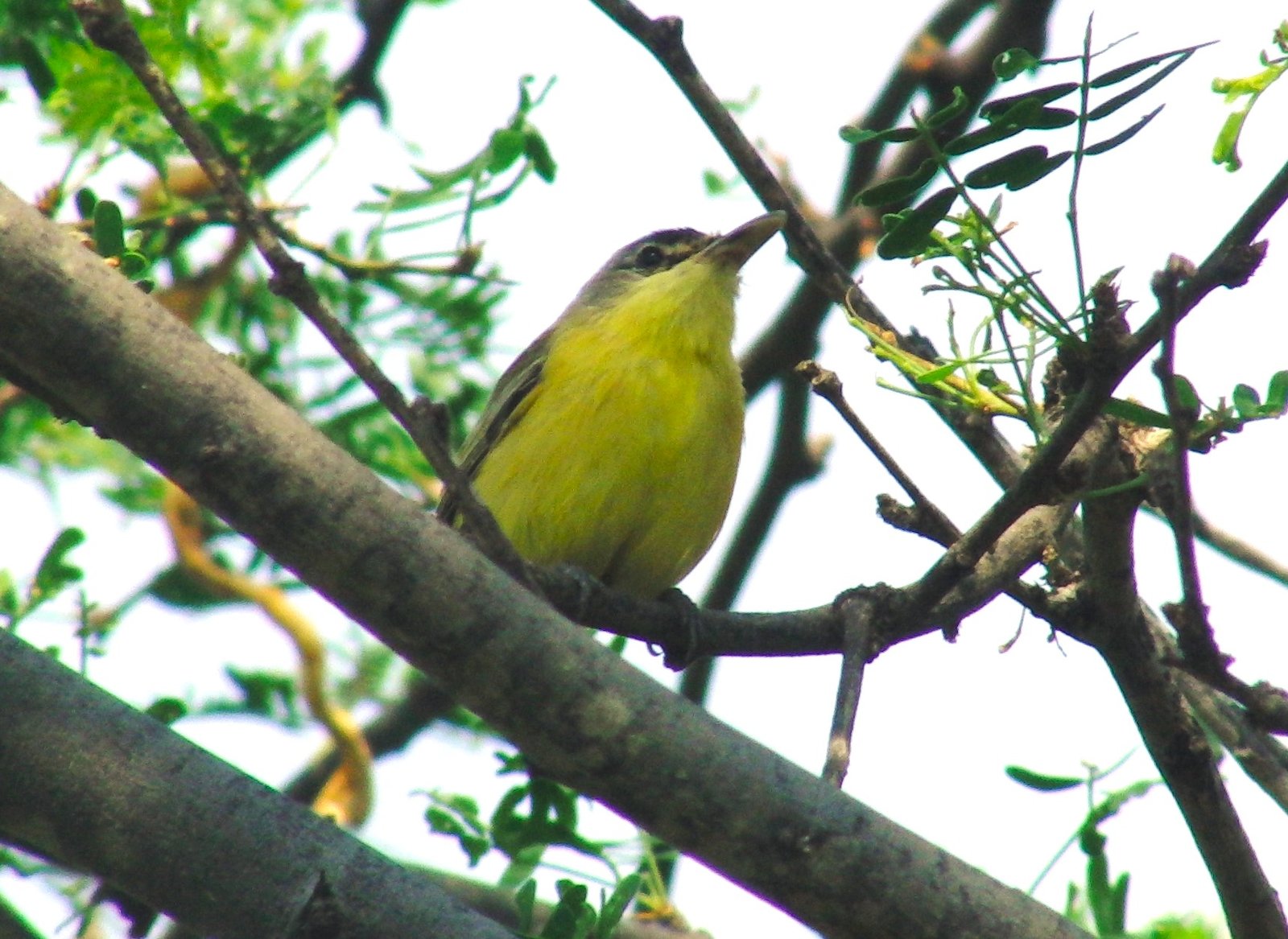
The Maracaibo Tody-Flycatcher is a small tyrant of dry coastal scrub in north-western Venezuela, around the mouth of Lake Maracaibo and on the Paraguaná Peninsula. In the guide area it is at most an exceptional vagrant in the far north-east of Colombia. Its short tail sets it apart from most of its relatives.
Voice
A series of about six sharp, high seek notes.
Recording: Francisco contreras — CC BY-NC-SA 4.0 · xeno-canto
Identification
9–10 cm, with a long, flat bill and a short tail. The forecrown is black, the hindcrown and nape grey; the lores and eye area are blackish, with a largely concealed yellowish-white spot above the bill. The back is pale olive-green. The wings are black with yellowish edgings and two wing bars; the tail is black with white edges and tips. The underparts are pale yellow, with ochre flanks. The eye is usually dark, the lower mandible pink. The sexes are alike.
Confusion species
Common Tody-Flycatcher Todirostrum cinereum has a distinctly longer tail, brighter yellow underparts and usually a pale eye. Slaty-headed Tody-Flycatcher Poecilotriccus sylvia has a grey head and greyish-white underparts without yellow, and lives in more humid scrub.
Habitat
Dry and semi-arid coastal scrub and low woodland with acacias, cacti and prickly pears, less in deciduous and gallery forest, from sea level to about 200 m. It forages in pairs in shrubs and low trees for insects. The nest is a hanging pouch on a thin branch.
Where the bird is most at home, classified by the vegetation units of the Andes and the west coast.


Range and movements
In the guide area at most an exceptional vagrant in the dry north-east of Colombia (La Guajira), adjoining the Venezuelan breeding range; there are hardly any documented records. Absent from Ecuador, Peru, Bolivia and the Galápagos. Outside the guide area endemic to the coastal region of north-western Venezuela, from Zulia through Falcón to Anzoátegui.
How and when to look
A record in the guide area calls for good documentation, with photographs and sound recordings; in dry scrub of La Guajira watch for a small tody-flycatcher with a short tail and pale yellow underparts.
Conservation status
Least Concern. Its small range in Venezuela is losing habitat to development, overgrazing and wood cutting, and the population is thought to be declining.
Scientific name
Todirostrum viridanum | Hellmayr, 1927
Hellmayr described the species in 1927 and placed it straight away in the genus where it still stands. The genus Todirostrum was introduced in 1831 by Lesson. The genus name combines the genus Todus (todies) with Latin rostrum, 'bill', after the flat, tody-like bill. The species name is New Latin viridanus, 'greenish', from viridis, 'green', after the green upperparts. The specimen the first description was based on came from Río Aurare near Altagracia, Zulia, Venezuela.