All species › Passerines › New World sparrows › Chestnut-capped Brushfinch
Chestnut-capped Brushfinch | Arremon brunneinucha
Bruinkapstruikgors | Atlapetes gorra castaña | Tico-tico-de-coroa-castanha
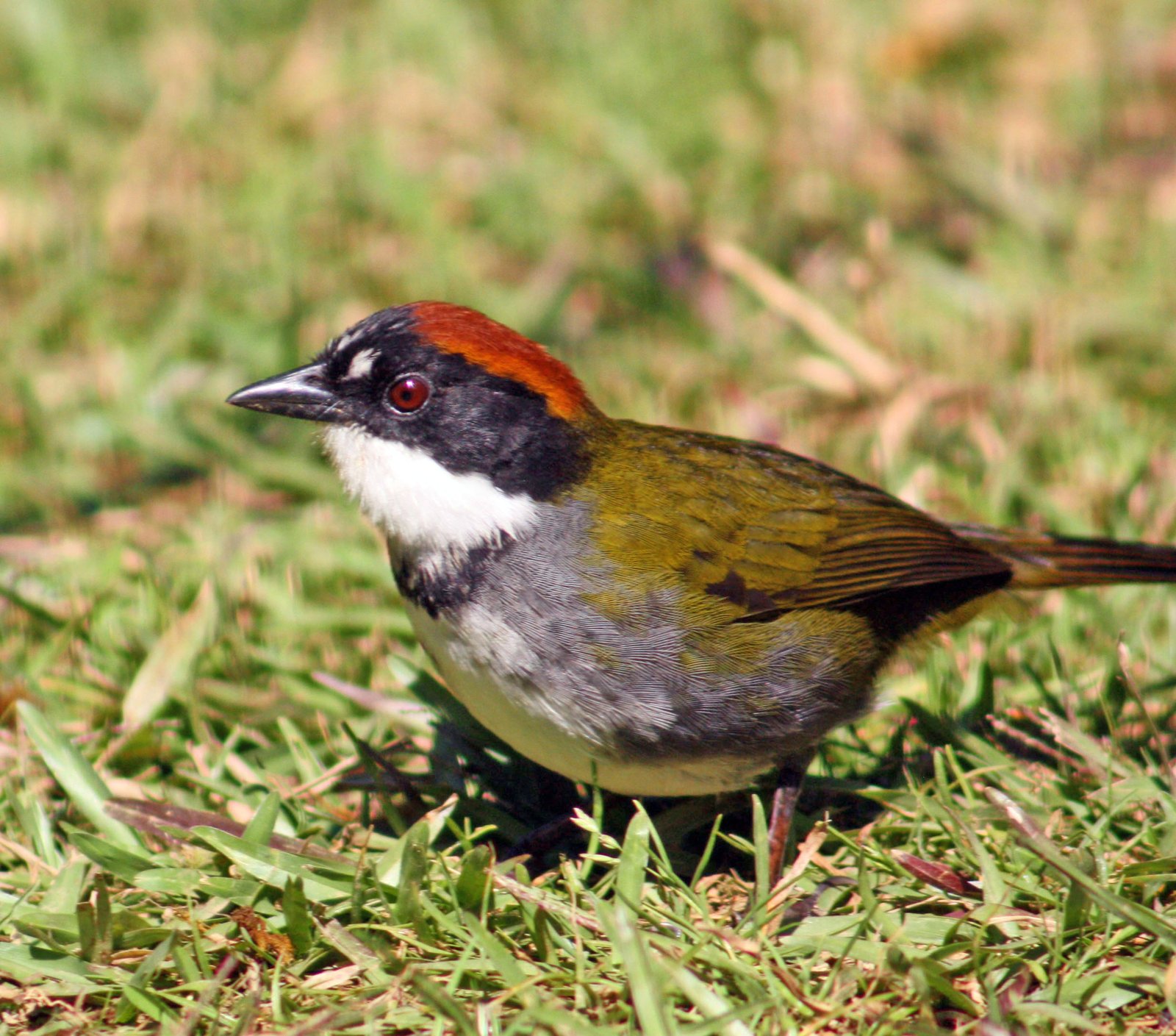
The Chestnut-capped Brushfinch is a large, olive-green brushfinch with a chestnut crown and a white throat, living on the floor of humid montane forest from Mexico to Peru. It forages in pairs among fallen leaves, flicking them aside with its bill. Its high calls are often the first sign of its presence.
Voice
Very high, thin calls, roughly tseet or see, often repeated at length. The song is a short series of evenly pitched, thin notes, often at dawn and dusk.
Recording: Juan Freile — CC BY-NC-SA 4.0 · xeno-canto
Identification
18–19 cm, sturdy, with a heavy, black bill. The forehead and face are black, with small white spots on the forehead; the crown and nape are chestnut, narrowly bordered ochre-yellow at the sides. The throat is bright white and is often puffed out; below it is a narrow black breast band, which is absent or faint in birds of western Ecuador. The back, wings and tail are olive-green, the flanks grey to olive-grey, the centre of the belly white. The sexes are alike. Juveniles are darker and browner, with an indistinct head and streaked, ochre-brown underparts.
Confusion species
White-browed Brushfinch Arremon torquatus has a black-and-white or black-and-grey striped head without chestnut. Olive Finch Arremon castaneiceps has a rufous head, but a dark olive throat without white, and lives mainly along streams. Yellow-breasted Brushfinch Atlapetes latinuchus and other rufous-crowned Atlapetes have yellow or grey underparts and no white throat.
Habitat
Floor and low undergrowth of humid montane forest and cloud forest, especially in dark, shady parts with much leaf litter, also in old secondary forest and shade coffee, roughly between 1000 and 2500 m. Turns over leaves with its bill in search of insects, spiders and other invertebrates, also seeds and fruit. The nest is a cup of rootlets and moss, low in a shrub or among creepers.
Where the bird is most at home, classified by the vegetation units of the Andes and the west coast.


Range and movements
In Colombia in all three Andean ranges, in the Sierra Nevada de Santa Marta and the Serranía de Perijá. In Ecuador on both slopes of the Andes. In Peru on the eastern slope south to Cuzco. Absent from Bolivia and the Galápagos. Outside the guide area from Mexico through Central America to Venezuela.
- Resident
- dark = core range, pale = thinly spread
How and when to look
Search quiet forest trails in cloud forest and listen for the rustle of turned leaves. The birds stay on the ground and in the shade; stand still in the early morning near a spot with plenty of leaf litter.
Conservation status
Least Concern. The range is large; locally the species disappears where montane forest is cleared.
Scientific name
Arremon brunneinucha | (de Lafresnaye, 1839)
De Lafresnaye described the species in 1839 as Embernagra brunnei-nucha; because it was later moved to another genus, the author and year stand in brackets. The genus Arremon was introduced in 1816 by Vieillot. The genus name comes from Greek arrhēmōn, 'silent, without speech'. The species name comes from Medieval Latin brunneus, 'brown', and nucha, 'nape': 'brown-naped', after the chestnut cap. The specimen the first description was based on came from Xalapa, Veracruz, Mexico.