All species › Passerines › New World sparrows › Olive Finch
Olive Finch | Arremon castaneiceps
Olijfgroene struikgors | Cerquero capirrufo | Tico-tico-oliváceo
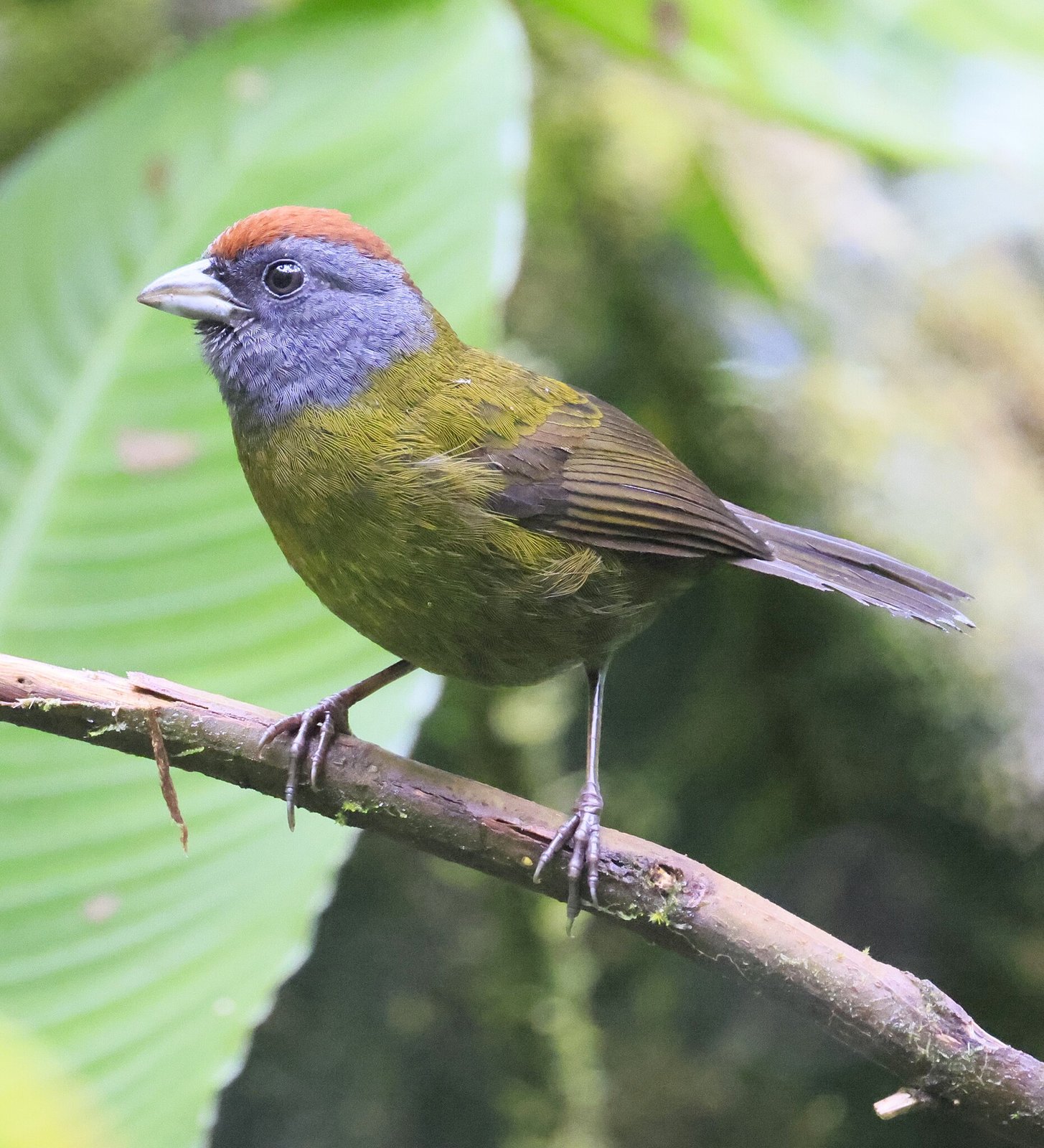
The Olive Finch is a dark, olive-green sparrow with a rufous head, living on the floor of wet montane forests in the northern Andes. It mainly keeps to steep stream valleys and ravines, often on mossy rocks along running water. It is patchily distributed and occurs at low densities.
Voice
High, thin calls, roughly tseet, often audible above the sound of the stream. The song is a short series of high, thin notes, so far little recorded.
Recording: Carlos Delgado JUMABITA — CC BY-NC-SA 4.0 · xeno-canto
Identification
16–17 cm, sturdy, with a short, heavy, black bill. The crown, nape and sides of the head are rufous to chestnut, with greyish lores and a dark patch around the eye. The rest of the plumage is uniform dark olive-green, slightly paler and greyer on the belly. The legs are dark. The sexes are alike. Juveniles are duller and browner, with a less rufous head.
Confusion species
Chestnut-capped Brushfinch Arremon brunneinucha lives in the same forest, but has a black face, a bright white throat and a black breast band. Tanager Finch Oreothraupis arremonops has a black head with grey stripes and orange-rufous underparts. Rufous-crowned brushfinches of the genus Atlapetes have yellow or grey underparts and a black face.
Habitat
Floor and low undergrowth of wet, mossy montane forests, especially in steep ravines, along streams and on landslides, roughly between 1000 and 2300 m. Hops over stones and among leaf litter in search of insects and other invertebrates. Little is known of the nest.
Where the bird is most at home, classified by the vegetation units of the Andes and the west coast.


Range and movements
In Colombia locally in the Western and Central Andes and on the eastern slope in the south, in Nariño and Putumayo. In Ecuador locally on both slopes of the Andes. In Peru on the eastern slope in the north and centre, south to about Huánuco. Absent from Bolivia and the Galápagos. Does not occur outside the guide area.
- Resident
- dark = core range, pale = thinly spread
How and when to look
Walk along streams and through steep ravines in cloud forest and check mossy rocks and fallen trunks close to the water. The birds are shy and keep to the half-light; waiting by a stream in the early morning gives most sightings.
Conservation status
Near Threatened. The habitat is fragmented and the population is probably declining because of the clearance of montane forest in the northern Andes; the species lives at low densities and has disappeared locally.
Scientific name
Arremon castaneiceps | (Sclater, 1860)
Sclater described the species in 1860 as Buarremon castaneiceps; because it was later moved to another genus, the author and year stand in brackets. The genus Arremon was introduced in 1816 by Vieillot. The genus name comes from Greek arrhēmōn, 'silent, without speech'. The species name comes from Latin castaneus, 'chestnut', and -ceps, 'headed': 'chestnut-headed'. The specimen the first description was based on came from Río Napo, Ecuador.