All species › Passerines › New World sparrows › Rufous-collared Sparrow
Rufous-collared Sparrow | Zonotrichia capensis
Roodkraaggors | Chingolo común | Tico-tico
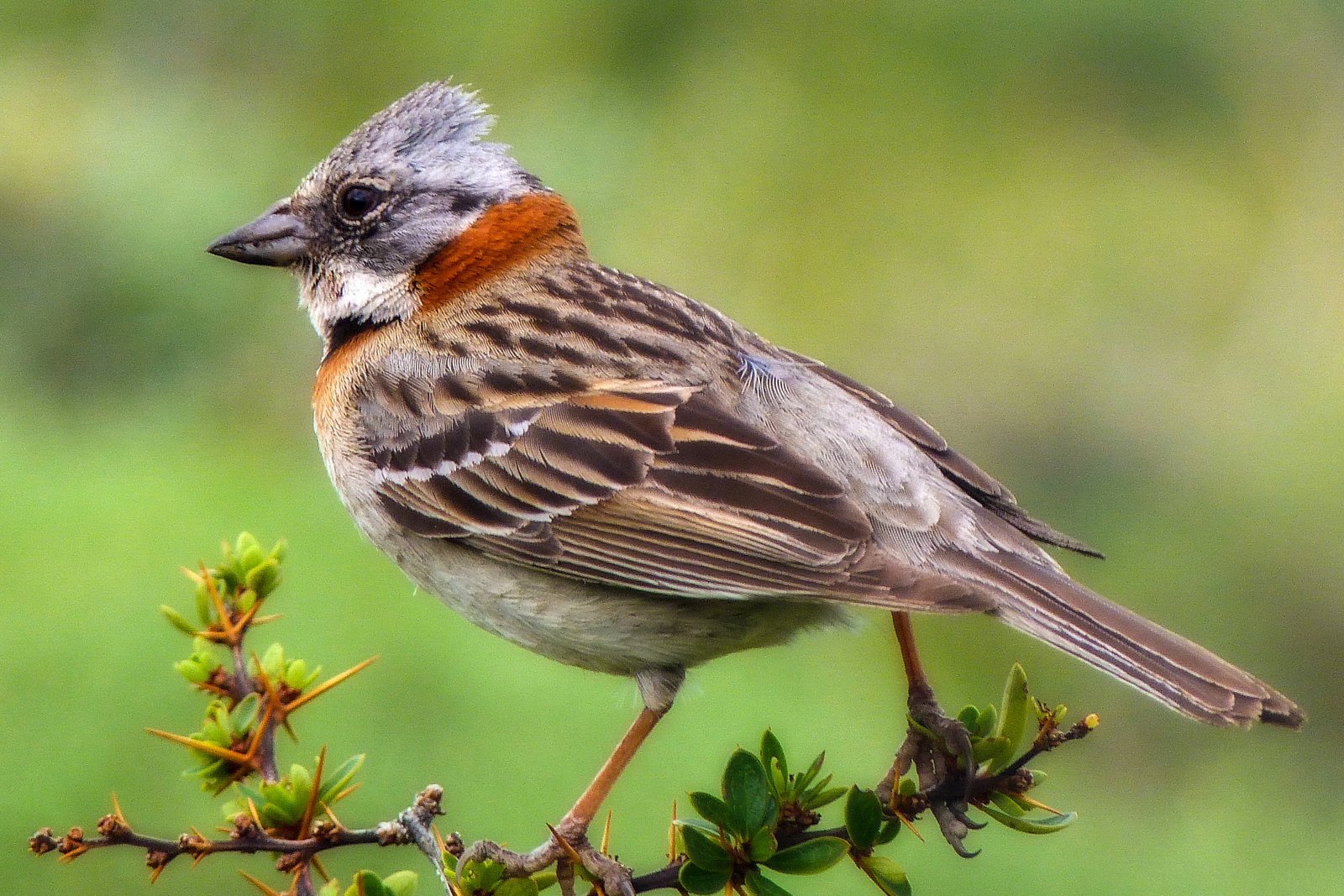
The Rufous-collared Sparrow is the most widespread sparrow of the guide area and one of the commonest birds of the Andes, from fields and village squares to the edge of the páramo and puna. With its grey, black-striped head, small crest and rufous collar it is a familiar sight throughout the region. Its short, whistled song varies from district to district and has been studied in depth as an example of song dialects.
Voice
The song is a short, clear whistle of two or three notes, often followed by a trill, roughly tee-teeoo tee-tee-trrrr, given from a post, roof or bush and also heard at night. Each district has its own variants. The call is a sharp chip.
Recording: Juan Freile — CC BY-NC-SA 4.0 · xeno-canto
Identification
14–15 cm, with a short, conical, grey bill and a small crest that is often raised. The head is grey, with a black stripe on each side of the crown, a black eyestripe and a black malar stripe. A rufous band runs over the nape to the side of the breast, where there is a black patch. The throat is white, the breast and belly greyish white. The upperparts are brown streaked with black, with two narrow white wingbars. The sexes are alike. Juveniles lack the rufous collar and head pattern and are finely streaked dark on the breast and flanks.
Confusion species
Juveniles can resemble Grasshopper Sparrow Ammodramus savannarum, which has a flatter head, a buffy face and a shorter tail, or Grassland Sparrow Ammodramus humeralis, which has yellow in front of the eye and an unstreaked breast. White-crowned Sparrow Zonotrichia leucophrys, an exceptional vagrant, has a black-and-white striped crown and no rufous collar.
Habitat
Almost all open and semi-open landscapes in the Andes: fields, terraces, pastures, hedges, gardens, parks and villages, scrub in dry valleys, forest edges and the edge of páramo and puna, roughly from 500 m to above 4000 m; in Peru also in the coastal valleys down to sea level. Forages on the ground for seeds and insects. The nest is a grass cup on the ground or low in a shrub.
Where the bird is most at home, classified by the vegetation units of the Andes and the west coast.


Range and movements
In Colombia, Ecuador, Peru and Bolivia common throughout the Andes, also in the Sierra Nevada de Santa Marta and in the coastal valleys and oases of Peru. Largely absent from the Amazonian lowlands, with scattered small groups on savannas and isolated hills, and locally in open country in eastern Bolivia. Absent from the Galápagos. Outside the guide area from southern Mexico and Hispaniola to Tierra del Fuego.
- Resident
- dark = core range, pale = thinly spread
How and when to look
Almost every Andean town and village has Rufous-collared Sparrows; watch for birds singing on roofs and walls. Compare the song at different altitudes and in different valleys to hear the regional variants.
Conservation status
Least Concern. One of the commonest songbirds of South America; the species has benefited from deforestation and the spread of farming and settlements in the Andes.
Scientific name
Zonotrichia capensis | (Müller, 1776)
Müller described the species in 1776 as Fringilla capensis; because it was later moved to another genus, the author and year stand in brackets. The genus Zonotrichia was introduced in 1832 by Swainson. The genus name comes from Greek zōnē, 'band', and thrix, 'hair', referring to the striped head. The species name refers to the Cape of Good Hope, the erroneous origin given for the described specimen. The specimen the first description was based on came from Cayenne, French Guiana.