All species › Passerines › New World sparrows › White-naped Brushfinch
White-naped Brushfinch | Atlapetes albinucha
Witnekstruikgors | Atlapetes nuca blanca | Tico-tico-de-nuca-branca
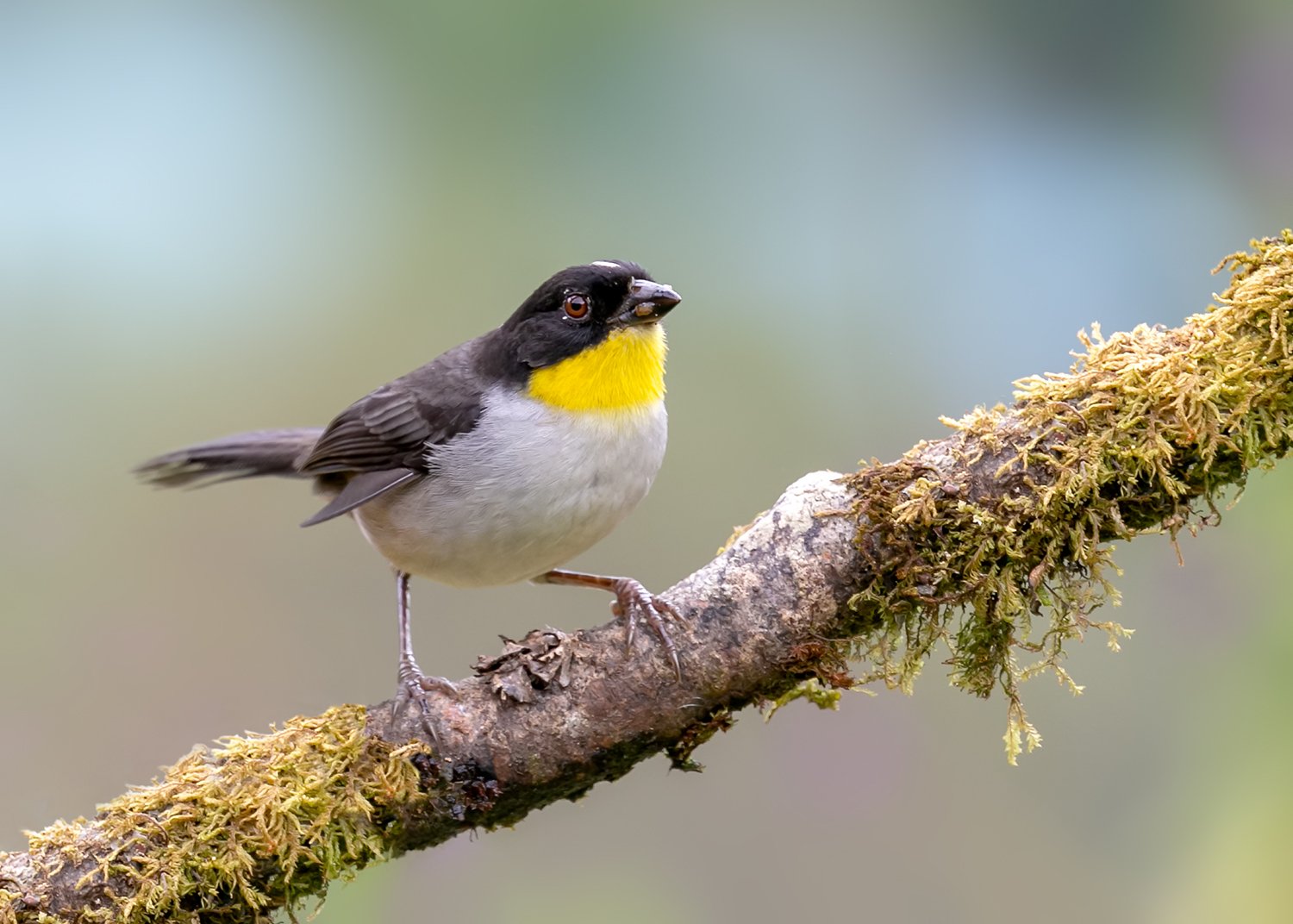
The White-naped Brushfinch is a brushfinch of forest edges and scrub from southern Mexico to Colombia. Birds in the guide area have a yellow throat and were formerly treated as a separate species, Yellow-throated Brushfinch. It lives in pairs close to the ground, often in coffee plantations and overgrown clearings.
Voice
High, thin calls, roughly tseet. The song is a short series of high, thin whistles and trills, often given as a duet by a pair.
Recording: Manuel Grosselet — CC BY-NC-SA 4.0 · xeno-canto
Identification
17–18 cm, with a stout, black bill and a fairly long tail. The head is black, with a narrow white median crown stripe running back to the nape. The throat is bright yellow; the breast and belly are greyish white, and the flanks olive-grey. The upperparts are dark olive-grey. The sexes are alike. Juveniles are browner, with a less sharp crown stripe and streaked underparts.
Confusion species
Pale-naped Brushfinch Atlapetes pallidinucha has a cinnamon to whitish nape stripe, but entirely yellow underparts, and lives higher. Yellow-breasted Brushfinch Atlapetes latinuchus has a rufous crown and yellow underparts. Chestnut-capped Brushfinch Arremon brunneinucha has a chestnut crown, a white throat and a narrow black breast band.
Habitat
Forest edges, scrub, secondary forest, overgrown pastures and shaded coffee plantations, roughly between 1000 and 2500 m, locally lower. It searches on the ground and low in shrubs for insects, seeds and berries. The nest is a cup of grass and rootlets, low in a shrub or dense vegetation.
Where the bird is most at home, classified by the vegetation units of the Andes and the west coast.


Range and movements
In Colombia in the Andes, mainly on the slopes of the Central and Western Andes, locally also in the Eastern Andes. Absent from Ecuador, Peru, Bolivia and the Galápagos. Outside the guide area from southern Mexico through Central America to Panama.
- Resident
- dark = core range, pale = thinly spread
How and when to look
Search forest edges and coffee plantations at middle elevations in the Colombian Andes. Pairs forage low in the scrub and often call with their high notes; the yellow throat stands out even in shade.
Conservation status
Least Concern. The species tolerates farmland with scrub and hedgerows well.
Scientific name
Atlapetes albinucha | (d'Orbigny, ACVMD & de Lafresnaye, 1838)
D'Orbigny, ACVMD & de Lafresnaye described the species in 1838 as Embernagra albinucha; because it was later moved to another genus, the author and year stand in brackets. The genus Atlapetes was introduced in 1831 by Wagler. The genus name comes from Greek: the mythical titan Atlas and petēs, 'flyer'. The species name comes from Latin albus, 'white', and Medieval Latin nucha, 'nape', for the white nape stripe. The specimen the first description was based on came from Caribbean slope of Mexico.