All species › Passerines › New World sparrows › Moustached Brushfinch
Moustached Brushfinch | Atlapetes albofrenatus
Witbaardstruikgors | Atlapetes bigotudo | Tico-tico-bigodudo
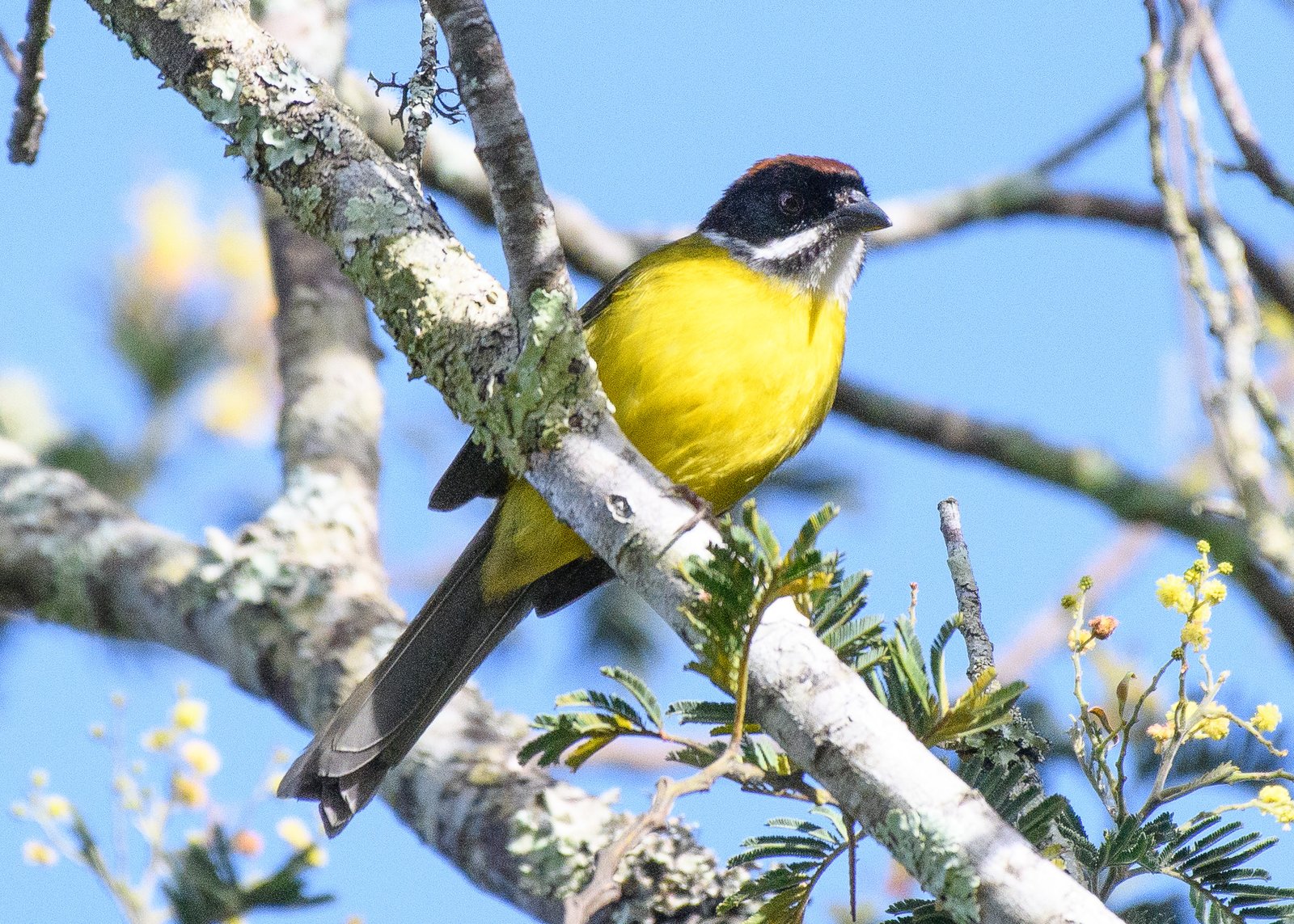
The Moustached Brushfinch is a brushfinch of the montane forests of the Eastern Andes in north-eastern Colombia and adjacent Venezuela. Its name refers to the white moustachial stripe that contrasts sharply with the black face. It lives in pairs or small groups in the undergrowth and at forest edges.
Voice
High, thin calls, roughly tseet, and a short, rapid series of high, thin notes as song.
Recording: Jorge Muñoz — CC BY-NC-SA 4.0 · xeno-canto
Identification
17–18 cm, with a stout, black bill. The crown and nape are rufous; the forehead, lores and cheeks are black. A conspicuous white moustachial stripe runs from the base of the bill below the eye, bordered by a black malar stripe. The throat and underparts are yellow, and the flanks olive. The upperparts are olive-green. The sexes are alike; juveniles are duller and browner, with a less sharp head pattern.
Confusion species
Yellow-breasted Brushfinch Atlapetes latinuchus also has a rufous crown and yellow underparts, but lacks the white moustachial stripe. Pale-naped Brushfinch Atlapetes pallidinucha has a cinnamon forecrown that becomes paler towards the rear and lives higher. Ochre-breasted Brushfinch Atlapetes semirufus has an entirely orange-rufous head and breast.
Habitat
Undergrowth and edges of humid montane and cloud forest, secondary forest and scrub, roughly between 1500 and 2700 m. It searches low in the vegetation and on the ground for insects, seeds and fruit, sometimes in mixed flocks. The nest is a cup low in a shrub.
Where the bird is most at home, classified by the vegetation units of the Andes and the west coast.


Range and movements
In Colombia in the Eastern Andes, from Norte de Santander southwards, locally. Absent from Ecuador, Peru, Bolivia and the Galápagos. Outside the guide area in the Andes of western Venezuela.
- Resident
- dark = core range, pale = thinly spread
How and when to look
Search forest edges and mountain roads in the Eastern Andes in Norte de Santander and Santander. Pairs move low through the scrub; the white moustache stands out when a bird sits in the open for a moment.
Conservation status
Not Evaluated as a separate species. Habitat is lost locally to forest clearance for farming, but the species tolerates secondary forest and forest edges.
Scientific name
Atlapetes albofrenatus | (Boissonneau, 1840)
Boissonneau described the species in 1840 as Tanagra (Arremon) albo-frenatus; because it was later moved to another genus, the author and year stand in brackets. The genus Atlapetes was introduced in 1831 by Wagler. The genus name comes from Greek: the mythical titan Atlas and petēs, 'flyer'. The species name comes from Latin albus, 'white', and frenatus, 'bridled', for the white moustachial stripe. The specimen the first description was based on came from Bogotá, Colombia.