All species › Passerines › Ovenbirds and woodcreepers › Chestnut-winged Hookbill
Chestnut-winged Hookbill | Ancistrops strigilatus
Haakbekbladspeurder | Picogancho alicastaño | Limpa-folha-picanço
The Chestnut-winged Hookbill is a large, streaked foliage-gleaner of the Amazonian lowlands, with a heavy bill that has a distinct hook at the tip. It is the only species in its genus. It usually travels with mixed-species flocks in the middle and upper levels of the forest, where it searches dead leaves and epiphytes.
Voice
The song is a fast, rising trill that grows louder and then continues on one pitch, sometimes for half a minute or longer. Calls are a harsh, buzzing bzzt and a tee-chew.
Recording: Guilherme Melo — CC BY-NC-SA 4.0 · xeno-canto
Identification
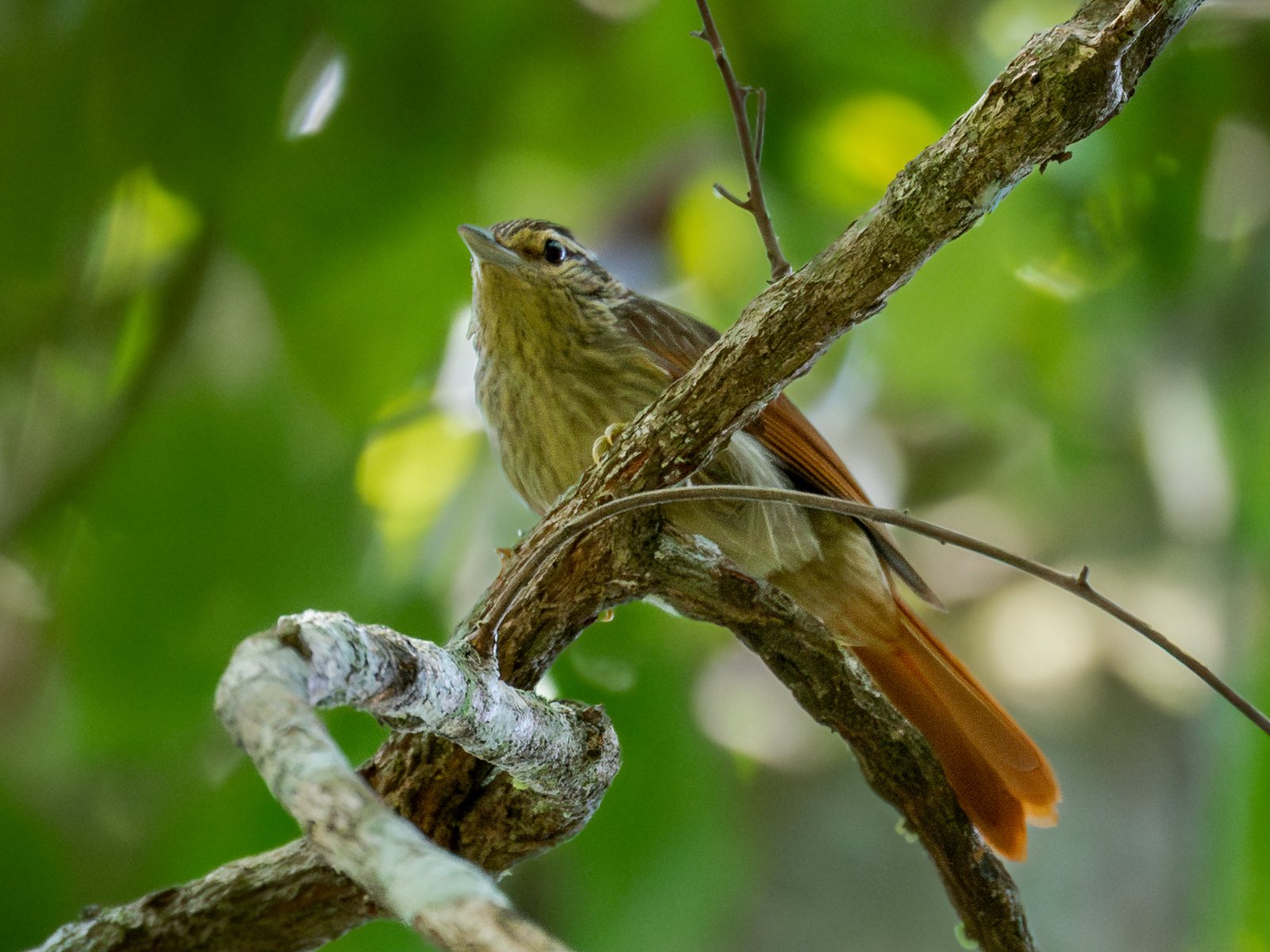
18–19 cm, with a heavy, straight bill with a hooked tip and a fairly long tail. The crown and back are dark olive-brown with narrow golden-buff streaks. A broad whitish to buff supercilium stands out. The wing coverts are dull chestnut and the tail is bright rufous. The throat and underparts are yellowish buff with brown streaks. The sexes are alike; juveniles are more irregularly and darkly streaked.
Confusion species
Chestnut-winged Foliage-Gleaner Dendroma erythroptera has a slimmer bill, unstreaked upperparts and brighter rufous wings. Eastern Woodhaunter Automolus subulatus is also streaked, but has a slimmer bill and plain brown wings, and forages lower in the forest. Streaked Xenops Xenops rutilans is much smaller, with an upturned bill and a white cheek stripe.
Habitat
Humid evergreen lowland forest, mainly terra firme, locally also várzea, mostly below 500 m and locally up to about 900 m. It searches dead leaves, clusters of leaf litter and epiphytes in the mid-storey and lower canopy for insects and other arthropods. Almost nothing is known about its nest.
Where the bird is most at home, classified by the vegetation units of the Andes and the west coast.


Range and movements
Colombia: the south-east, in the Amazonian lowlands. Ecuador: the eastern lowlands. Peru: the eastern lowlands along the whole length of the country. Bolivia: the north. Absent from the Galápagos. Outside the guide area in western and southern Amazonian Brazil.
- Resident
- dark = core range, pale = thinly spread
How and when to look
Follow mixed-species flocks in terra firme forest and look for a streaked foliage-gleaner probing hanging dead leaves with its heavy bill. The long, swelling trill often gives it away first.
Conservation status
Least Concern. The species depends on undisturbed lowland forest and disappears where it is cleared, but its habitat is still extensive.
Scientific name
Ancistrops strigilatus | (Spix, 1825)
Spix described the species in 1825 as Thamnophilus strigilatus; because it was later moved to another genus, the author and year stand in brackets. The genus Ancistrops was introduced in 1862 by Sclater. The genus name comes from Greek ankistron, 'hook', and ōps, 'face', for the hook-tipped bill. The species name comes from Modern Latin strigilatus, 'striped' (from Latin striga, 'furrow', 'streak'), for the streaked plumage. The specimen the first description was based on came from Rio Solimões, Brazil (suggested).