All species › Passerines › Ovenbirds and woodcreepers › Peruvian Seaside Cinclodes
Peruvian Seaside Cinclodes | Cinclodes taczanowskii
Brandingwipstaart | Churrete marisquero | Pedreiro-costeiro-peruano
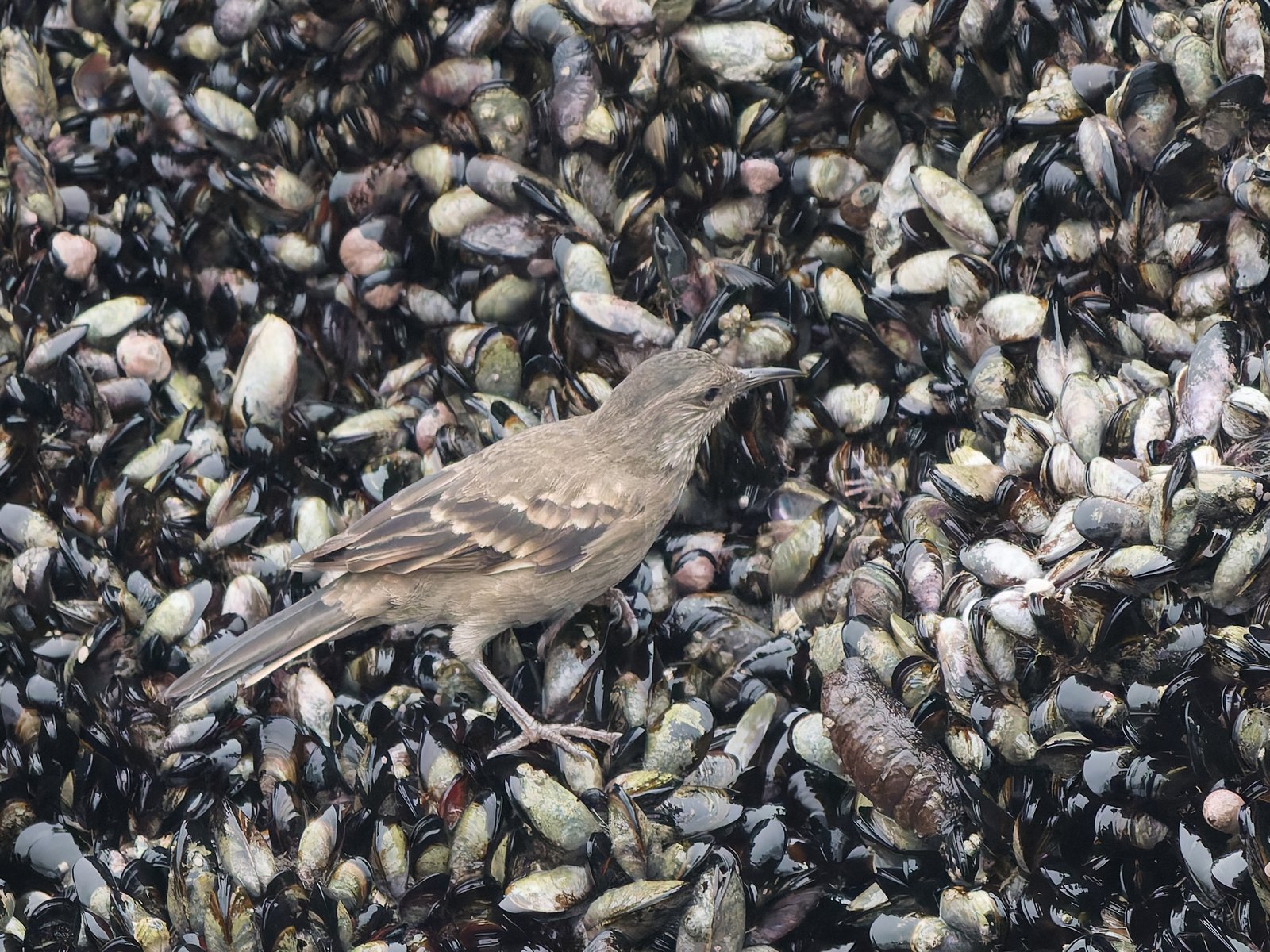
The Peruvian Seaside Cinclodes is a large, dark cinclodes found only along the coast of Peru. It is one of the few passerines in the world that forage in the ocean surf, and it rarely moves more than a few metres from the water's edge. Little is known about its breeding biology.
Voice
The song is a trill. The call is a short, abrupt chec.
Recording: Dan Lane — CC BY-NC-SA 4.0 · xeno-canto
Identification
21 cm, a robust cinclodes with a straight, strong bill. The upperparts are dark brown, with a dark sepia crown and an indistinct buffy eyebrow. The throat is dirty white with dusky spots, the breast brown with short pale streaks, the belly plain brown. In flight a rufous wing band stands out. The outer tail feathers have pale rufous tips. The sexes are alike.
Confusion species
Chilean Seaside Cinclodes Cinclodes nigrofumosus of the Chilean coast is its closest relative and very similar; the two are sometimes treated as one species and are best identified by range. Other cinclodes, such as Buff-winged Cinclodes Cinclodes fuscus, are smaller and paler and live in the high Andes, not on the coast.
Habitat
The intertidal zone of rocky shores and nearshore islands, occasionally also adjacent sandy beaches. It forages alone or in pairs on wet rocks in the surf for small crabs and other crustaceans, small bivalves and snails, isopods and beetles. The only nest described was a cup of seaweed with some plant fibres and feathers in a rock crevice.
Where the bird is most at home, classified by the vegetation units of the Andes and the west coast.


Range and movements
Endemic to Peru: along the coast from Ancash south to Tacna near the Chilean border, and on several nearshore islands. Not known from Colombia, Ecuador, Bolivia or the Galápagos.
- Resident
- dark = core range, pale = thinly spread
How and when to look
Along the rocky coast of Peru this is the only cinclodes that forages in the intertidal zone, often just above the breaking surf.
Conservation status
Least Concern. The range is small, but the species is fairly common in suitable coastal habitat and the population is considered stable.
Scientific name
Cinclodes taczanowskii | Berlepsch & Sztolcman, 1892
Berlepsch & Sztolcman described the species in 1892 and placed it straight away in the genus where it still stands. The genus Cinclodes was introduced in 1840 by Gray. The genus name combines Ancient Greek kinklos, an unidentified waterside bird, with -oidēs, 'resembling'. The species name honours Władysław Taczanowski (1819–1890), Polish zoologist, curator of the Warsaw University Museum and author of an ornithology of Peru. The specimen the first description was based on came from Chorrillos near Lima, Peru.