All species › Passerines › Ovenbirds and woodcreepers › White-winged Cinclodes
White-winged Cinclodes | Cinclodes atacamensis
Witvleugelwipstaart | Churrete aliblanco | Pedreiro-de-asa-branca
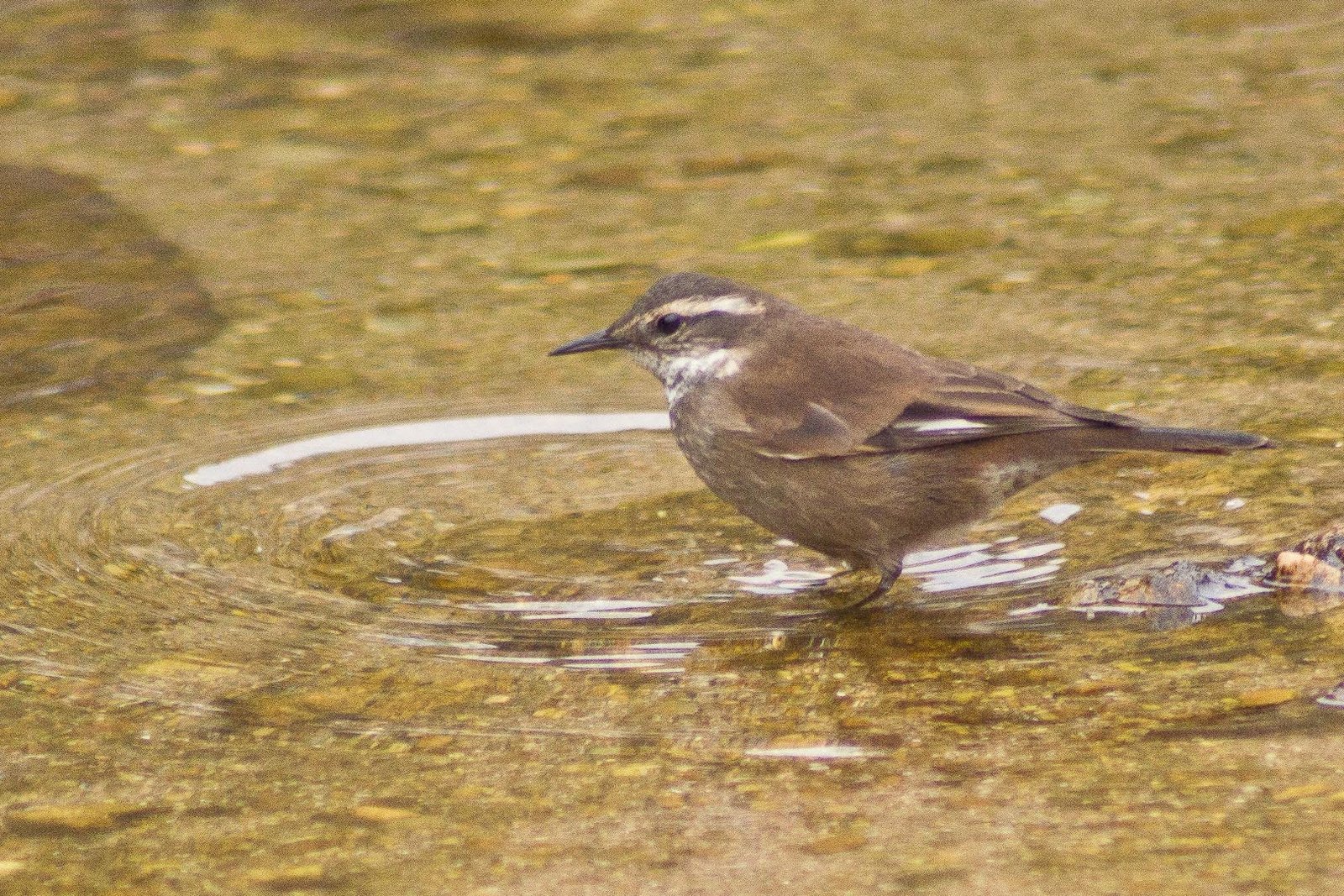
The White-winged Cinclodes is a large cinclodes of running water in the puna. It forages on stones and banks of streams and small rivers and shows large white wing patches in flight. When singing it often raises its wings.
Voice
The song is a fast, loud trill, often given with raised, quivering wings. The call is a sharp cheek.
Recording: Bernabe Lopez-Lanus — CC BY-NC-SA 3.0 · xeno-canto
Identification
20–22 cm, with a fairly long, straight to slightly decurved bill. The upperparts are warm rufous-brown, with a pale eyebrow. The throat is white, the breast grey-brown, the belly paler and whitish in the centre. On the wing a large white patch forms a broad band in flight; the tail is dark, with white tips to the outer feathers. The sexes are alike.
Confusion species
White-bellied Cinclodes Cinclodes palliatus of central Peru is larger, with bright white underparts and a grey head. Buff-winged Cinclodes Cinclodes fuscus is smaller, with a shorter bill, grey-brown upperparts and a narrower, creamy wing band. Rufous-throated Dipper Cinclus schulzii of Bolivia also lives along mountain streams but is compact and grey, with a rufous throat.
Habitat
Streams, small rivers, springs and bofedales with stony banks in the puna and high valleys, roughly between 2500 and 4800 m, also around villages and irrigation channels. It searches stones in and along the water for aquatic insects, larvae and other invertebrates. The nest is placed in a burrow in a bank, in a rock crevice or in a wall.
Where the bird is most at home, classified by the vegetation units of the Andes and the west coast.


Range and movements
Peru: in the Andes from the centre (from about Ancash) south to Puno and Tacna. Bolivia: in the Andes and on the altiplano. Absent from Colombia, Ecuador and the Galápagos. Outside the guide area in northern Chile and western Argentina.
- Resident
- dark = core range, pale = thinly spread
How and when to look
Along mountain streams and irrigation channels on the altiplano and in high valleys, for example around Cusco and Lake Titicaca. The bird often sits on stones in the water.
Conservation status
Least Concern. The species is widespread; pollution of streams by mining may play a role locally.
Scientific name
Cinclodes atacamensis | (Philippi, 1857)
Philippi described the species in 1857 as Upuarthia atacamensis; because it was later moved to another genus, the author and year stand in brackets. The genus Cinclodes was introduced in 1840 by Gray. The genus name combines Ancient Greek kinklos, an unidentified waterside bird, with -oidēs, 'resembling'. The species name refers to Atacama in northern Chile. The specimen the first description was based on came from San Pedro de Atacama, Chile.