All species › Passerines › Ovenbirds and woodcreepers › White-bellied Cinclodes
White-bellied Cinclodes | Cinclodes palliatus
Witbuikwipstaart | Churrete ventriblanco | Pedreiro-de-barriga-branca
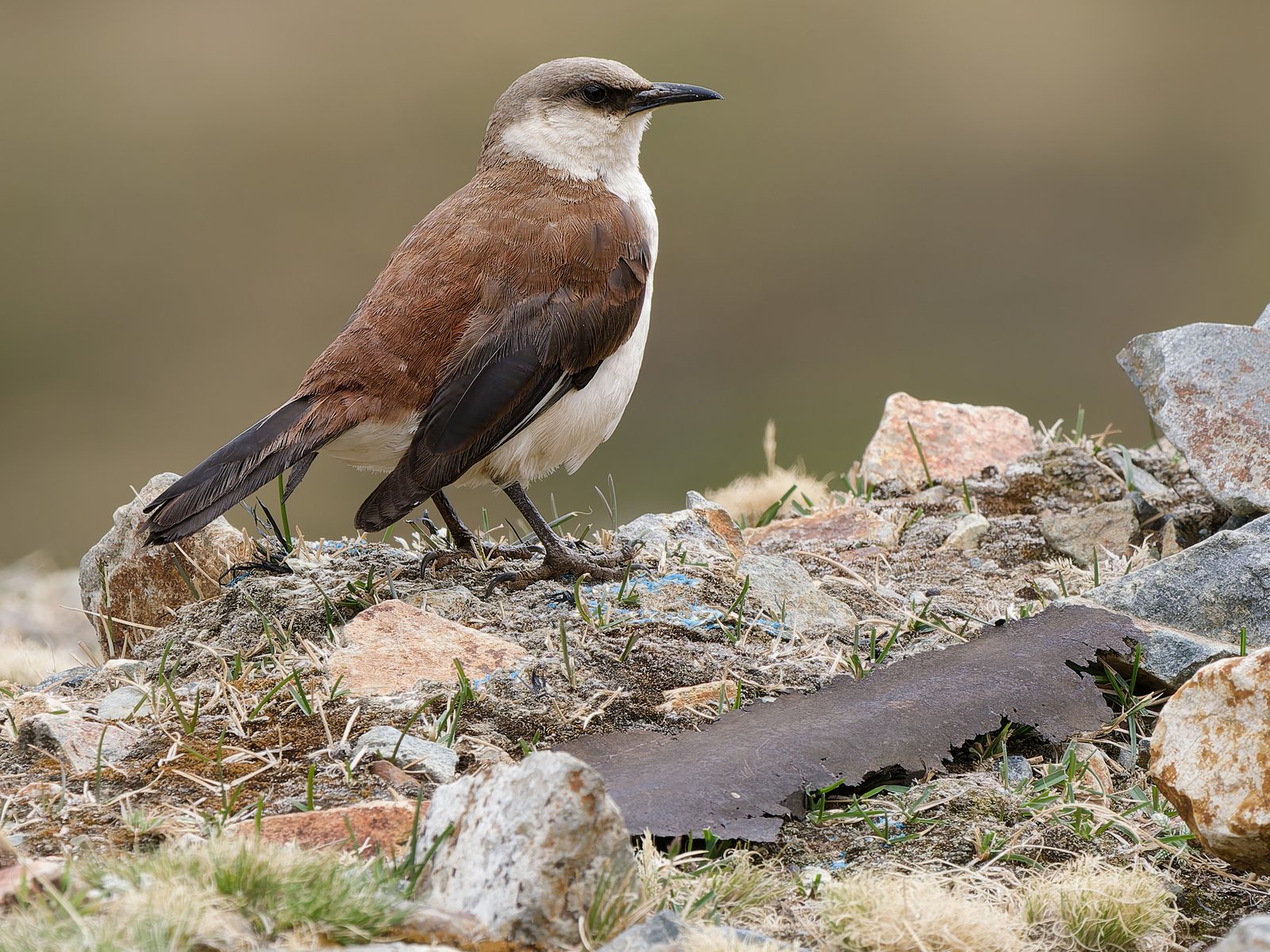
The White-bellied Cinclodes is the largest cinclodes and one of the largest ovenbirds. It lives only in the high mountains of central Peru, in cushion bogs (bofedales) at the foot of rocky slopes, mostly above 4400 m. The population is very small.
Voice
A loud, fast series of notes and trills. It gives hard, short calls.
Recording: Dan Lane — CC BY-NC-SA 4.0 · xeno-canto
Identification
23–24 cm, large and robust, with a thick, slightly decurved bill. Head and neck are pale grey, the upperparts warm brown. The underparts are bright white. The wings are dark with a broad white band; the tail is dark. The sexes are alike.
Confusion species
White-winged Cinclodes Cinclodes atacamensis is smaller, with more rufous upperparts, a grey-brown breast and a white throat, and lives along streams, often lower. Other cinclodes in the area, such as Buff-winged Cinclodes Cinclodes fuscus, are much smaller and brown or grey-brown below.
Habitat
Cushion bogs (bofedales) and wet, mossy places at the foot of rocky slopes and scree fans, roughly between 4400 and 5000 m. It searches the bog and the cushion plants for insects, larvae and other invertebrates. The nest is placed in a burrow or crevice among rocks.
Where the bird is most at home, classified by the vegetation units of the Andes and the west coast.


Range and movements
Endemic to Peru: only in the high Andes of central Peru, mainly in Junín and the adjacent highlands of Lima, with records from Pasco and Huancavelica. Absent from Colombia, Ecuador, Bolivia and the Galápagos.
- Resident
- dark = core range, pale = thinly spread
How and when to look
Known sites lie around Marcapomacocha in Junín, above 4500 m. The bird forages in the open in the bofedales.
Conservation status
Critically Endangered. The population is very small and is estimated at a few hundred adult birds at most. Threats are mining, peat extraction, grazing and changes in the water regime of the bofedales; climate change may further affect the habitat.
Scientific name
Cinclodes palliatus | (Tschudi, 1844)
Tschudi described the species in 1844 as Cillurus palliatus; because it was later moved to another genus, the author and year stand in brackets. The genus Cinclodes was introduced in 1840 by Gray. The genus name combines Ancient Greek kinklos, an unidentified waterside bird, with -oidēs, 'resembling'. The species name comes from Latin palliatus, 'cloaked' (from pallium, 'cloak'). The specimen the first description was based on came from Peru.