All species › Passerines › New World sparrows › Choco Brushfinch
Choco Brushfinch | Atlapetes crassus
Donkere struikgors | Atlapetes del Chocó | Tico-tico-do-chocó
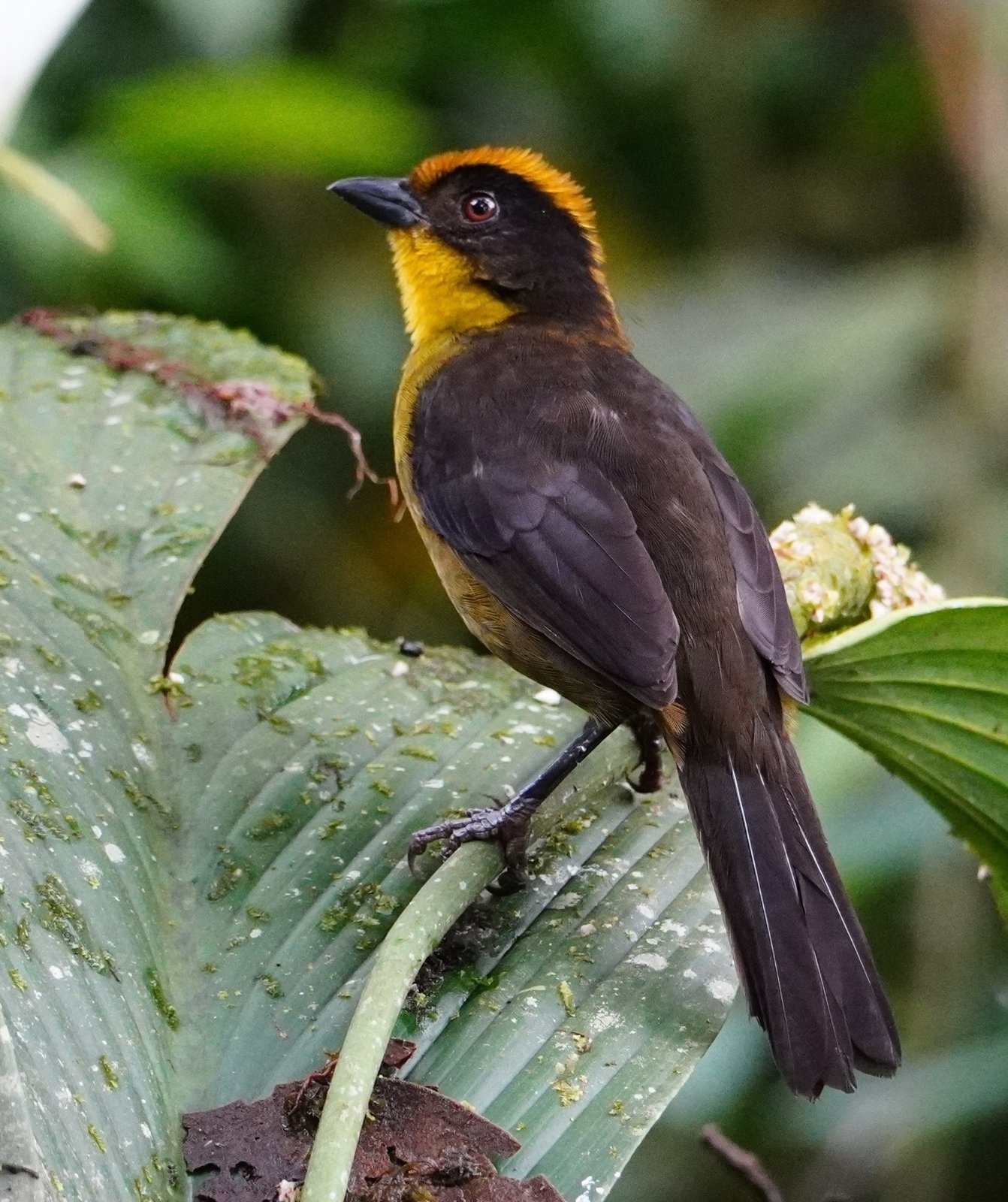
The Choco Brushfinch is an olive and yellow brushfinch with a golden-tawny crown of the Pacific slope of the Andes in Colombia and Ecuador. It was long treated as a subspecies of the Tricolored Brushfinch of Peru, but is now usually treated as a separate species. It lives in pairs at forest edges and in open cloud forest, often in mixed flocks.
Voice
The song is a lively phrase of two to three seconds, repeated at short intervals, mainly at dawn and in the early morning from a high perch. The call is a short, high, staccato note.
Recording: Carlos Delgado JUMABITA — CC BY-NC-SA 4.0 · xeno-canto
Identification
17–18 cm, with a sturdy black bill. The crown and nape are golden-tawny to ochre, the face is black. The upperparts are dark olive to greyish olive, the wings and tail darker. The throat and underparts are bright yellow, with an olive wash on the flanks. The sexes are alike. Juveniles are dark brown above and paler brown below, with a rufous crown.
Confusion species
Yellow-breasted Brushfinch Atlapetes latinuchus has a rufous crown, slate-grey upperparts without olive and usually lives higher. Dusky-headed Brushfinch Atlapetes fuscoolivaceus lives only in the upper Magdalena valley in Colombia and has a dark, sooty head without a golden-tawny crown. Tricolored Brushfinch Atlapetes tricolor closely resembles Choco Brushfinch, but lives only on the eastern slope in Peru.
Habitat
Undergrowth and edges of humid montane forest, open cloud forest, clearings and secondary woodland, mostly between 600 and 2000 m, locally higher and lower. It searches from the ground up to about ten metres for insects, other invertebrates, seeds and small fruits. The nest is a cup in dense undergrowth.
Where the bird is most at home, classified by the vegetation units of the Andes and the west coast.


Range and movements
In Colombia on the western slope of the Western Andes, from northern Antioquia south to Nariño. In Ecuador on the western slope in the north, south to western Cotopaxi, and further locally between eastern Guayas and El Oro. Absent from Peru, Bolivia and the Galápagos. Does not occur outside the guide area.
- Resident
- dark = core range, pale = thinly spread
How and when to look
Search forest edges and mountain roads in open cloud forest on the Pacific slope, for example around Mindo in Ecuador. In the early morning the bird sings from a high perch; during the day pairs often join mixed flocks.
Conservation status
Least Concern. The population is probably declining through deforestation, but the species tolerates secondary woodland and occurs in several protected areas.
Scientific name
Atlapetes crassus | Bangs, 1908
Bangs described the species in 1908 and placed it straight away in the genus where it still stands. The genus Atlapetes was introduced in 1831 by Wagler. The genus name comes from Greek: the mythical titan Atlas and petēs, 'flyer'. The species name comes from Latin crassus, 'thick, heavy', probably for the stout build. The specimen the first description was based on came from San Antonio, Valle del Cauca, Colombia.