All species › Trogons › Trogons › Choco Trogon
Choco Trogon | Trogon comptus
Blauwstaarttrogon | Trogón coliazul | Surucuá-do-chocó
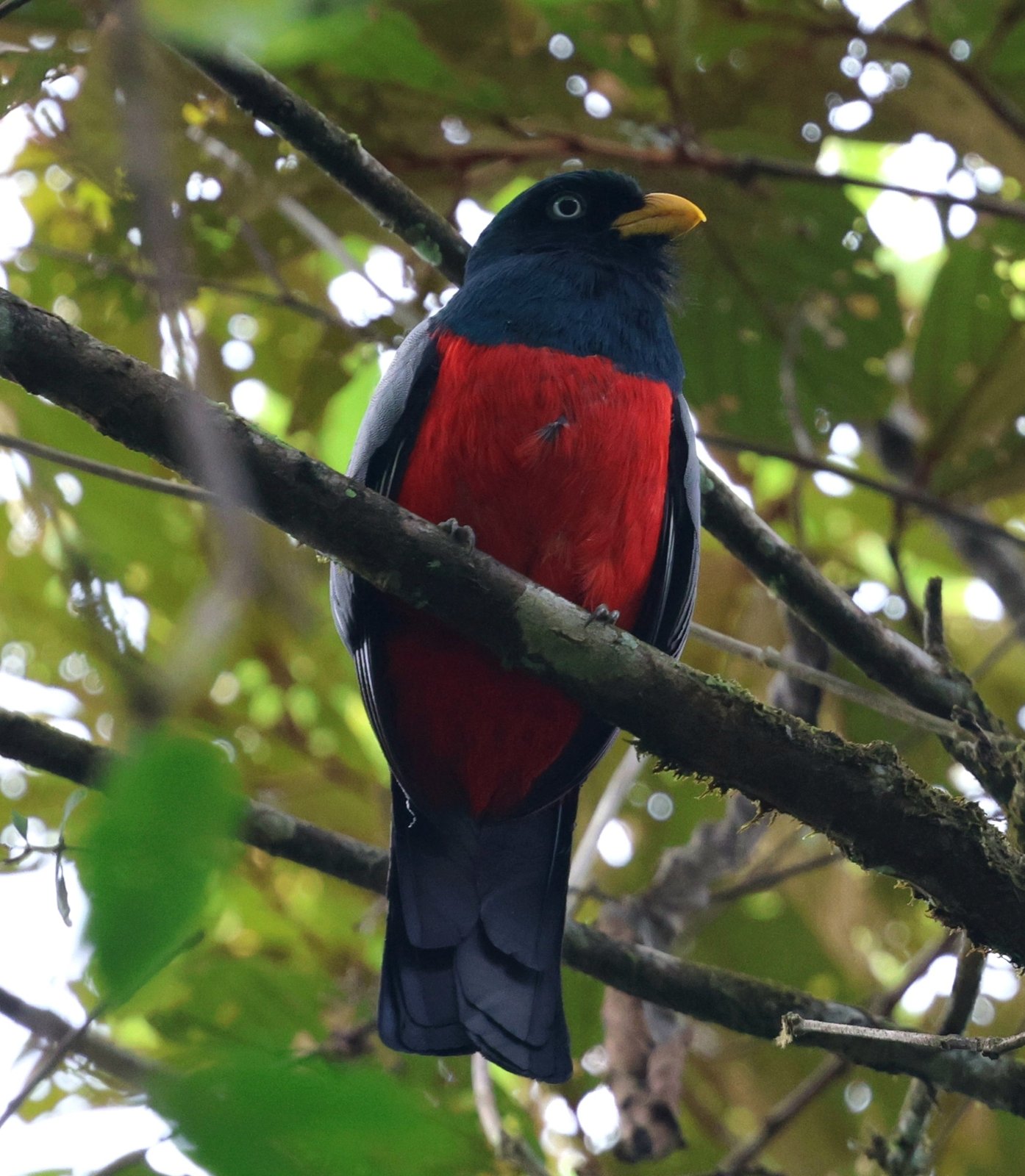
The Choco Trogon is a trogon of the Chocó, from north-western Colombia to north-western Ecuador. The male has a blue-green gloss, a blue to purplish-blue tail, a yellow bill and a white iris. It lives mainly in hilly forest in the Andean foothills.
Voice
The song is a slow series of seven to fifteen dull cow notes. The call is a fast krr-krr-krr.
Recording: Daan van der Hoeven — CC BY-NC-SA 4.0 · xeno-canto
Identification
28 cm. The male has a blackish face and throat and is green with a blue gloss on the crown, back and breast; the rump is purplish blue. The belly and undertail coverts are red, without a white breast band. The tail is purplish blue above with a black terminal band and plain slate-grey below. The bill is yellow and the iris white. The female is grey on the head, back and breast, with a red belly, a grey upper mandible and likewise a pale iris.
Confusion species
Slaty-tailed Trogon Trogon massena is larger, with an orange-red bill and eye-ring and a dark iris, and lives mainly lower. Ecuadorian Trogon Trogon mesurus also has a pale iris, but the male has a white breast band and a greener back. Black-tailed Trogon Trogon melanurus has a white breast band and a dark iris.
Habitat
The interior and edges of humid and wet forest, especially in hilly terrain, from sea level to about 1800 m, mostly in the foothills. It eats fruit and insects, taken while hovering. Little is known about the nest; like other trogons it presumably nests in a cavity in a termite nest or rotten trunk.
Where the bird is most at home, classified by the vegetation units of the Andes and the west coast.


Range and movements
In Colombia on the Pacific side, from northern Antioquia and north-eastern Chocó southwards. In Ecuador in the north-west, south to Pichincha. Absent from Peru, Bolivia and the Galápagos. Does not occur outside the guide area.
- Resident
- dark = core range, pale = thinly spread
How and when to look
In hilly forest in the Chocó of Colombia and in north-western Ecuador, including along roads in the foothills of Esmeraldas and northern Pichincha. The song gives it away in the morning.
Conservation status
Least Concern, but probably declining through forest clearance in the Chocó.
Scientific name
Trogon comptus | Zimmer, 1948
Zimmer described the species in 1948 and placed it straight away in the genus where it still stands. The genus Trogon was introduced in 1760 by Brisson. The genus name comes from Greek trōgōn, 'nibbling', from trōgō, 'to gnaw'; trogons gnaw out their nest holes in rotten wood. Comptus is Latin for 'adorned' or 'ornate'. The specimen the first description was based on came from Bahía Málaga, Colombia.