All species › Trogons › Trogons › Slaty-tailed Trogon
Slaty-tailed Trogon | Trogon massena
Massena's trogon | Trogón cola oscura | Surucuá-de-cauda-ardósia
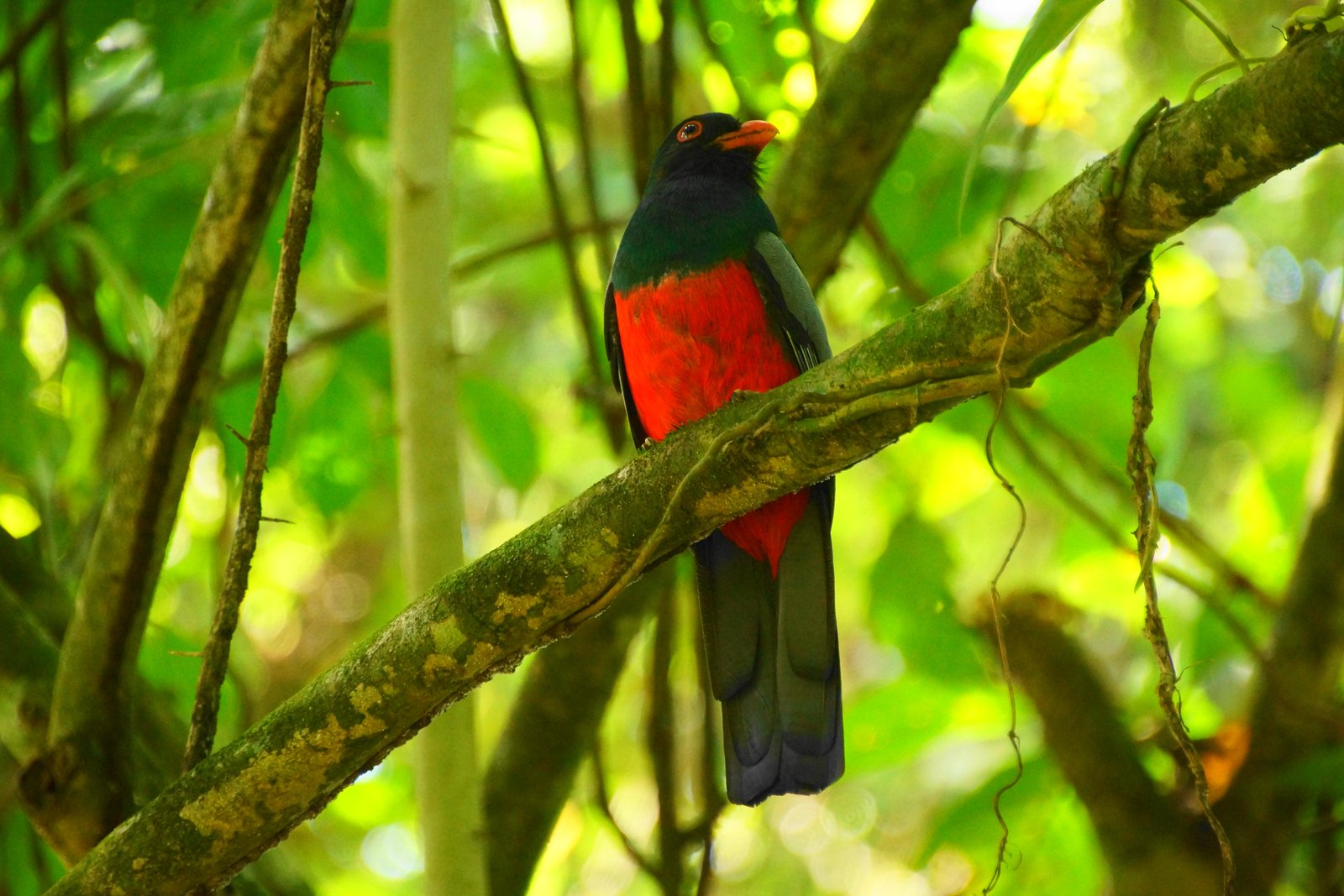
The Slaty-tailed Trogon is one of the largest trogons in the guide area, a species of the humid lowland forests of the Chocó and northern Colombia. The male has a red belly without a white breast band and a plain slaty undertail. It often sits motionless for long periods in the middle and upper canopy.
Voice
A long, even series of dull, crowing kuk-kuk-kuk notes, without clear acceleration. Also a dry, cackling chatter.
Recording: Stephan Risch — CC BY-NC-SA 4.0 · xeno-canto
Identification
30–34 cm. The male is green on the head, breast and upperparts; the crimson belly meets the green breast without a white band. The bill and eye-ring are orange-red. The tail is bronzy green above and plain slate-grey below, without bars or white tips. The wings are grey, finely vermiculated. The female is slate-grey on the head, breast and upperparts, with a red belly, an orange-red bill with a dark upper ridge and likewise a plain slate-grey undertail.
Confusion species
Choco Trogon Trogon comptus is smaller, with a white iris, a yellow bill and bluer upperparts and tail, and lives mainly in the foothills. Black-tailed Trogon Trogon melanurus and Ecuadorian Trogon Trogon mesurus have, in the male, a narrow white breast band between green and red, a yellow bill and a blacker undertail.
Habitat
Humid lowland and foothill forest, also forest edges, tall secondary forest and the edges of mangroves, from sea level to about 1000 m, locally higher. It eats fruit and large insects, taken while hovering. It nests in a cavity it digs in an arboreal termite nest or a rotten trunk.
Where the bird is most at home, classified by the vegetation units of the Andes and the west coast.


Range and movements
In Colombia in the Pacific lowlands of the Chocó and in the Caribbean lowlands of the north, east to the middle Magdalena valley. In Ecuador only in the north-west. Absent from Peru, Bolivia and the Galápagos. Outside the guide area from south-eastern Mexico to Panama.
- Resident
- dark = core range, pale = thinly spread
How and when to look
In the reserves of the Chocó and in the forests of Esmeraldas in Ecuador; listen for the long, monotonous series of kuk notes, then look for the bird sitting still in the canopy.
Conservation status
Least Concern. It is declining locally through clearance of lowland forest in the Chocó.
Scientific name
Trogon massena | Gould, 1838
Gould described the species in 1838 and placed it straight away in the genus where it still stands. The genus Trogon was introduced in 1760 by Brisson. The genus name comes from Greek trōgōn, 'nibbling', from trōgō, 'to gnaw'; trogons gnaw out their nest holes in rotten wood. The specific name honours Victor Masséna (1799–1863), Duke of Rivoli and Prince of Essling, a French collector with a large bird collection. The specimen the first description was based on came from Mexico.