All species › Trogons › Trogons › Crested Quetzal
Crested Quetzal | Pharomachrus antisianus
Kuifquetzal | Quetzal crestado | Quetzal-de-crista
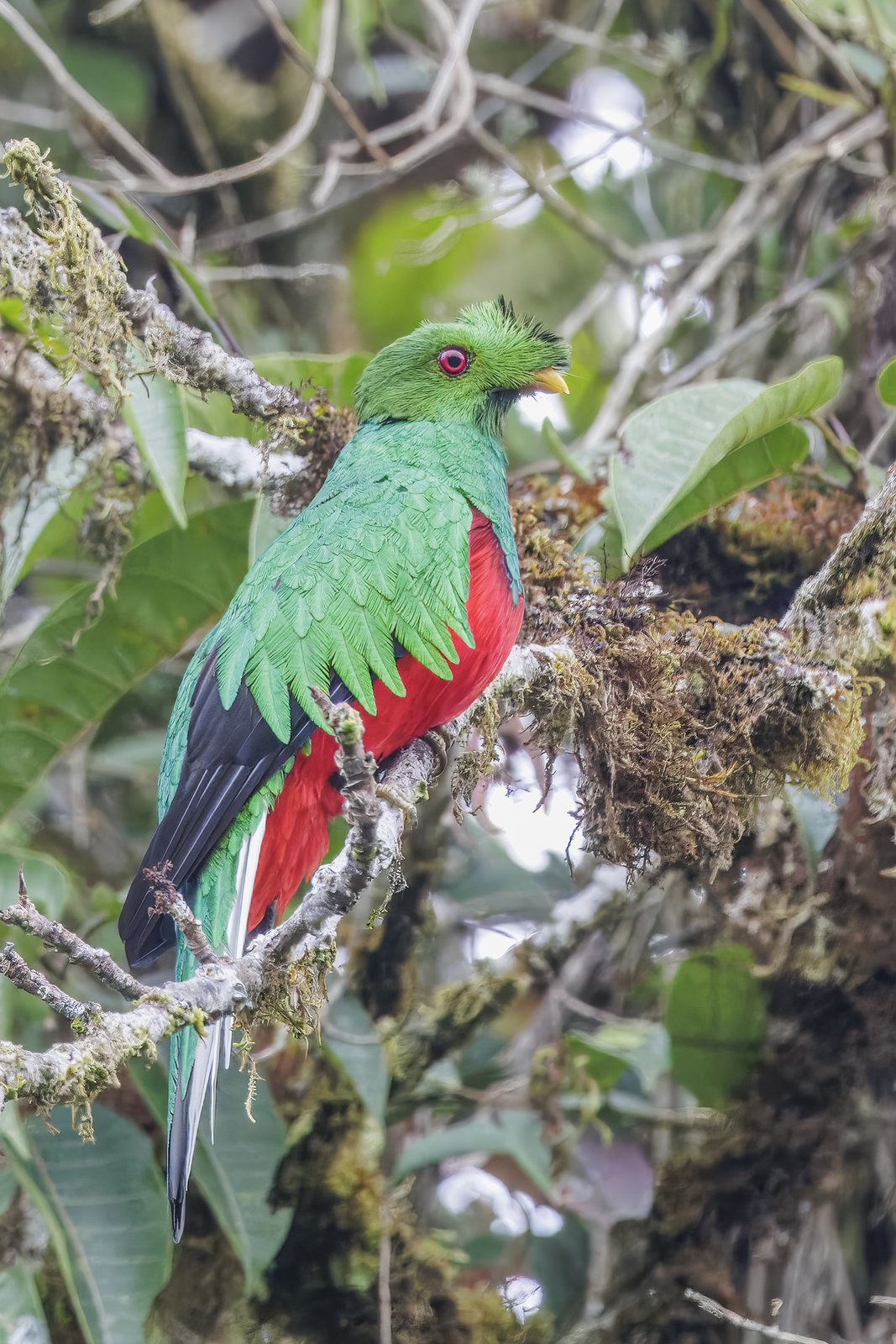
The Crested Quetzal is a quetzal of the montane forest of the Andes, from Colombia to Bolivia. The male has a short, bristly crest on the forehead that falls over the base of the bill, and a tail that is white from below. On average it lives higher than Golden-headed Quetzal, but the two species partly overlap.
Voice
The song is a repeated series of clear whistled notes, often in pairs and somewhat higher and hoarser than that of Golden-headed Quetzal. The call is a dry, cackling chatter.
Recording: Jorge L. Peña — CC BY-NC-SA 4.0 · xeno-canto
Identification
33–34 cm. The male is glossy metallic green on the head, breast and upperparts, with a short, bristly crest over the bill and a crimson belly and undertail coverts. The long green uppertail coverts reach beyond the tail tip. The tail is mostly white from below. The bill is yellow. The female is duller, with a browner head and breast, less red on the belly, a dark bill and black-and-white bars on the outer tail feathers.
Confusion species
Golden-headed Quetzal Pharomachrus auriceps has no crest and an all-black tail from below, also in the female. Pavonine Quetzal Pharomachrus pavoninus lives in the Amazonian lowlands, and the male has a red bill. White-tipped Quetzal Pharomachrus fulgidus occurs only in the Sierra Nevada de Santa Marta and has only white tips to the tail feathers. Collared Trogon Trogon collaris and Masked Trogon Trogon personatus are smaller, with a white breast band in the male and a barred undertail.
Habitat
Humid montane forest and cloud forest, also forest edges and clearings with fruiting trees, roughly between 1200 and 3000 m, mainly above 1500 m. It eats mainly fruit, plucked from branches while hovering, and also insects. It nests in a cavity in a rotten tree trunk.
Where the bird is most at home, classified by the vegetation units of the Andes and the west coast.


Range and movements
In Colombia in all three cordilleras and in the Serranía de Perijá. In Ecuador on the eastern and locally the western slope of the Andes. In Peru mainly on the eastern slope. In Bolivia on the eastern slope of the Andes. Absent from the Galápagos. Outside the guide area in the Andes and the Perijá of western Venezuela.
- Resident
- dark = core range, pale = thinly spread
How and when to look
Along mountain roads through cloud forest on the eastern slope of the Andes, such as the road to Manu in Peru, at fruiting trees on forest edges. With any quetzal, check the undertail to separate it from Golden-headed Quetzal.
Conservation status
Least Concern, but locally declining through deforestation on the Andean slopes.
Scientific name
Pharomachrus antisianus | (d'Orbigny, ACVMD, 1837)
D'Orbigny, ACVMD described the species in 1837 as Trogon Antisianus; because it was later moved to another genus, the author and year stand in brackets. The genus Pharomachrus was introduced in 1832 by De la Llave. The genus name comes from Greek pharos, 'mantle', and makros, 'long', after the long covert feathers. The species name is Modern Latin antisianus, 'of the Andes'. D'Orbigny found the species in Bolivia, east of the Andes, in the humid forests of the province of Yungas; compare also the Antis (Asháninka), a people of the rainforests of western Amazonia. The specimen the first description was based on came from Yungas, Bolivia.