All species › Trogons › Trogons › Ecuadorian Trogon
Ecuadorian Trogon | Trogon mesurus
Ecuadoraanse trogon | Trogón ecuatoriano | Surucuá-equatoriano
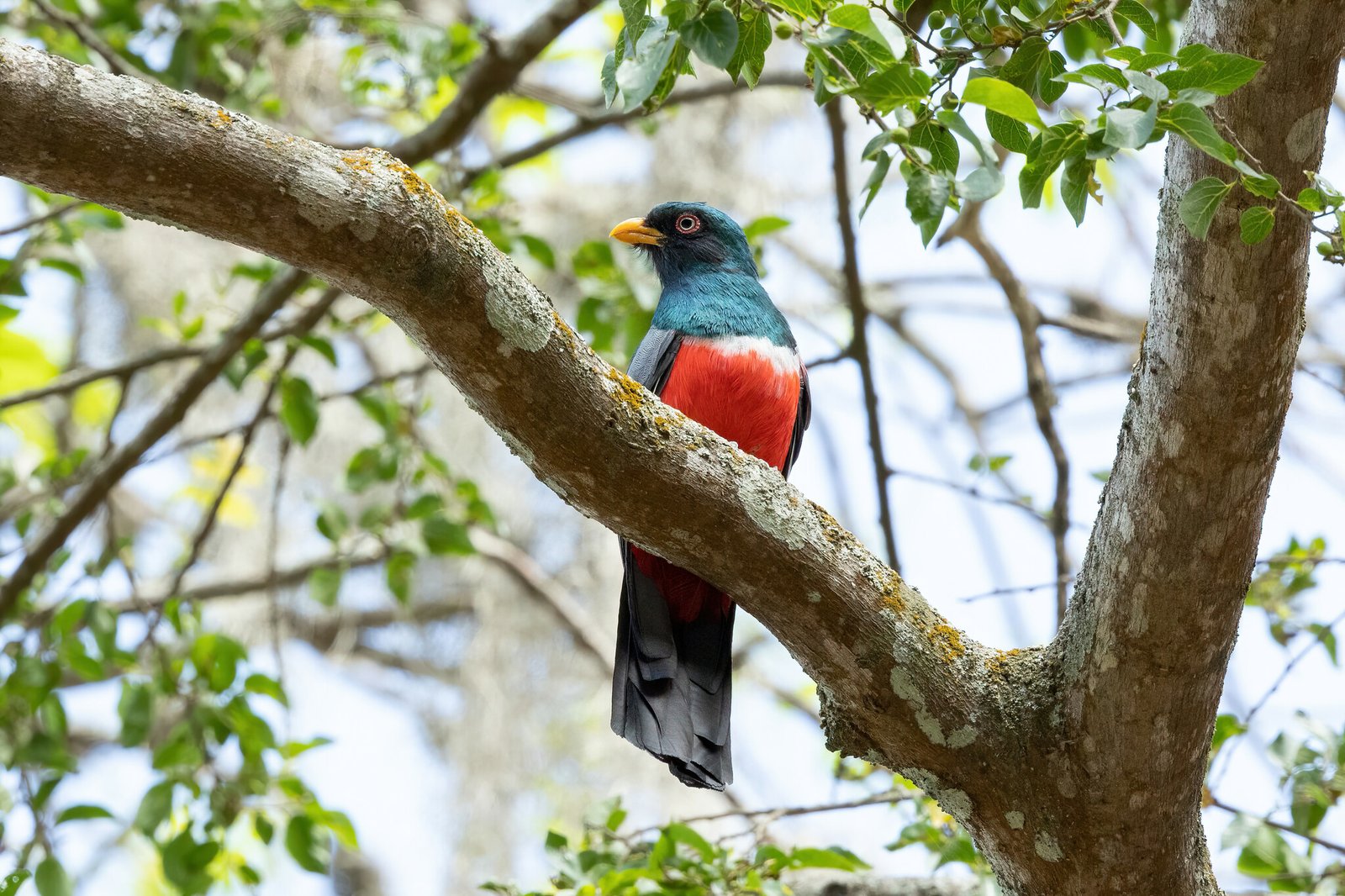
The Ecuadorian Trogon is a large, red-bellied trogon of dry and semi-humid forest west of the Andes in Ecuador and far north-western Peru. It was long treated as a subspecies of Black-tailed Trogon, but differs among other things in its pale iris and its voice. It occurs only in the guide area.
Voice
A series of hollow, even cow notes, often ten or more in a row. Also a soft, cackling chatter.
Recording: Juan Freile — CC BY-NC-SA 4.0 · xeno-canto
Identification
30–32 cm. The male is metallic green on the head, back and breast, with a black face and throat, a narrow white band across the breast and a red belly. The bill is yellow and the iris is pale, whitish. The undertail is plain slaty to blackish. The female is grey where the male is green, with a red belly and a partly yellow bill.
Confusion species
Collared Trogon Trogon collaris is smaller, has a dark iris and a black-and-white barred undertail with broad white tips, and lives mainly in wetter forest on the slopes. Choco Trogon Trogon comptus also has a pale iris, but lacks the white breast band and lives in humid foothill forest in north-western Ecuador. Gartered Trogon Trogon caligatus and White-tailed Trogon Trogon chionurus have a yellow belly. Black-tailed Trogon Trogon melanurus has a dark iris and occurs only east of the Andes and in northern Colombia.
Habitat
Dry deciduous forest, semi-humid forest, gallery forest and tall secondary forest in the lowlands and hills west of the Andes, from sea level to about 1000 m, locally higher. It sits still for long periods in the middle and upper storeys and eats fruit and large insects. It nests in a cavity in a termite nest or rotten wood.
Where the bird is most at home, classified by the vegetation units of the Andes and the west coast.


Range and movements
In Ecuador in the lowlands and hills west of the Andes, mainly in the drier parts of the centre and south. In Peru only in the north-west, in Tumbes and adjacent Piura. Absent from Colombia, Bolivia and the Galápagos. It does not occur outside the guide area.
- Resident
- dark = core range, pale = thinly spread
How and when to look
In dry forest with tall trees, such as Machalilla National Park and Bosque Protector Cerro Blanco near Guayaquil in Ecuador and the Tumbes forest in Peru. The series of cow notes leads the way; in a red-bellied trogon with a white breast band, check for the pale iris.
Conservation status
Least Concern. The dry forest of the west coast is heavily fragmented, so the species has declined locally.
Scientific name
Trogon mesurus | (Cabanis & Heine, 1863)
Cabanis & Heine described the species in 1863 as Troctes mesurus; because it was later moved to another genus, the author and year stand in brackets. The genus Trogon was introduced in 1760 by Brisson. The genus name comes from Greek trōgōn, 'nibbling', from trōgō, 'to gnaw'; trogons gnaw out their nest holes in rotten wood. The specific name comes from Greek mesos, 'middle, intermediate', and -ouros, 'tailed', from oura, 'tail'. The specimen the first description was based on came from Babahoyo, Ecuador.