All species › Trogons › Trogons › Black-tailed Trogon
Black-tailed Trogon | Trogon melanurus
Zwartstaarttrogon | Trogón colinegro | Surucuá-de-cauda-preta
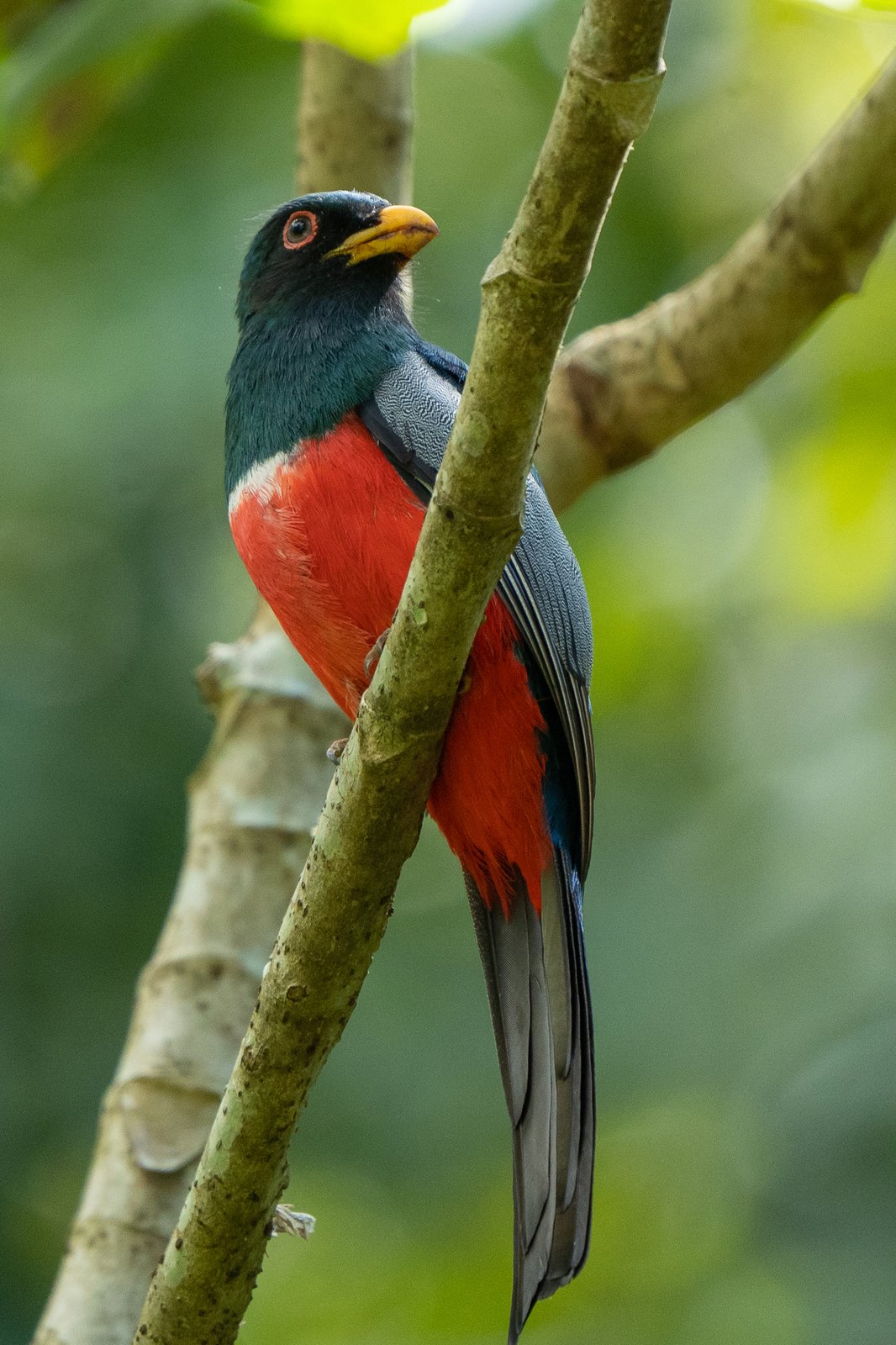
The Black-tailed Trogon is a large, red-bellied trogon of the Amazonian lowlands and northern Colombia. It sits motionless and upright for long periods in the middle storey, often in forest along rivers and lakes. Its plain dark undertail, yellow bill and white breast band make it the standard for comparing the other red-bellied trogons.
Voice
A series of hollow, even cow notes, often long sustained, lower and slower than in the smaller trogons. Also a soft, cackling chatter.
Recording: Mauricio Cuéllar Ramírez — CC BY-NC-SA 4.0 · xeno-canto
Identification
28–32 cm. The male is metallic green on the head, back and breast, with a black face and throat, a narrow white band across the breast and a red belly. The bill is yellow, the bare eye-ring orange-red and the iris dark. The undertail is plain slaty to blackish. The female is grey where the male is green, with a red belly, a yellow lower mandible and a dark upper mandible.
Confusion species
Blue-crowned Trogon Trogon curucui is smaller and, in the male, has a blue head and a finely black-and-white barred undertail. Collared Trogon Trogon collaris is smaller, lives mainly in the hills and mountains and has a barred undertail with broad white tips. Pavonine Quetzal Pharomachrus pavoninus is larger, has a red bill in the male and lacks the white breast band. Slaty-tailed Trogon Trogon massena in north-western Colombia lacks the white breast band and has an orange-red bill. Ecuadorian Trogon Trogon mesurus west of the Andes has a pale iris.
Habitat
Humid terra firme lowland forest, várzea, gallery forest and tall secondary forest, often near rivers, oxbow lakes and swamp forest, mainly below 500 m, locally to about 1000 m. It sits still for long periods in the middle and upper storeys and eats fruit and large insects, taken in a short sally from a branch. It nests in a cavity in a termite nest or rotten wood.
Where the bird is most at home, classified by the vegetation units of the Andes and the west coast.


Range and movements
In Colombia in the Caribbean lowlands of the north and in the lowlands east of the Andes. In Ecuador and Peru in the Amazonian lowlands and on the lower eastern slope. In Bolivia in the lowlands of the north and east. Absent west of the Andes in Ecuador and Peru and from the Galápagos. Outside the guide area in Panama, Venezuela, the Guianas and Amazonian Brazil.
- Resident
- dark = core range, pale = thinly spread
How and when to look
Along rivers and oxbow lakes in the Amazonian lowlands, for example at lodges along the Napo in Ecuador and in Tambopata and Manu in Peru, where it often perches on an open branch above the water. The low, long series of cow notes is the first clue.
Conservation status
Least Concern. The species has a large range and tolerates tall secondary forest, but disappears where lowland forest is cleared entirely.
Scientific name
Trogon melanurus | Swainson, 1838
Swainson described the species in 1838 and placed it straight away in the genus where it still stands. The genus Trogon was introduced in 1760 by Brisson. The genus name comes from Greek trōgōn, 'nibbling', from trōgō, 'to gnaw'; trogons gnaw out their nest holes in rotten wood. The specific name comes from Greek melas, 'black', and oura, 'tail': 'black tail'. The specimen the first description was based on came from Demerara, Guyana.