All species › Trogons › Trogons › White-tailed Trogon
White-tailed Trogon | Trogon chionurus
Witstaarttrogon | Trogón coliblanco | Surucuá-de-cauda-branca
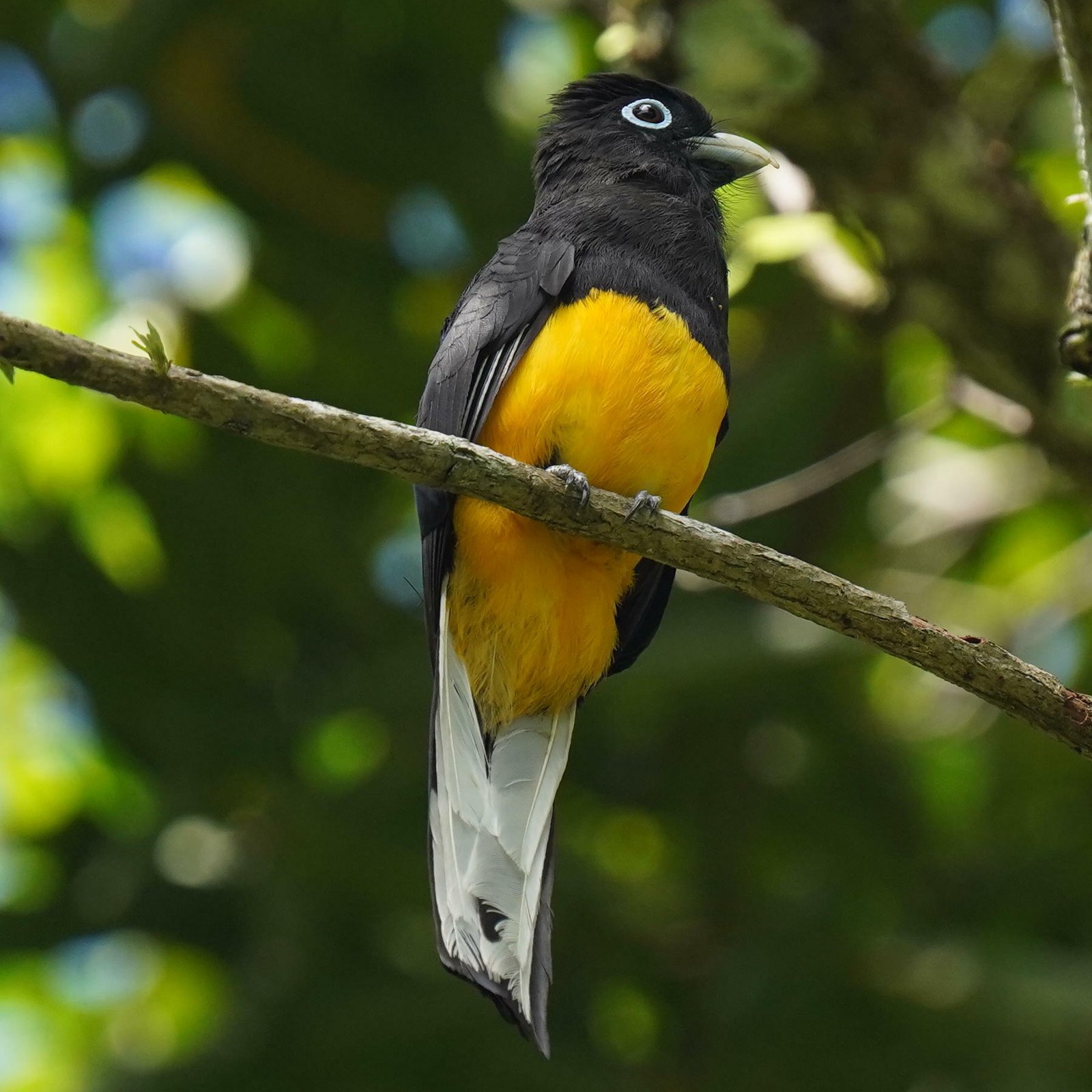
The White-tailed Trogon is a yellow-bellied trogon of humid lowland forest in the Chocó region, from Panama through western Colombia to north-western Ecuador. It was formerly treated as a subspecies of the Amazonian Green-backed Trogon. The name refers to the male's almost entirely white undertail.
Voice
A long series of clear cow or choo notes that starts slowly and then accelerates, longer and often slightly lower than in Gartered Trogon. Also a soft, clucking chuck.
Recording: Fabrice Schmitt — CC BY-NC-SA 4.0 · xeno-canto
Identification
26–28 cm. The male has a blue-black head and breast with a violet gloss, a pale blue bare eye-ring, a bluish-grey bill, a green to blue-green back and an orange-yellow belly. The undertail is almost entirely white. The female is grey on the head, breast and back, with a yellow belly, a broken white eye-ring and an undertail with black bars at the base and broad white tips.
Confusion species
Gartered Trogon Trogon caligatus is smaller, has a yellow eye-ring and, in the male, a finely black-and-white barred undertail with white tips. Collared Trogon Trogon collaris and Choco Trogon Trogon comptus have a red belly and, in the male, a green head. Green-backed Trogon Trogon viridis is very similar, but occurs only east of the Andes; the male shows less white under the tail.
Habitat
Humid lowland and hill forest, Chocó rainforest, tall secondary forest and forest edges, up to about 900 m, locally higher. It sits still for long periods in the middle and upper storeys and eats fruit and insects. It nests in a cavity in an arboreal termite nest or rotten wood.
Where the bird is most at home, classified by the vegetation units of the Andes and the west coast.


Range and movements
In Colombia in the Pacific lowlands and the north-west, locally east into the northern Magdalena valley. In Ecuador in the lowlands and hills of the north-west. Absent from Peru, Bolivia and the Galápagos. Outside the guide area in central and eastern Panama.
- Resident
- dark = core range, pale = thinly spread
How and when to look
In the Chocó forest of north-western Ecuador, such as along the Río Silanche and in Esmeraldas province, and in the Pacific lowlands of Colombia. The long, accelerating series is often the first clue; then search the middle storey for an upright perched bird.
Conservation status
Least Concern. It tolerates some disturbance, but lowland forest in the Chocó region is being converted rapidly to farmland and oil-palm plantations.
Scientific name
Trogon chionurus | Sclater & Salvin, 1871
Sclater & Salvin described the species in 1871 and placed it straight away in the genus where it still stands. The genus Trogon was introduced in 1760 by Brisson. The genus name comes from Greek trōgōn, 'nibbling', from trōgō, 'to gnaw'; trogons gnaw out their nest holes in rotten wood. The specific name comes from Greek chiōn, 'snow', and oura, 'tail': 'snow-white tail'. The specimen the first description was based on came from Lion Hill, Panama Canal Zone, Panama.